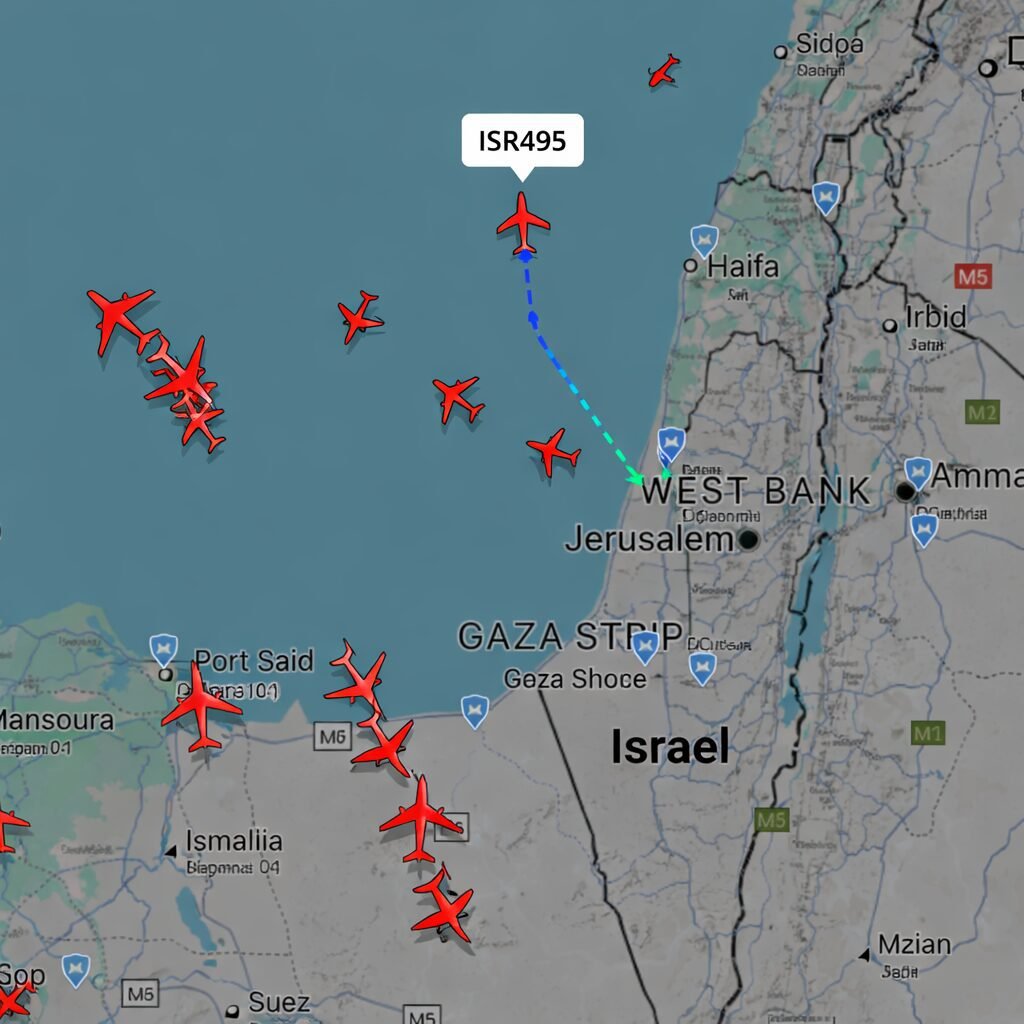
For the millions of travelers who flock to the Middle East for business, tourism, and connection, Saturday morning brought an unprecedented nightmare: one by one, the region’s skies slammed shut.
Iran closed its airspace first, shortly after U.S. and Israeli strikes began. Iraq, Jordan, and Lebanon followed. Then Qatar, Kuwait, and the United Arab Emirates partially suspended operations. By midday, the world’s busiest international air travel hub — Dubai — had halted all flights.
The result: thousands of passengers stranded, hundreds of flights cancelled, and planes already in the air ordered to turn back or divert to distant airports.
Sarah Short was sitting on a plane at Dubai International Airport, ready to return to London Heathrow, when the pilot’s voice came over the speaker.
“We got on the plane and were literally about to taxi when the pilot said: ‘We have some bad news — we’re not going anywhere,'” she told the BBC. “We then sat on the plane on the tarmac for over three hours.”
When passengers finally disembarked, they found chaos. “There’s no flights, everything’s suspended. BA said there’s nothing they can do,” Short said. “It’s all so volatile, you just don’t know what’s going to happen next.”
The Airlines Respond
British Airways cancelled services to Tel Aviv and Bahrain through Wednesday, and to Amman, Jordan, on Saturday. More than 200 passengers on the 8 p.m. flight to Doha Friday night were ordered to turn back a third of the way through the journey, returning to Heathrow.
Virgin Atlantic cancelled a Heathrow-to-Dubai flight and warned that its services to India, Saudi Arabia, and the Maldives may take longer due to rerouting around closed airspace.
Wizz Air suspended all flights to and from Israel, Dubai, Abu Dhabi, and Amman until next Saturday. Qatar Airways temporarily halted operations from Doha due to the closure of Qatari airspace. Emirates stopped services to and from Dubai.
Heathrow, the UK’s busiest airport, urged travelers to check with their airlines for updates.
Tourists in the Crossfire
For Western tourists, the sudden eruption of war turned holidays into survival situations.
John Henry, 71, from Northampton, was at a shopping center in Doha with his family when air raid sirens blared.
“We heard a bit of a thud and felt a tremor, and we saw a number of people moving quickly out of the shopping centre,” he told the BBC.
Outside, they witnessed Qatari air defenses intercepting Iranian missiles. “You could see the vapour trails where they had hit,” Henry said. “We’ve heard four or five additional thuds where something must have happened.”
Qatar’s defense ministry confirmed it had successfully countered multiple attacks on its territory. The UAE also reported intercepting Iranian missiles. Footage circulating on social media appears to show the moment a U.S. facility in Bahrain was hit.
The UK Foreign Office issued urgent guidance to British nationals in Bahrain, Qatar, Kuwait, and the UAE: “Immediately shelter in place”.
The Wider Warning
The travel advisory expanded rapidly. UK nationals in Jordan, Syria, Lebanon, Iraq, Yemen, Turkey, Saudi Arabia, and Oman were told to “remain vigilant, follow local authority advice and take shelter if advised”.
The warnings reflect a stark reality: Iranian retaliatory strikes targeted not just Israel, but multiple nations hosting U.S. military assets across the Gulf. Bahrain’s U.S. Navy 5th Fleet headquarters was hit. Qatar’s Al Udeid Air Base — the largest U.S. facility in the region — was targeted. Debris from intercepted missiles fell on the UAE, killing one person.
No country in the region can guarantee safety. No airline can guarantee departure. No traveler can guarantee a return.
What Happens Next
Prime Minister Keir Starmer chaired a COBRA emergency meeting Saturday morning. A government spokesperson said: “Our immediate priority is the safety of UK nationals in the region and we will provide them with consular assistance”.
But consular assistance has limits when airports are closed, airspace is shut, and missiles are flying.
For the thousands of British tourists waking up in Dubai hotel lobbies, Doha shopping centers, and Tel Aviv airport terminals, the question is no longer when they’ll get home — but whether they can get out at all.
The Foreign Office advice is to shelter in place. The airlines say no flights are operating. And the war shows no sign of ending.
For Sarah Short, still waiting in Dubai, the uncertainty is the hardest part.
“You just don’t know what’s going to happen next.”