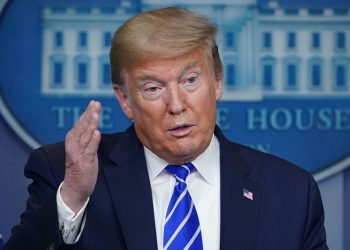
The interview was supposed to be about the shooting. The gunman. The security failure and the narrow escape. But when the reporter started reading the suspect’s manifesto aloud, the president lost his cool.
On April 25, 31-year-old Cole Tomas Allen, a former Caltech engineer, allegedly opened fire at a security checkpoint outside the Washington Hilton, where the White House Correspondents’ Association Dinner was underway. A bullet struck a Secret Service agent’s bulletproof vest. No one was seriously injured. Trump, Melania, Vice President JD Vance, and others were evacuated. Allen now faces federal charges, including assault on a federal officer.
The next day, Trump sat down with CBS’s “60 Minutes.” Host O’Donnell began reading from an email Allen allegedly sent — a manifesto. In it, the suspect called Trump a pedophile and a traitor.
Trump interrupted this, however, calling the question a “disgrace.” Then he pivoted.
The Explosion
According to the X thread documenting the interview, Trump cut O’Donnell off mid-sentence, dismissing the manifesto’s contents and redirecting the conversation toward Jeffrey Epstein instead. He praised the Secret Service’s rapid response and insisted the dinner continued without further incident.
On X, reactions poured in. One user wrote: “The 60 Minutes interview was a train wreck. Trump couldn’t handle the question, so he changed the subject.” Another posted: “He called the manifesto ‘disgraceful’ but refused to address any of its actual claims. That’s not a defense. That’s avoidance.”
A third commenter noted: “The reporter was just doing his job. The suspect wrote those things. Asking about them is legitimate journalism.”
What People Are Saying
The thread captured a divided nation. Some defended Trump’s reaction. “He just survived an assassination attempt and they’re reading the shooter’s words to his face? Of course he was angry,” one user wrote. Another said: “The media always does this — amplifies the shooter’s message instead of focusing on the victims. Trump was right to shut it down.”
Others saw it differently. “This is the same man who called for reporters to be fired and news organizations to be shut down. Now he’s literally interrupting them on air for reading a public document,” a user posted.
Some focused on the content of the manifesto itself. “Calling the president a pedophile and a traitor is serious. The public deserves to know why the suspect believed that, even if Trump doesn’t want to hear it,” one commenter wrote.
Another added: “Trump’s response was to bring up Epstein. Think about that. The shooter called him a pedophile, and Trump’s immediate counter was to mention the most famous pedophile scandal in modern history. That’s not a denial. That’s a deflection.”
The Broader Context
Trump has a long history of clashing with journalists. He has called the press “the enemy of the people.” He has decried “fake news” at hundreds of rallies. He has refused to answer questions from reporters he deems hostile.
The “60 Minutes” interview fits that pattern. When faced with a question he did not like — not about his policies, but about what a would-be assassin wrote — he did not answer. He attacked the question itself. He called it a “disgrace.” He moved the conversation to safer ground.
For his supporters, this is a strength. He does not let the media dictate the terms. For his critics, it is avoidance. He cannot defend himself against the allegations, so he refuses to engage.
The Stakes
The shooting at the White House Correspondents’ Dinner was a near-miss. A Secret Service agent was hit. The president was evacuated. The suspect is in custody. But the manifesto — whatever one thinks of its contents — is now part of the public record. It contains serious accusations against the sitting president of the United States.
Trump wants those accusations ignored. He wants the focus to be on the heroism of the Secret Service and the resilience of the dinner attendees. Those are legitimate stories. But so is the content of a shooter’s manifesto, especially when it provides insight into his motives.
The journalists who covered the shooting cannot simply pretend the manifesto does not exist. And the president, for better or worse, cannot simply shout down every question he finds uncomfortable.
The Bottom Line
In a “60 Minutes” interview following the White House Correspondents’ Dinner shooting, President Trump lost it when host O’Donnell began reading from suspect Cole Tomas Allen’s manifesto, which allegedly called Trump a pedophile and a traitor. Trump interrupted, called the question a “disgrace,” and pivoted to discussing Jeffrey Epstein and praising the Secret Service.
On X, reactions were sharply divided. Some defended Trump’s anger as understandable, given he had just survived an assassination attempt. Others criticized his refusal to address the manifesto’s claims, calling it avoidance and deflection. A third group noted that by bringing up Epstein, Trump inadvertently highlighted the very scandal the shooter had invoked.
The interview did not clarify anything about the shooting, nor explain why the suspect wrote what he wrote, nor reassure a nervous public. It did, however, demonstrate once again that when pressed on uncomfortable topics, President Trump would rather fight the reporter than answer the question.