President Donald Trump is seeking to reverse the long-term decline in the number of oil refineries operating in the United States, arguing that increased refining capacity could help bring down petrol prices.
Trump recently invited oil executives to the White House as part of efforts to encourage the reopening of closed refineries, expansion of existing facilities and construction of new ones.
“President Trump and his entire energy team will continue supporting reopening shuttered refineries, expanding the capacity of existing refineries, and constructing new refineries to lower prices and strengthen our national security,” White House spokesperson Taylor Rogers told CNN.
However, industry analysts say increasing the number of US refineries would not provide an immediate solution to high fuel prices and may not be commercially attractive over the longer term.
No new US refinery with significant unit capacity has been built since 1977, while the number of operating refineries has fallen sharply over the past four decades. There were about twice as many refineries operating in 1982 compared with today.
Even if companies began building new facilities immediately, analysts say it would take several years before they could produce enough petrol and diesel to have a meaningful impact on prices.
Global Refining Capacity Under Pressure
US oil companies have also shown little interest in launching major refinery construction projects despite currently enjoying strong profits.
Analysts say the recent disruption to global energy markets is likely to be temporary, making a multi-billion-dollar investment in facilities that could take years to complete difficult to justify.
“What’s the Strait of Hormuz going to look like in four to five years?” said John Auers, marketing director of refined fuels at data analytics firm Novi Labs.
“The assumption is it’ll be opened by then, and Russian refineries will be back to normal. So, it doesn’t really matter what’s happening now or next year when making plans for a major expansion project.”
Auers said the current pressure on fuel prices was being driven largely by a shortage of global refining capacity rather than the relatively modest reduction in US capacity.
ExxonMobil CEO Darren Wood also pointed to the global refining shortage, saying the market was now being shaped more by the supply and demand for refined products than crude oil.
“In my 35 years in the refining business, there’s been an excess (refining) supply,” Wood told CNBC earlier this summer.
“(But now) we have a refinery constraint. So, pump prices are being established by supply and demand of refining products — not crude.”
Military attacks have damaged refineries in parts of the Middle East and Russia, while Russia, previously a major refined-fuel exporter, has become a net importer amid domestic shortages.
Shipping disruptions have also limited the amount of refined fuel that refineries in the Persian Gulf can send to international markets.
Auers estimated that global markets had lost about two million barrels per day of supply from Russia and the Middle East.
“The problem is we’ve lost 2 million barrels per day of supply combined between Russia and the Middle East to global markets. That is huge in a market that was already fairly tight,” he said.
US Refiners Enjoy Record Profits
The supply constraints have coincided with a sharp increase in crude oil prices, which have recently climbed above $100 per barrel.
Despite the higher cost of crude, refiners have benefited from exceptionally high margins because prices for petrol and diesel have risen even faster.
US refiners are making roughly $100 per barrel on diesel and between $40 and $50 per barrel on petrol, according to oil analyst and Gulf Oil adviser Tom Kloza.
“These numbers aren’t just off the chart — they’re out of the galaxy,” he said.
The lucrative margins have encouraged existing US refineries to operate at almost full capacity this year, according to the US Energy Information Administration.
ExxonMobil has even postponed some maintenance work in an effort to maintain production and take advantage of the strong market. The company reported $14.5bn in profit during the second quarter, more than twice the figure recorded in the same period a year earlier.
But Wood warned that maintaining such high utilisation indefinitely would not be possible.
“The utilization that we’ve seen can’t be sustained for the long term,” he told CNBC.
Auers said refineries would eventually have to undergo maintenance, temporarily reducing supply and potentially putting additional pressure on fuel prices.
New Refineries Face Long Payback Period
Despite the decline in the number of US refineries, the country has generally been able to meet domestic fuel demand through the facilities that remain.
Many of the plants that closed were smaller and less competitive, while technological improvements, greater efficiency and expansions at surviving refineries helped increase overall capacity.
US refinery output increased by 16 per cent between 1999 and 2019, reaching a record 18.6 million barrels per day, according to the EIA. Capacity has fallen by only about three per cent since then.
At the same time, domestic petrol demand has weakened as vehicles become more fuel-efficient, electric vehicle use increases and remote work reduces commuting.
Kloza said petrol demand this summer, excluding the pandemic period, was likely to be the lowest for a summer season since 2001.
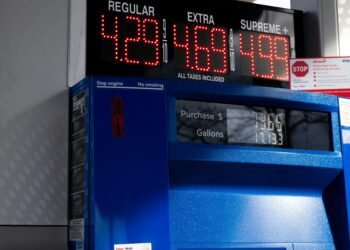
US petrol prices nevertheless surged following the outbreak of the Iran war in late February, rising faster than crude oil prices. The national average reached $4.31 per gallon on Saturday, according to AAA, the highest September price on record. Diesel also crossed $6 per gallon for the first time.
Analysts say new refinery projects are unlikely to offer relief soon because expanding an existing facility can take at least three years, while a new refinery can take even longer.
Auers said that even where a refinery has already been designed and is ready for environmental review, “you’re still looking at four to five years until it’s going to start producing.”
Long-term uncertainty over regulations and future fuel demand also makes such projects risky because investors need decades of operation to recover the huge construction costs.
Kloza said North America remained an attractive region for refiners in the medium term.
“North America is the best continent to be a refiner at the moment, and probably for the next five to 10 years,” he said. “Beyond that, who knows?”
The uncertainty has encouraged oil companies to channel much of their current profits into investments with faster returns, including oil exploration and pipelines, or to return money to shareholders through dividends and stock buybacks.
“They’re putting it back in (stock) buybacks and dividends,” Auers said.
He added that even when companies such as Marathon and Phillips 66 reinvested their profits, much of their recent capital spending had gone into midstream infrastructure such as pipelines rather than refining.
“That’s because that’s where Wall Street wanted them to put their money.”