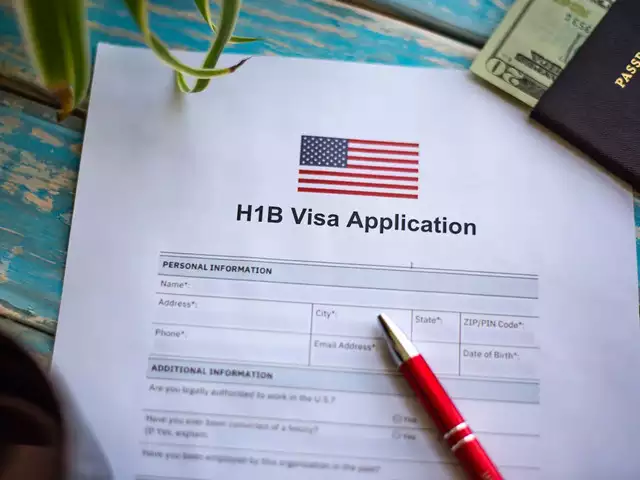

A Republican lawmaker in the United States House of Representatives has introduced legislation seeking tougher penalties for employers found guilty of serious violations of the H-1B visa programme, including increasing the maximum fine from $35,000 to $250,000.
The H-1B Visa Fraud Crackdown Act was introduced on October 1 by Representative Beth Van Duyne of Texas. The two-page proposal seeks to amend the Immigration and Nationality Act by raising financial penalties and extending the period during which certain employers could be prohibited from participating in immigration programmes.
The H-1B visa allows US employers to recruit foreign nationals for specialised occupations.
The proposed legislation comes as the administration of President Donald Trump continues to pursue tighter controls and oversight of the H-1B programme.
Explaining the reason for introducing the bill, Van Duyne told Newsweek, “As Vice President Vance recently noted in interviews, the H-1B program is being grossly abused. As he explicitly stated, it is up to Congress to enact reforms to stop H-1B visa abuse, which is why I introduced the Visa Fraud Crackdown Act to create severe financial penalties for companies that choose to break our laws and take advantage of the American workforce as a normal course of their business practices.
“If the H-1B program was severely limited, as it was originally intended, to help U.S. companies attract the best, brightest, and most intelligent individuals in their field, then it would be a useful program which serves American interests, but unfortunately the H-1B program has been severely degraded and is now a discriminatory barrier to American jobs going to American workers. For companies who are concerned about how the Visa Fraud Crackdown Act may affect their operations, I would simply say, ‘If your business model is built on breaking American laws, you need a different business model.”
The H-1B programme has become a point of disagreement within Trump’s political coalition. Immigration hard-liners have argued that the programme should face stricter restrictions or be ended, saying it can affect employment opportunities for American workers.
On the other hand, technology industry figures have defended the programme, describing it as an important avenue for US companies to recruit highly skilled workers from other countries.
Under Van Duyne’s proposal, one category of violation would attract a maximum fine of $100,000, up from $5,000. The minimum period an employer could be barred from participating in certain immigration programmes for the violation would also increase from two years to five years.
For more serious violations, the maximum financial penalty would rise from $35,000 to $250,000, while the minimum ban would increase from three years to 10 years.
The bill also proposes significantly higher penalties for document fraud connected to immigration programmes.
Fines currently ranging from $250 to $2,000 would be increased to between $1,000 and $10,000. Another existing penalty range of $2,000 to $5,000 would rise to between $20,000 and $50,000.
Announcing the bill on X, Van Duyne said it would “drastically increase monetary penalties for intentional H-1B violations by employers.”
The Texas representative also said she had previously called for an investigation into suspected H-1B fraud in North Texas and maintained that legislative action was needed to address alleged abuse of the programme.
“Now, we need to make serious legislative reforms to stop the corruption and cheating that costs American jobs,” Van Duyne wrote.
The proposal was introduced with five Republican cosponsors, all from Texas. They are Representatives Brandon Gill, Pete Sessions, Keith Self, Brian Babin and Pat Fallon.
The legislation is part of a wider push by some members of Congress to change the US employment-based immigration system.
Republican Representative Eli Crane of Arizona has introduced the End H-1B Visa Abuse Act, which seeks to suspend new H-1B visas for three years, reduce the annual visa cap and introduce a $200,000 salary requirement.
Another Republican, Representative Chip Roy of Texas, has proposed the American White-Collar Worker Jobs Act. His proposal would prevent H-1B workers from using the visa as a route towards permanent residency while also changing the way the visas are allocated.
Other lawmakers have introduced proposals taking a different approach to employment-based immigration, including legislation aimed at reducing the green-card backlog affecting millions of applicants, among them H-1B workers.
Meanwhile, the Trump administration has pursued several other changes to the H-1B system.
A $100,000 fee introduced in 2025 for certain H-1B workers entering the US was struck down by a federal judge in June, although the administration appealed the decision. The Department of Homeland Security has also proposed a $103,265 fee for H-1B petitions covered by the annual cap, in addition to existing filing fees paid by employers.
The administration has further sought changes to the visa selection process and proposed ending a rule that allows some foreign workers to remain in the country for up to 60 days after losing their jobs.
However, Van Duyne’s proposed penalties are not yet in force. The bill has only been introduced in the House and would have to pass both chambers of Congress and receive presidential approval before becoming law.
The legislation has been referred to the House Judiciary Committee and currently has five Republican cosponsors. Its passage is therefore subject to further consideration in Congress before any proposed changes to H-1B penalties can take effect.