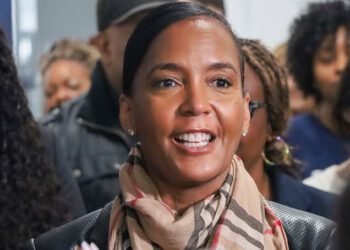
Democratic state Representative Gina Hinojosa has defeated incumbent Texas Governor Greg Abbott, according to an NBC News projection, ending nearly three decades of Republican control of the state’s governorship.
Hinojosa’s victory makes her the first Hispanic woman to become governor of Texas and marks the first time Democrats have captured the office since 1995.
The outcome comes despite Abbott’s campaign spending tens of millions of dollars more than his Democratic challenger. The three-term Republican had initially appeared well-positioned to secure another victory in a state that has consistently supported Republican candidates for decades.

However, shifting voter demographics and growing political challenges facing Republicans nationally and in Texas contributed to Abbott’s defeat. Republican candidates in several races also faced controversies and criticism during the campaign.
In her victory speech, Hinojosa said Abbott had called to congratulate her and pledged to introduce significant changes across the state.
“I want to say something to the powerful people who have gotten very comfortable running this state,” she said. “The voters have delivered a mandate for change, and it is change they will get.”
Born and raised in the Rio Grande Valley, Hinojosa entered the Texas House of Representatives in 2016. Before joining politics, she worked as a civil rights and labour lawyer.
Education has remained central to her political career. She previously identified her involvement in efforts to prevent her son’s elementary school from closing because of state budget cuts as the experience that inspired her to seek public office.
During her campaign, she made education funding and reform major priorities. She also promised that one of her first decisions as governor would be to remove the state’s education commissioner, pointing to declining student performance across Texas.
Another major issue in the contest was the expansion of data centres, which has generated concerns in several parts of the state, particularly rural communities.
Abbott, who had enjoyed strong backing from rural voters in previous elections, faced criticism over his support for data centre development.
Texas currently has more than 500 data centres, making it the second state with the highest number in the United States.
The governor later softened his position on the issue, directing state authorities in September to suspend approval of new data centre permits while an audit examined their impact on the state’s electricity grid.
Hinojosa accused Abbott of prioritising wealthy supporters over ordinary residents. In campaign advertisements, she alleged that the governor was “doing the bidding of his billionaire donors” and “selling out Texas” through his backing of data centre projects.
Her ability to communicate fluently in Spanish also helped her connect with Latino voters, who account for roughly one-third of Texas’ electorate. She reached the community through bilingual television advertisements and town hall meetings conducted in Spanish.
Abbott, meanwhile, sought to portray his challenger as a radical candidate, using campaign commercials to criticise her previous positions on transgender female athletes and gender-affirming healthcare for minors.
One of his advertisements referred to her as “Gender Bender Gina”.
Hinojosa responded by shifting attention to the economic challenges facing working-class residents.
“They want to run an entire campaign saying that I’m too woke. I plan to spend an entire campaign focused on the fact that working people are too broke,” she said in an advertisement.
“That’s the difference. I’m Gina Hinojosa. My pronouns are mom, Texan and soon-to-be governor.”
The contest ended without the two candidates holding a formal debate, despite repeated calls from Hinojosa for Abbott to participate.
After the governor failed to respond to invitations, Hinojosa staged a mock debate outside the Governor’s Mansion in mid-October to highlight his refusal to face her publicly.