
U.S. Immigration and Customs Enforcement (ICE) agents have reached a disturbing new low in their massive Minnesota crackdown, detaining at least four elementary and high school students—including a 5-year-old boy—from a single suburban school district, according to local officials who accuse the federal government of using children as tactical pawns and bait in a sweeping, politically-charged operation.
The arrests have transformed the Minneapolis suburb of Columbia Heights into a landscape of fear. School Superintendent Zena Stenvik told a press conference that armed, masked ICE officers are “roaming our neighborhoods, circling our schools, following our buses… and taking our kids.”
The detained students include Liam Conejo Ramos, 5; a 10-year-old; and two 17-year-olds. Liam and his father, both in the country legally as asylum applicants according to their lawyer, were swiftly transferred to a family detention center in Dilley, Texas, over 1,000 miles away.

The 5-Year-Old Liam as ‘Bait’
The detention of 5-year-old Liam has become the central flashpoint, with starkly conflicting accounts highlighting the brutality of the tactic. Witnesses, including city council members and school board officials, describe a scene where Liam—wearing a blue hat and a Spider-Man backpack—watched masked agents seize his father in their driveway after preschool.
Crucially, multiple witnesses allege ICE agents then attempted to use the boy as “bait” to lure his mother out of the house. School Board Chair Mary Granlund confirmed this when asked directly, stating, “Correct.” She and neighbors offered to take custody of the child but were refused, despite being legally authorized to do so. “He was frozen and paralyzed… He looked so scared,” recounted city council member Rachel James.
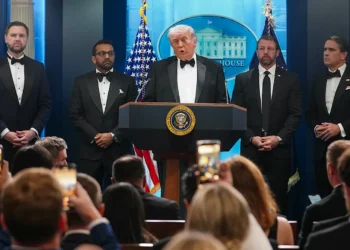
Vice President JD Vance, visiting Minneapolis to support ICE, offered a diametrically opposed narrative. He claimed the father “ran away,” “abandoning” Liam, forcing officers to take the boy to prevent him from freezing. “What are they supposed to do?… Are they not supposed to arrest an illegal alien?” Vance challenged. This official story was immediately contradicted by witnesses and the family’s lawyer, Marc Prokosch, who stated the family has no criminal record and was awaiting a lawful immigration hearing.
‘Why Are They Detaining Students?’: The Operation as Political Theater
The answer to the headline’s question lies in the nature of “Operation Metro Surge,” the deployment of roughly 3,000 federal agents to the Minneapolis area. The operation, a centerpiece of President Trump’s immigration agenda, is not a precision law enforcement action but a deliberate show of overwhelming force designed to instill terror and demonstrate political resolve following the controversial police shooting of U.S. citizen Renee Good on January 7.
Detaining children serves multiple purposes for this operation: it maximizes community trauma to deter sanctuary policies, creates sympathetic propaganda for the administration (the “abandoned child” narrative), and tests the limits of public and legal tolerance for extreme tactics. By targeting students, ICE directly assaults the core institution of community safety—the local school—sending a message that no one, not even a kindergartener with a Spider-Man backpack, is beyond reach.
The ‘New Low’: Weaponizing Childhood Against a Community
Superintendent Stenvik’s statement that the “onslaught of ICE activity is inducing trauma” is the definitive answer. The “new low” is not an accident; it is a feature. When immigration enforcement moves from arresting individuals to seizing children from their driveways and schools, it crosses a moral and psychological threshold.
It turns a policy dispute into a visceral, generational trauma. The image of a 5-year-old used as bait, of a 10-year-old detained, of teenagers taken from their community, answers the “why.” These actions are not focused on catching dangerous fugitives; instead, they are about demonstrating total power, breaking community will, and redefining the very meaning of “security” in America—where the state itself becomes the primary source of fear for its youngest residents.