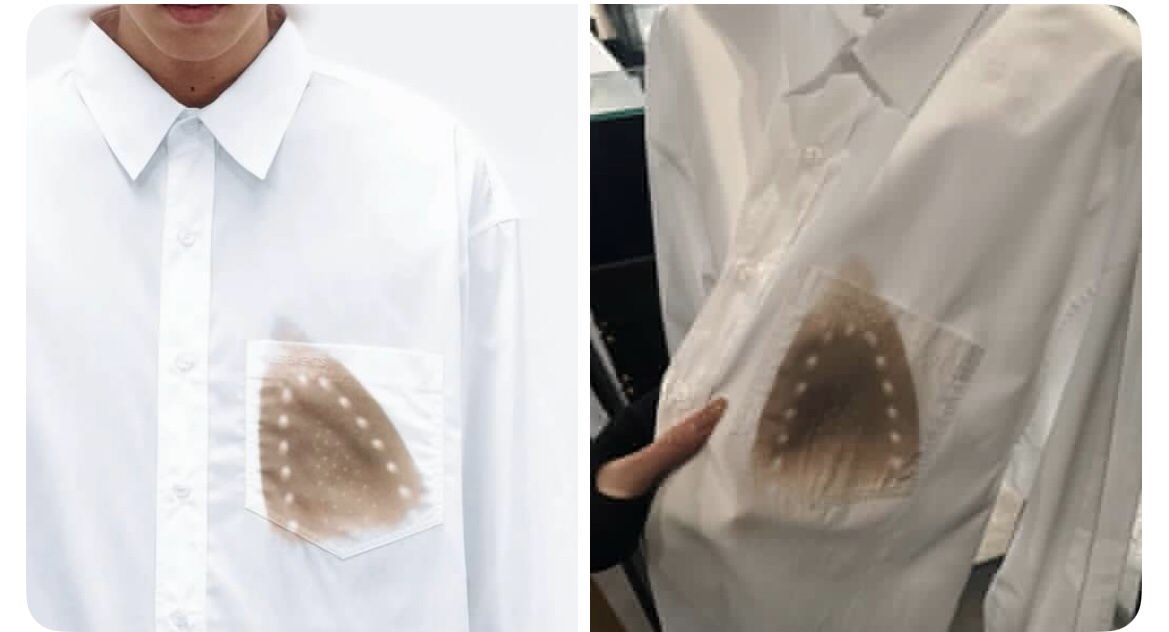

On February 17, 2026, the fashion corner of X did what it does best: it went into a collective fever dream over a designer top. This time, the culprit was Vetements. The offending item? A stark white button-down featuring a hyper-realistic, scorched-brown iron mark seared into the chest. The price tag boasts a staggering $1,139—roughly ₦1.7 million. For what, exactly?

For anyone who grew up in a Nigerian household, that brown singe isn’t a ‘design choice.’ It is the scent of a ruined Monday morning, the frantic attempt to spit-rub a burn out of a school uniform, and the immediate dread of a parent’s heavy hand. The dreaded singe is a domestic accident born of haste, heat, and more often than not, a lack of options. Yet, in the hands of Guram Gvasalia, it has been rebranded as avant-garde.
The Luxury of Failure
This latest move by Vetements is what I call ‘Poverty Cosplay.’ To remain relevant, brands like Vetements and Balenciaga have realized they must weaponize audacity. Nothing is more provocative to a billionaire than the ability to look like they’ve actually had a hard day.

Selling a burnt shirt for the price of an annual rent payment in Yaba or Gbagada is a very specific, very violent kind of privilege. It signifies the ability to wear failure as a seasonal costume, taking comfort in the knowledge that you can unzip that reality and return to your temperature-controlled penthouse whenever the aesthetic gets too heavy. It is fashion’s version of slumming it—where the struggle is stripped of its consequence and sold back to the people who will never have to live it.
A History of Appropriation
This isn’t the first time the fashion industry has played this card. We saw a similar stunt play out with agonizing clarity just last year. In 2025, Louis Vuitton decided to monogram the ‘Ghana Must Go’ bag—the Chékéré—and slap a $3,000 (over ₦4.5 million) price tag on it. They called it ‘utilitarian chic.’ I called it a heist ()
For the West, that woven plastic is a retro print found in thrift stores. But for us West Africans, it is the visual and physical representation of the 1983 mass expulsion of Ghanaians from Nigeria. It is a constant remembrance for over a million people who were uprooted, forced to stuff their entire lives into ₦500 bags as they crossed borders in fear.
In essence, it is a story of survival, grit, and displacement. When a French luxury house sanitizes that trauma for a Parisian runway, they aren’t ‘honoring’ the culture. They are, rather, colonizing a memory and suggesting that our survival is only ‘chic’ once it has been validated by a European logo.
The ‘Struggle’ as a Commodity
Why does the industry keep doing this? Because the ‘Struggle Aesthetic’ offers something that high-end silk and cashmere cannot: a sense of realness. But it is a curated, safe realness. When Vetements burns a shirt, they aren’t celebrating the worker; they are, quite frankly, mocking the work.
The industry’s obsession with blue-collar symbols—from DHL t-shirts to trash-bag totes—relies on a fundamental disconnect. There is a bitter irony here that feels particularly pointed in Nigeria. The person buying a $1,139 scorched shirt is often the same decision-maker debating whether a ₦70,000 minimum wage is “sustainable.” It is a feedback loop that only works if you ignore the humanity of the ‘muse.’ It turns the actual struggle of the Nigerian working class into a costume for the people who manage their poverty.
The Reclamation: Authenticity vs. The Gaze
The harsh but needed reality is that while luxury houses sample our daily lives, they rarely invest in the communities that birth these trends. However, 2025 also showed us that the mood board is fighting back.
We saw the rise of a new guard—designers like Kenneth Ize and Nkwo—who didn’t just sample our textures; they documented them. Using Aso-oke and upcycled materials, they proved that authenticity isn’t something you can manufacture in a European studio. Their work doesn’t read as a stunt, but as a continuation of a lineage. They are reclaiming the narrative from the colonial gaze of the Great Houses, proving that the original is always more valuable than the caricature.
The Verdict for 2026
Whether it is a scorched shirt or a monogrammed migrant’s tote, the message remains the same: the wealthy want the look of hardship without a single drop of the sweat.
In 2026, fashion’s greatest luxury is the immunity, not the craft. It is the ability to treat someone else’s life, their accidents, and their historical trauma as a seasonal trend to be discarded when the next ‘edgy’ thing comes along. We have to stop being the uncredited mood board for brands that wouldn’t know a real struggle if it burned them.