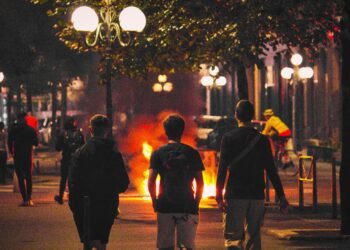
Verona’s streets turned into a stage of a different kind on Saturday as hundreds of demonstrators marched through the city ahead of the Olympics closing ceremony. While officials prepared for the evening spectacle inside the city’s ancient Roman arena, protesters gathered to voice concerns over housing costs and environmental impact linked to the Winter Games.
The closing ceremony, scheduled for 8:30 p.m., is set to take place in Verona’s historic amphitheatre, a landmark known for hosting major cultural events. But outside the security perimeter, chants and banners told a contrasting story.
Protesters Rally Against Costs and Development
The demonstration, organised under the slogan “Olympics? No thanks,” drew participants from university groups and civic associations. The organisers argue that hosting the Games has placed financial pressure on residents while reshaping parts of the landscape in ways they consider harmful.
“We are here to defend our territory from speculation,” said Giannina Dal Bosco, a 76-year-old activist who joined the march. She criticised what she described as the “impossible cost” of attending Olympic events, noting that tickets for seats at the closing ceremony were priced at around 400 euros.
One banner captured the mood of the rally: “Fewer Games for the few, more homes for everyone.”
Environmental Concerns Take Centre Stage
Beyond ticket prices, many protesters focused on infrastructure projects tied to the Games. Francesca, 34, who travelled from Vicenza, expressed frustration over what she called visible changes to the landscape.
“They built concrete structures that will serve no real purpose,” she said, referring specifically to Olympic facilities. “Public money has been wasted that could have been used for housing and environmental protection.”
For demonstrators, the issue extends beyond aesthetics. Critics argue that large-scale construction associated with global sporting events can strain ecosystems and redirect funds from other public priorities.
March Route and Symbolic Presence
Protesters planned to march for approximately two hours, staying outside the designated security zones. The route stretched from Porta Palio, a 16th-century city gate, to Arsenal Square, an area known for its historical significance.
Several participants wore keffiyeh scarves and waved Palestinian flags, adding a broader political dimension to the gathering. While the central focus remained on local concerns, the imagery reflected how global events often intersect with wider social debates.
Wider Discontent Seen Earlier in the Games
Saturday’s march follows a much larger demonstration that took place in Milan at the start of the Games, where nearly 10,000 people gathered. That protest later turned violent, highlighting the intensity of opposition among some groups.
By contrast, the Verona rally unfolded in a tense but largely controlled atmosphere, with demonstrators remaining outside restricted areas as the city prepared for the ceremony.
Ceremony Proceeds Amid Protests
Despite the protests, the Olympics closing ceremony is expected to proceed as planned inside Verona’s Roman arena. The contrast between celebration and dissent underscores the mixed reactions that often accompany major international sporting events.