

Iran’s expanding retaliatory campaign directly targeted the heart of the global energy system Monday, striking Saudi Arabia’s Ras Tanura refinery — the kingdom’s largest — and forcing a complete shutdown of a facility that handles nearly 7% of the world’s daily oil supply.
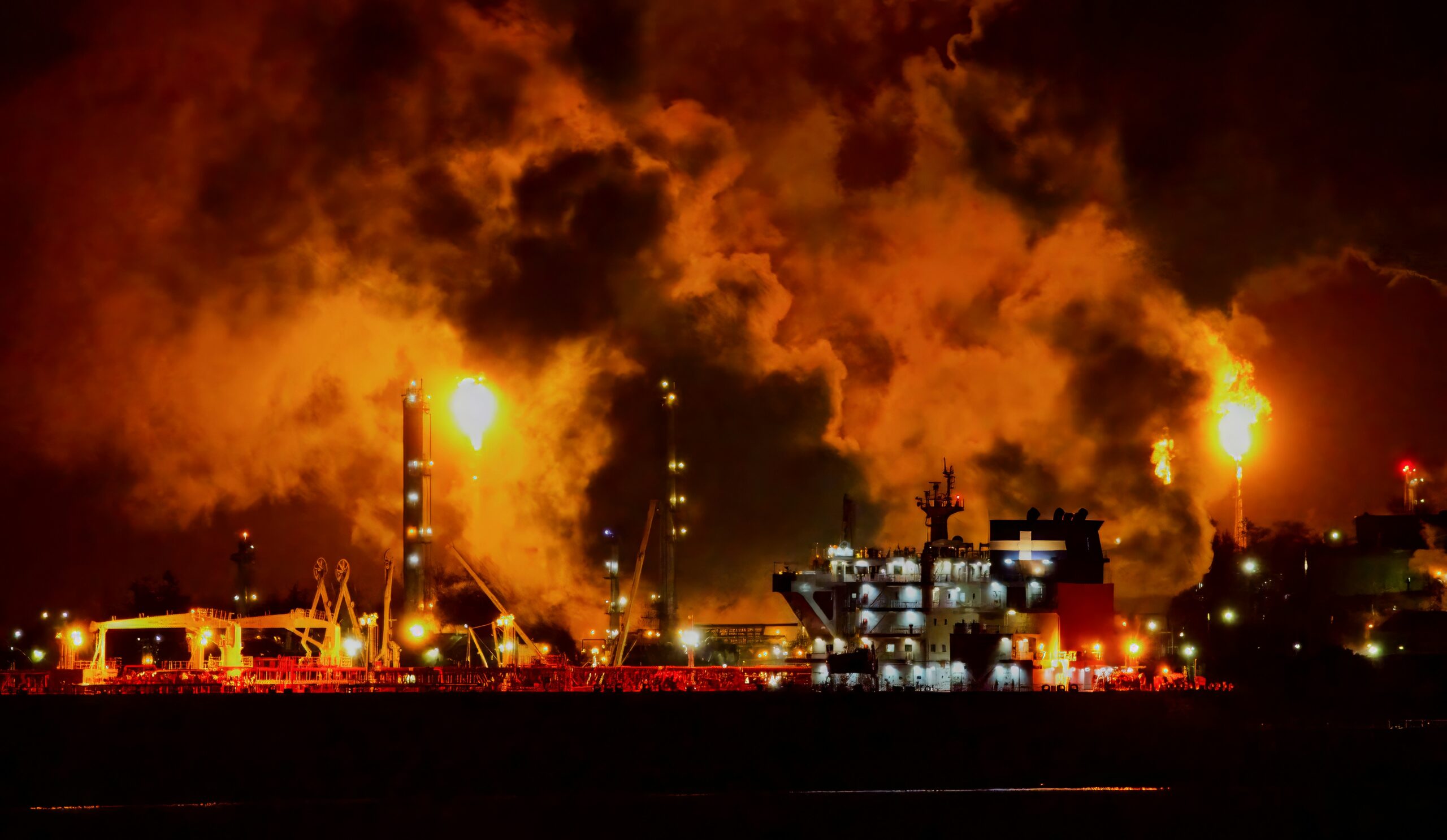
Saudi Aramco halted operations at the Ras Tanura complex after Iranian drones struck the facility, triggering a fire in its processing area. The refinery has a capacity of roughly 550,000 barrels per day and serves as the kingdom’s primary oil export terminal, processing crude from the giant Ghawar, Abqaiq, and Khurais fields.
Authorities said the blaze was contained and no casualties have been confirmed. Saudi state television reported the shutdown was a “precautionary measure”. The Saudi Defense Ministry’s spokesperson said two drones were intercepted at the facility, with debris causing a limited fire and no injuries.
A Target Decades in the Making
The Ras Tanura complex, located on Saudi Arabia’s Gulf coast near Dammam, is not just another refinery. It is the nerve center of global energy markets :
· Refining capacity: 550,000 barrels per day
· Export volume: Approximately 6.5 million barrels of crude daily
· Global share: Nearly 7% of the world’s oil supply passes through this single site
· Domestic impact: The refinery meets roughly 40% of Saudi Arabia’s domestic fuel demand
The facility has three specialized terminals and 28 berths across Ras Tanura and Juaymah, capable of loading six supertankers simultaneously. It handles heavy, medium, light, and extra-light crude, plus jet fuel, propane, butane, gasoline, and diesel.
Energy infrastructure of this scale has been targeted before — most notably in September 2019, when drone and missile attacks on Abqaiq and Khurais temporarily knocked out more than half of Saudi production. But Monday’s strike represents the first time Iran has directly attacked Gulf energy infrastructure during the current conflict.
Global Markets React
Oil prices surged immediately on the news. Brent crude futures jumped approximately 10% on Monday, trading near $80 per barrel — the highest level in seven months. West Texas Intermediate rose 8.6% to around $73.
The price spike reflects twin supply shocks: the Ras Tanura shutdown and the near-total paralysis of shipping through the Strait of Hormuz, through which about one-fifth of global oil consumption flows. At least three oil tankers have been attacked on the route since Sunday.
“An extended period of uncertainty lies ahead as Iran seeks to impose a heavy economic cost by putting tankers, regional energy infrastructure, trade routes and U.S. security partners in the crosshairs,” said Torbjorn Soltvedt, Principal Middle East Analyst at risk intelligence firm Verisk Maplecroft.
Sascha Bruchmann, a defense analyst with the International Institute for Strategic Studies in Bahrain, told the Associated Press that Iran’s goal in hitting energy infrastructure is to “cause global backlash and impose costs” on the U.S. president. However, he noted that “this is not the wholesale destruction of critical infrastructure the Iranian regime seeks” — yet.
The Escalation
The strike on Ras Tanura came as part of a broader wave of Iranian retaliation across the Gulf. Explosions were reported in Abu Dhabi, Dubai, Doha, Manama, and Oman’s commercial port of Duqm. Critical infrastructure was hit in multiple countries:
· Kuwait: An oil refinery in Ahmadi was struck by debris from intercepted drones, injuring two workers. “Several” U.S. warplanes also crashed in Kuwait, with crews safely evacuated.
· Bahrain: Salman Port was hit by an Iranian missile; Iran’s Press TV claimed the port was being used to transport American logistical equipment intended for strikes on Iran.
· UAE: Dubai International Airport was struck, injuring four people.
· Qatar: Air defenses intercepted incoming missiles.
Iran’s Islamic Revolutionary Guard Corps announced what it called the “tenth wave” of its operation, dubbed “Operation True Promise,” stating that “massive gates of fire” had been opened upon the occupied territories.
Regional Implications
The attack on Saudi infrastructure marks a dangerous turning point. Gulf Arab states, which have largely stayed on the sidelines of the US-Israeli campaign against Iran, now find themselves directly in the crossfire.
“The attack on Saudi Arabia’s Ras Tanura refinery marks a significant escalation, with Gulf energy infrastructure now squarely in Iran’s sights,” Soltvedt said . “The attack is also likely to move Saudi Arabia and neighboring Gulf states closer to joining US and Israeli military operations against Iran”.
Saudi Arabia’s heavily fortified energy facilities have been tested before. The kingdom has spent years hardening defenses since the 2019 Abqaiq attack. But Monday’s strike demonstrates that no amount of protection can guarantee safety when Iran is determined to retaliate.
What Comes Next
The duration of the Ras Tanura shutdown remains unclear. Aramco has not commented on when operations might resume. The company is reportedly assessing damage and determining whether the fire caused structural harm to processing units.
Meanwhile, the Strait of Hormuz remains nearly impassable. Shipping through the world’s most important oil chokepoint has ground to a near-halt after vessels were attacked on Sunday. Energy traders are betting that crude flows could slow significantly — if not stop entirely.
Morgan Stanley analysts warned that if the Strait of Hormuz is closed for more than 25 days, major Gulf producers may be forced to halt production entirely. Citigroup raised its short-term Brent forecast to $85 and warned that in an extreme scenario — with sustained damage to regional energy infrastructure — prices could spike to $120.
For now, the world watches and waits. One of its most critical energy facilities is offline. The waterway that moves a fifth of its oil is nearly impassable. And Iran has made clear that this is just the beginning.