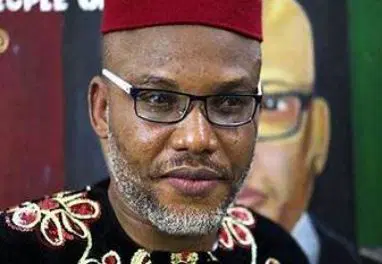

The apex Igbo socio-cultural organization, Ohanaeze Ndigbo, has called on President Bola Tinubu to grant amnesty to detained IPOB leader Nnamdi Kanu on or before June 12, 2026, arguing that his continued incarceration has become a political weapon for opposition figures while Tinubu’s own political rivals walk free.
In a statement issued by factional Deputy President-General Mazi Okechukwu Isiguzoro and National Spokesman Chief Thompson Ohia, Ohanaeze said Kanu’s release—preferably timed to coincide with Nigeria’s Democracy Day—would signal “a bold commitment to justice, inclusion, and healing decades-old grievances in the Southeast.”
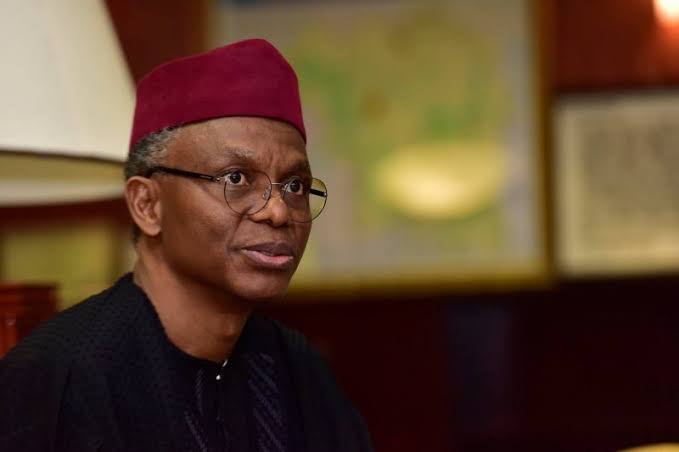
The group pointed to the recent release of former Kaduna State Governor Nasir El-Rufai as a compelling precedent. “If El-Rufai can be freed despite facing serious allegations, why not Kanu?” the statement asked, framing the demand as a question of equitable justice rather than ethnic favoritism.
‘Biafra of the Mind’
Ohanaeze sought to clarify what it called a widespread misunderstanding of Kanu’s agitation, arguing that his advocacy aligns with the philosophical vision of Chukwuemeka Odumegwu Ojukwu—specifically the concept of a “Biafra of the Mind.”
According to the group, this ideology promotes consciousness, self-determination through dialogue, and socio-political equity within a united Nigeria, not secession.
The organization traced Kanu’s activism back to his early years under Ralph Uwazuruike, noting that his initial approach was rooted in non-violence and public enlightenment. It acknowledged that evolving security concerns and political tensions over the years contributed to a shift in tone, which it said had since been “misinterpreted by many.”
‘Kanu’s Release Won’t Hurt Tinubu in 2027’
Ohanaeze dismissed fears that releasing Kanu could destabilize the country or threaten Tinubu’s re-election prospects in 2027. Instead, the group argued, such a move would likely enhance the President’s standing in the Southeast and demonstrate leadership anchored on reconciliation.
“President Tinubu has nothing to lose and everything to gain,” the statement said. “The Southeast is not a monolith of opposition. A gesture of this magnitude would be remembered.”
The group further alleged that opposition figures—including Atiku Abubakar, Peter Obi, and Rabiu Kwankwaso—are leveraging Kanu’s continued detention as a political tool to galvanize support among Igbo voters ahead of the 2027 general elections. By releasing Kanu now, Ohanaeze argued, Tinubu would neutralize that weapon and defuse a narrative that has long painted the Federal Government as hostile to the Southeast.
Commending Tinubu, But Asking for More
In a carefully calibrated statement, Ohanaeze acknowledged the Tinubu administration’s ongoing infrastructure development in the Southeast, particularly the rehabilitation of key federal roads. It described these efforts as “a step in the right direction.”
But the group stressed that releasing Kanu would carry even greater symbolic and political significance.
“Roads can be built. Bridges can be repaired. But trust takes years to rebuild,” the statement said. “Granting amnesty to Nnamdi Kanu would open a new chapter of trust, unity, and cooperative nation-building.”
What Happens Next
Ohanaeze expressed confidence that Kanu, if released, would embrace dialogue and contribute constructively to national discourse rather than incite conflict.
The group did not specify what action it would take if its appeal is ignored. But the timing—ahead of Democracy Day, with the 2027 election cycle already stirring—suggests the demand is intended as a political test for a President seeking to expand his electoral base into the Southeast.