A Secret Service officer was shot in the chest. The suspected gunman is in custody. The President was rushed from the scene. But three days later, the Justice Department cannot say who fired the bullet.
And that is just the first of many questions piling up in the aftermath of the April 25 attack at the White House Correspondents’ Dinner.
Acting Attorney General Todd Blanche admits investigators are not sure whether the alleged assailant, Cole Allen, fired the shot that struck the officer in his bulletproof vest. Allen is charged with attempting to assassinate President Donald Trump and with discharging a firearm during a crime of violence. But he is not charged with assaulting a law enforcement officer.
Why not? If an officer was shot, and the alleged gunman was the only person firing at officers, shouldn’t the math be simple?
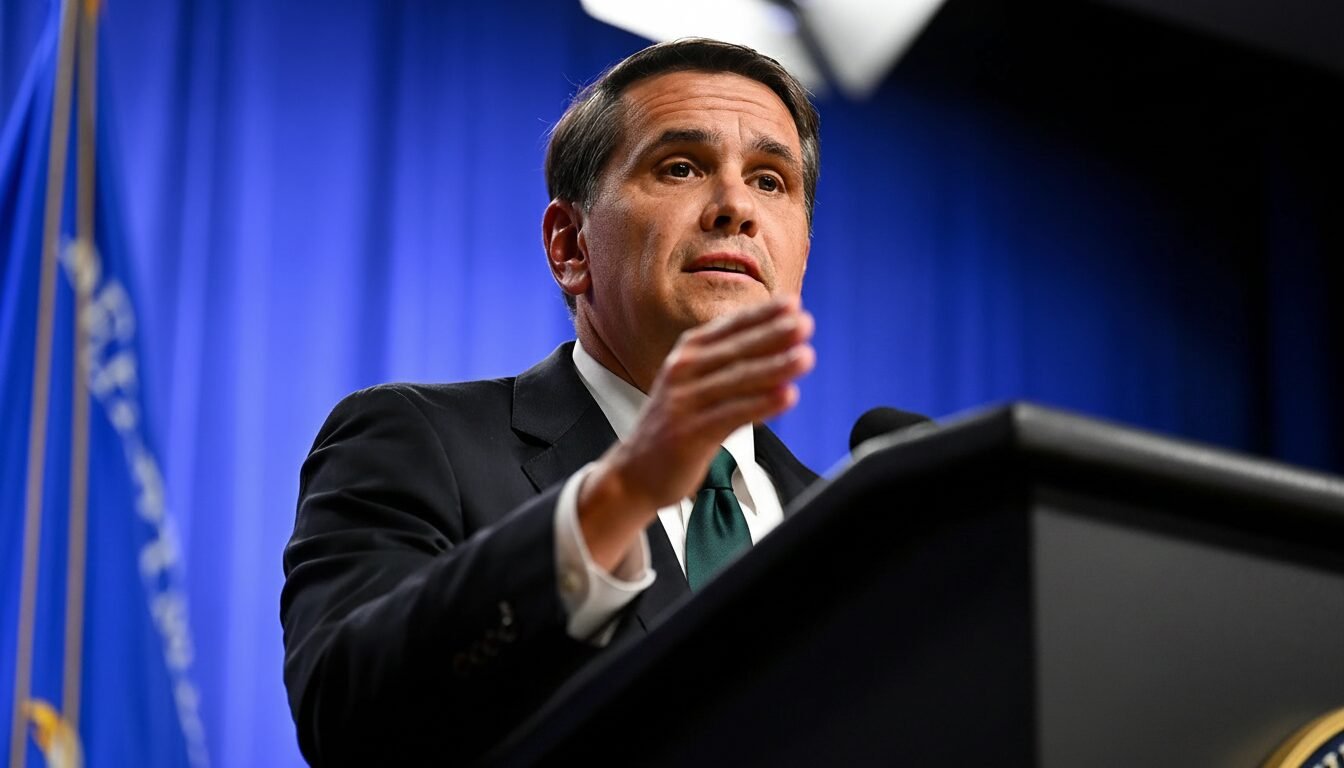
The Missing Bullet
Blanche’s explanation has only deepened the mystery. He said a preliminary review suggests Allen fired his weapon once, with an empty casing remaining inside the firearm — meaning he didn’t pump it to reload. He also emphasized that buckshot from a gun like Allen’s is difficult to trace.
“It’s not an exact science,” Blanche said. “It scatters everywhere. Sometimes it just disappears actually.”
Sometimes it just disappears? A bullet that hits a Secret Service officer in the chest “just disappears”? That is not a scientific explanation but an evasion.
So whose bullet was it? If not Allen’s, then who fired the shot that struck the officer? The Secret Service officer who was hit returned fire, firing five times at Allen but missing him. Could the officer have been hit by friendly fire? The DOJ isn’t saying. Could there have been another shooter? The DOJ isn’t saying that either.
And where is the bullet? If the officer was hit in the chest, the bullet or its fragments would be somewhere at the scene — in his vest, on the ground, embedded in a wall. The idea that buckshot “just disappears” defies basic physics. Investigators should be able to find it. If they haven’t, the question is why they are not looking harder.
The Staging Question
These gaps in the official story naturally lead to a more troubling possibility. Was the shooting staged?
Consider the timeline. Immediately after the attack, the Trump administration cited Allen’s alleged assault in a court filing urging a federal judge to withdraw an order that briefly blocked construction of a $400 million White House ballroom. Secret Service Deputy Director Matthew Quinn recounted the moment in vague terms: “During the event, a gunman opened fire at a Secret Service security checkpoint … One Secret Service Police officer was shot before the suspect was apprehended.”
The administration is using a shooting that it cannot fully explain to justify a $400 million construction project. That is not conspiracy theorizing. That is following the paper trail.
How come immediately after the shooting, Trump and the DOJ started making a case for Trump’s ballroom to be built? Was this staged to get the ballroom completed? The question here is not whether there was a shooting. There clearly was. The question to be asked, rather, is whether the chaos of that night is being leveraged to push through a project that had been blocked.
The Convenient Timing
The ballroom has been a priority for the Trump administration. The president has personally championed the project. A federal judge had briefly blocked its construction. Then, days later, a gunman attacks the White House Correspondents’ Dinner, and the administration immediately uses the incident to argue for the ballroom’s necessity as a security upgrade.
No one doubts that security at the White House and its surrounding venues is important. But the speed with which the administration pivoted from “we’re still investigating” to “this proves we need the ballroom” is striking.
If the ballroom was always a security necessity, why did a judge block it? If the shooting proves the need for better protection, why can’t the DOJ explain basic facts about who shot whom? The administration cannot have it both ways. Either the attack was a major security failure that requires immediate remediation — in which case the DOJ should be able to provide clear answers — or it is being used as a political prop to advance a construction project. There is no comfortable middle ground.
What the DOJ Isn’t Saying
The initial charges filed against Allen are unlikely to be the only ones. US Attorney Jeanine Pirro has promised “additional charges.” But the absence of an assault-on-a-federal-officer charge in the initial filing is glaring. The officer was hit. The government should know who shot him. If it doesn’t know yet, that raises questions about the quality of the investigation. If it does know and is not saying, that raises questions about transparency.
Blanche’s comment that investigators want to “get that right” before making allegations is a reasonable position — for a few hours. For three days? At some point, “still looking” becomes “not finding.”
The FBI has declined to elaborate on Blanche’s comments or the language in official court filings. Spokespeople for the Justice Department and the Secret Service did not respond to requests for comment. The silence is not reassuring.
The Bottom Line
The DOJ cannot say whether alleged WHCD shooter Cole Allen fired the bullet that struck a Secret Service officer in the chest. Allen is not charged with assaulting law enforcement. The acting attorney general says buckshot “sometimes just disappears.” The administration is using the still-unexplained shooting to justify a $400 million White House ballroom that a federal judge had temporarily blocked.
Questions multiply faster than answers. Whose bullet hit the officer? Where is that bullet now? If it can’t be found, why not? Why the immediate pivot to the ballroom construction? And is it possible that the chaos of a real attack is being weaponized for political and architectural gain?
The shooting was real. The officer was hurt. The suspect is in custody. But the official story has holes large enough to drive a ballroom through. Until the DOJ provides clear, verifiable answers, Americans are right to ask: what really happened — and who benefits from the confusion?