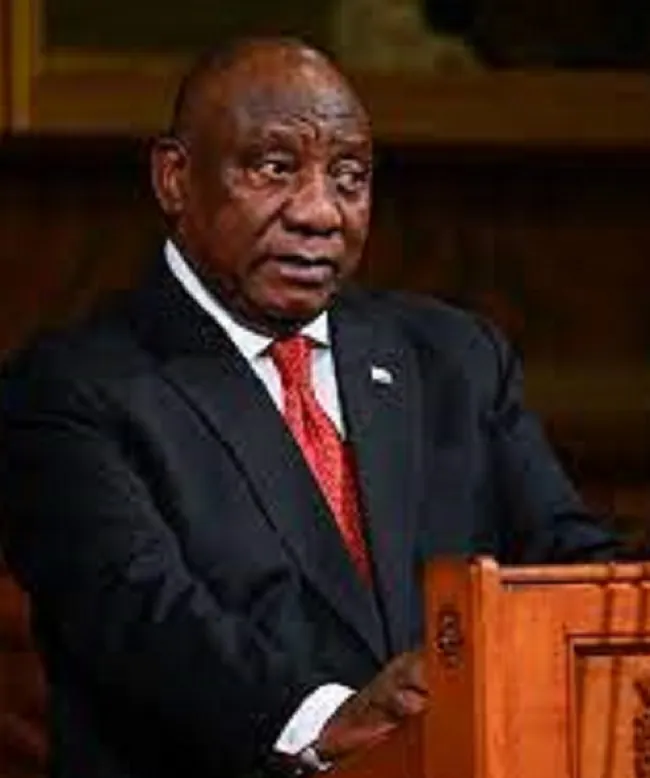

South African President Cyril Ramaphosa has pledged to strengthen immigration controls and tighten border security as anti-foreigner protests continue to spread across the country.
Addressing the nation on Sunday, Ramaphosa acknowledged shortcomings in the government’s management of migration and promised decisive action to curb illegal immigration while maintaining that only state authorities have the power to enforce the law.
His remarks came as hundreds of foreign nationals, including both documented and undocumented migrants, departed South Africa through repatriation flights and buses arranged by their respective home countries.
Over the weekend, chartered flights transported Ghanaian nationals who opted to return home, while several undocumented migrants in the Western Cape were moved to the Lindela Repatriation Centre. In Hermanus, some displaced foreign nationals were also assisted by their embassies to leave the country.

The President warned citizens against taking immigration enforcement into their own hands.
“I must make it clear that only the authorised government officials may act against violations of the law, including violations of our immigration laws. No other person is allowed, for example, to confront someone in the street to demand proof of nationality,” he said.
Ramaphosa insisted that South Africans should reject xenophobia and other forms of intolerance.
“We know that South Africans are not xenophobic as there is no space for xenophobia, racism, sexism, Afrophobia or any other forms of intolerance in South Africa,” he stated.
He also accused certain groups of exploiting public concerns about illegal migration for political and personal gain, warning against misinformation circulating on social media.
According to the President, weaknesses in immigration management, enforcement failures, corruption, and loopholes in existing systems have contributed to public frustration.
“There have been weaknesses in the way migration has been managed. There have been weaknesses in rigorous and focused enforcement. There have been instances of corruption. There have been gaps in our systems that have undermined public confidence,” he said.
As part of planned reforms, Ramaphosa announced the accelerated phase-out of South Africa’s green identity document, which authorities believe has been widely abused in the production of fraudulent identification papers.
He also revealed plans to stop the misuse of the Traffic Registration Number system, which some foreign nationals have reportedly used as an alternative form of identification.
The President further disclosed that the government has finalised a National Labour Migration Policy that would introduce quotas for the employment of documented foreign workers and increase penalties for employers who hire undocumented migrants.
To strengthen enforcement, the government will recruit 10,000 labour inspectors during the current financial year and intensify inspections targeting businesses suspected of employing undocumented foreign nationals.
Ramaphosa also said authorities are considering dedicated immigration courts to speed up deportation processes and confirmed plans to gradually relocate refugee reception centres to border areas, beginning with the Tshwane centre.
According to him, the Border Management Authority intercepted more than 450,000 attempted illegal border crossings over the past year.
While acknowledging public concerns over illegal immigration, the President urged citizens to reject vigilantism and focus on addressing broader economic challenges.
“We should all reject those who stoke hatred and division, or who tacitly encourage vigilantism,” he said, adding that sustainable economic growth and job creation remain critical to resolving many of the frustrations fueling the current tensions.