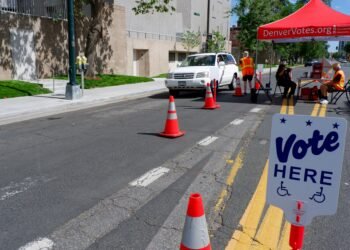
The battle over control of the U.S. House of Representatives took a massive turn in Florida on Wednesday, June 10, 2026. The Florida Supreme Court cleared the way for Republicans to use a highly controversial new congressional map for the upcoming November midterm elections. Critics are calling the move a court abdication that hands Trump four free seats in Congress.
In a 6-1 decision, the state’s highest court rejected a plea from voting rights groups to block the heavily gerrymandered voting lines. Gerrymandering means redrawing voting districts to give one political party an unfair advantage. By refusing to stop the map, the court all but guarantees that the newly designed boundaries will remain in place for the fall elections. This hands national Republicans a massive advantage in their race to keep a slim House majority.
Shifting the Balance of Power
The court’s ruling does not officially end the overall lawsuit against the maps, but it runs out the clock before the midterms. Prospective congressional candidates face a strict deadline this Friday to qualify for the August 18 primaries, making a last-minute map change impossible.

The immediate political impacts of the decision are major:
1. A Massive GOP Gain: Florida’s current congressional delegation favors Republicans with a 20-8 split. The new map, which was drawn directly by Governor Ron DeSantis’s office and passed in a lightning-fast two-day special legislative session, could easily widen that gap to an overwhelming 24-4 Republican advantage.
2. Erasing Minority Districts: The new boundaries actively dismantle a southeastern Florida voting district that was specifically created to protect minority voting blocks and help elect Black representatives under the federal Voting Rights Act.
3. Voter Shifting: According to data from the lawsuit, the new layout leaves 82% of voters in Republican districts exactly where they were before. Meanwhile, it completely rearranges the lines for Democratic voters, leaving only 41% of them in their original districts.
The Court is Letting Politicians Pick Their Own Voters
This ruling is a massive failure of judicial duty. In 2010, the people of Florida went to the polls and voted to pass the Fair Districts Amendment. That amendment explicitly altered the state constitution to ban partisan gerrymandering and stop politicians from diluting the voting power of minority communities. By refusing to pause a map that clearly violates those rules, the Florida Supreme Court essentially told the public that their votes and their constitution do not matter.
The judges hid behind a technical excuse, claiming they “lacked jurisdiction” to step in while the case winds its way through lower appellate courts. But as the lone dissenting justice, Jorge Labarga, rightly pointed out, the court has stepped in during urgent election crises before. Waiting around for a slow legal process to play out over the next two years means millions of Floridians will cast their ballots in fake, unconstitutional districts this November. By the time a lower court finally rules the map is illegal, the damage will already be done. Republicans will have already taken those four seats, and they will use them to pass federal laws in Washington.
Even worse is the defense used by the governor’s legal team. They argued that because the federal Supreme Court weakened parts of the Voting Rights Act, Florida’s entire state ban on gerrymandering is now invalid. They are calling this extreme, lopsided redraw a “cause for celebration” and a “colorblind map.” That is total political spin. There is nothing colorblind about a map that protects 82% of Republican voters while throwing more than half of all Democratic voters into entirely new districts just to guarantee a GOP victory. The courts are supposed to protect the people from government overreach. Instead, Florida’s judges just handed politicians the keys to rig their own elections.
Partisan Warpath Over State Lines
The Florida ruling is part of a larger, coordinated national push by national Republicans to reshape congressional maps midway through the decade. While state map battles usually happen just once every ten years after the national census, multiple states have aggressively pushed mid-decade redraws to maximize partisan gains.
The national redistricting war has split the country:
1. The Southern Blitz: Florida’s legislative push occurred on the exact same day the U.S. Supreme Court struck down a majority-Black district in Louisiana. Since then, multiple Southern states have moved to eliminate minority-heavy districts that traditionally elect Democrats.
2. Democratic Defeats: While Democrats successfully secured more favorable maps in states like California and Utah, their efforts failed completely in Virginia. The Virginia Supreme Court struck down a spring redistricting plan that could have netted Democrats four seats.
3. Fierce Outrage: Voting rights organizations slammed the Florida decision. Genesis Robinson, the executive director of the Black-led voting rights group Equal Ground, called the court’s silence an absolute “assault on democracy and an abdication of its duty to the people of Florida.”
Voting Lines Locked In for November
While Governor Ron DeSantis celebrated the decision online as a final rejection of partisan challenges, the legal fight will likely drag on into the 2028 election cycle. For the immediate future, however, the political map is locked in. By choosing not to intervene, the Florida Supreme Court has fundamentally reshaped the national electoral landscape, forcing voters to use a map that critics call one of the most extreme partisan power grabs in the last half-century.