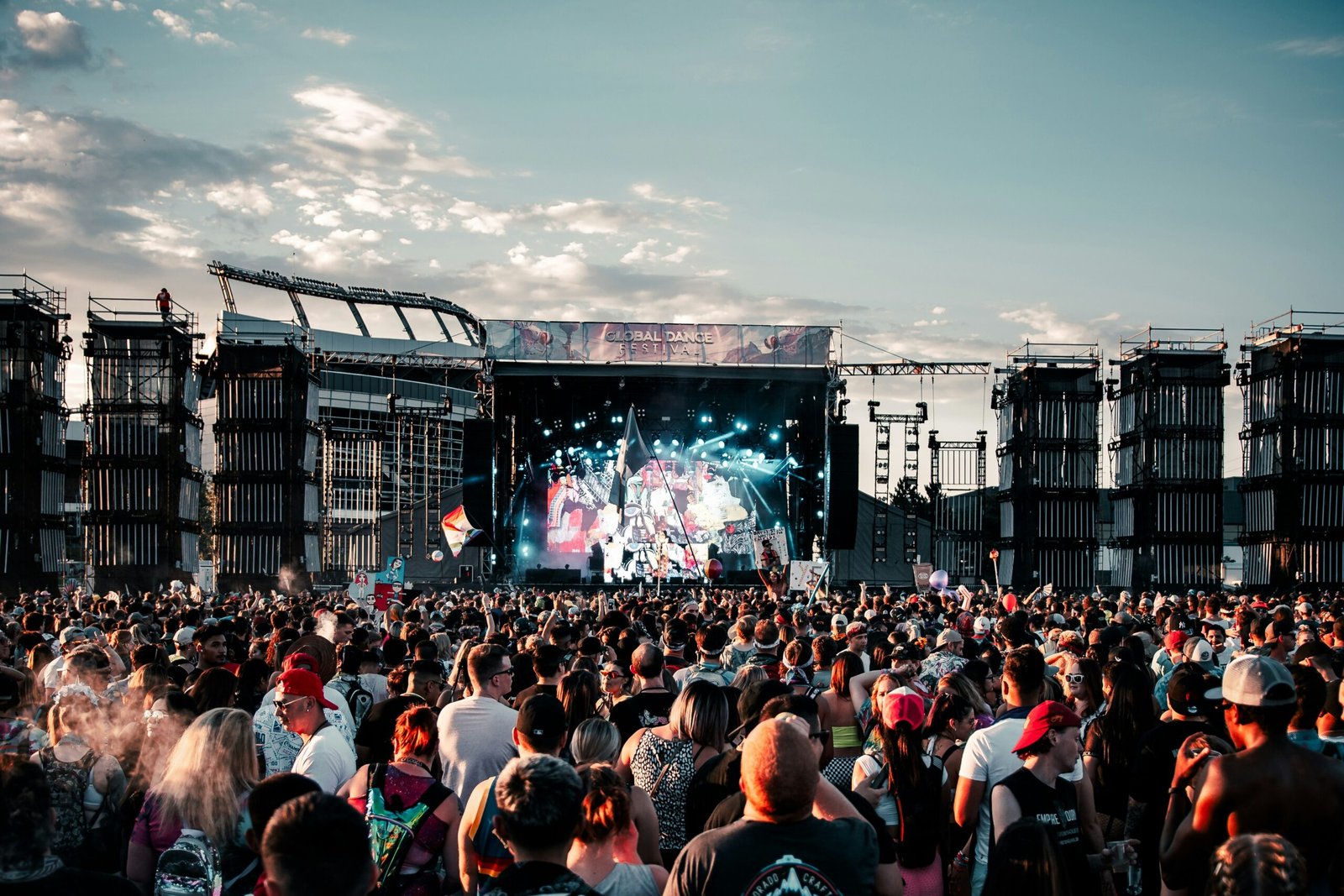

Linkin Park are poised to make history this weekend by becoming the first rock band fronted by a female singer to headline the United Kingdom’s biggest rock festival.
Since its launch in 2003, Download Festival at Donington Park in Leicestershire has largely been headlined by male-fronted bands, including major acts like Iron Maiden, Slipknot, and Metallica.
Linkin Park, with Emily Armstrong as lead singer, are scheduled to headline the final night of the three-day rock and metal festival on Sunday.
Some fans have described the inclusion of a female-fronted act at the top of this year’s lineup as a significant milestone, while others argue it does not represent as much progress on diversity as it may initially seem.
Linkin Park reunited in 2024, seven years after the death of their original lead singer, Chester Bennington, who died by suicide.
Chester Bennington’s family also expressed criticism of the band, with his son Jaime alleging that the remaining members were “quietly erasing” his father’s “life and legacy.”
The selection of Emily Armstrong drew backlash from some fans, who cited her alleged association with the Church of Scientology and her previous support for US actor Danny Masterson, who was later convicted of rape.
Armstrong has since moved to distance herself from Danny Masterson, making clear that she does not support any form of “abuse or violence against women.”
The band’s comeback single The Emptiness Machine reached number four on the UK Top 40 chart, while reaction to their Download Festival headline performance has been largely positive, even with the controversy surrounding their return.
As he arrived at the festival, Linkin Park fan James Harvey told BBC Newsbeat that Armstrong is “a really good fit,” adding that her inclusion reflects how the scene is “changing for the better.”
The singer noted that achieving more diverse headline acts may “take a while,” but believes the future “is going to get even better.”
Lambrini Girls bassist Selin Macieira-Boşgelmez told BBC Newsbeat that many women working in rock music frequently struggle with feelings of imposter syndrome.
“Partially because we are so under-represented in alternative music,” she says.
Selin and Phoebe Lunny launched the English punk rock duo in 2019, and by 2025 they had received the grassroots Loud Women Mercury Prize as well as a nomination for Rolling Stone UK’s Rising Stars Award.
She, however, said breaking into the music industry was not easy for them and took significant effort to establish themselves.
“In terms of even seeing myself in it, I very often would just go through my male friends that were musicians,” says Selin.
“I think that part of the problem is that they’re often not really given the chance on account of not being taken seriously.”
Selin believes that traits such as “loudness and aggression,” which are central to heavier music genres, are often praised in men but criticised or frowned upon when expressed by women.
Selin described seeing Armstrong headline the Download Festival as a “bittersweet” moment.
“It is kind of the bare minimum,” she says.
“I think that’s a problem across the whole industry, not just this particular festival.”
Radio host Sophie K of the UK has encouraged festivalgoers to welcome the positive shift, rather than target Emily for being the first to achieve the milestone.
“I’m over the conversation about criticising festivals for their headliners,” she says.
Sophie K co-presents the On Wednesdays We Wear Black podcast with Yasmine Summan, which focuses on elevating voices that are often under-represented in rock and metal music.
Sophie, who is among the first Black women to present an alternative radio show in the UK, said fans “should be thanking Linkin Park for choosing a queer woman to front their band.”
“They could have chosen anyone.”
Co-host Yasmine Summan described seeing Armstrong headline a major festival as “really validating,” while noting that “there definitely is always room for more.”
According to Summan, growing up and seeing her co-host Sophie as a “loud and proud Black woman in rock music” was “incredibly important” to her.
Summan believes that one of the reasons progress on representation has been slow is due to a reluctance to take risks.
“Doing creative jobs often isn’t considered for queer people, for brown people, for women, because it’s really hard for us to exist.”
They expressed hope that Emily Armstrong’s achievement will help prove that it can be “a viable career option.”
According to Yasmine, music listeners and fans also have an important role to play in encouraging change within the industry.
“You guys need to start telling festivals what bands you want to listen to; if enough people want this artist at a festival, they get booked for it.”