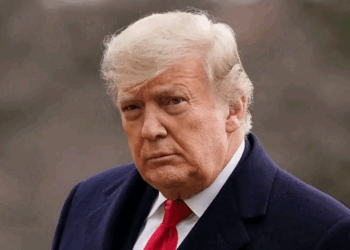
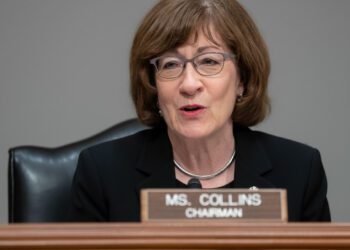
The prospect of federal law enforcement taking possession of ballots while an election is still underway was once regarded as highly unlikely in the United States. But with President Donald Trump intensifying his efforts to investigate alleged voter fraud, election officials and legal experts are now preparing for the possibility.
A state election official, who was not authorised to speak publicly, told NPR that the office had conducted three statewide training sessions this year to prepare for potential requests by law enforcement agencies to seize ballots or other election materials before voting had concluded.
The preparations come as the UCLA Safeguarding Democracy Project published a guide on Wednesday to assist judges handling search warrant affidavits involving election processes.
“Lots of things that were off the table are now on the table,” said Rick Hasen, director of the Safeguarding Democracy Project and lead author of the guide.
Trump has previously said he regretted not taking stronger action to have the federal government seize election equipment following the 2020 presidential election. This year, search warrants carried out in Fulton County, Georgia, and Riverside County, California, have already resulted in ballots being seized.
The developments have prompted election officials to consider what could happen if federal authorities seek access to ballots during closely contested races this autumn.
“This is the thing we really fear,” the state voting official, whose office conducted the trainings, said in an earlier interview with NPR. “[Say] we have really close races [in our competitive districts] then the DOJ, FBI come knocking on one of our county doors and they say, ‘We believe there’s hijinks going on, we’re going to confiscate all the ballots so we can count them.’”
If ballots were removed under a warrant before an election was certified, officials could face difficulties determining how many ballots had been returned and whether the seized materials had been altered.

Such a situation could disrupt what election authorities call the chain of custody, which tracks the handling of ballots from the time they are received until the election is completed.
“They could do so much damage if they did that,” the official said.
Legal experts, however, described widespread ballot seizures during an active election as an extreme and unlikely possibility. They noted that law enforcement would still need judicial approval before taking such action.
“Right now, the judiciary writ large has their antennae up, anticipating what might be coming down the pike,” said retired federal Judge Philip Pro, who served as chief judge of the District of Nevada. “They’re going to be prepared.”
Concerns Over Search Warrant Affidavits
The search warrant executed at the elections office in Fulton County, Georgia, has heightened concerns within the legal community, particularly over the information used to obtain judicial approval.
“Eventually we got to see the search warrant and it confirmed some of our worst fears,” Hasen said. “It contained information about potential fraud in Georgia that was based on discredited conspiracy theories.”
Hasen said magistrate judges, who commonly handle warrant applications, may not have specialised knowledge of election procedures. That could create challenges if judges are presented with questionable allegations amid a wave of election-related misinformation.
The UCLA guide therefore encourages judges to seek input from election administrators before approving warrants involving ballots.
“One of our key recommendations is to bring election administrators into the conversation,” Hasen said.
Retired Judge Maureen O’Connor, a former chief justice of the Supreme Court of Ohio, said warrant applications are normally considered privately, without a public hearing or testimony, limiting the opportunity for courts to thoroughly examine the claims presented.
She argued that greater transparency should be considered when a warrant could affect an ongoing election.
“This isn’t something that the judge has to just look the officer in the eye and say, ‘yeah, I think I can trust him,’” O’Connor said. “That deserves to be discussed in a courtroom on the record, with the judge asking questions of witnesses under oath and determining then, by the totality of the circumstances, whether there should be a warrant issued.”
O’Connor and Pro are members of Keep Our Republic, a nonprofit organisation focused on democracy and the rule of law. The group is among several civil society organisations preparing for possible federal intervention in the electoral process.
“[Judges] are going to be looking behind the curtain rather than simply relying on what is presented [in the affidavit] as being gospel,” Pro said.
Officials Warn Of Chain-Of-Custody Risks
Hasen said the guide was intended to remind judges of the potential consequences of approving a warrant while voting is underway, particularly because removing ballots from election officials’ custody could undermine confidence in the process.
He pointed to a 2025 mayoral election in Michigan in which the chain of custody was disrupted for only a few dozen ballots. The contest, which was decided by 11 votes, remains disputed.
Election officials fear that a similar controversy involving a closely fought congressional race could have far greater consequences, particularly if the result determines control of the US House or Senate.
“We want judges to understand you can’t unscramble the egg,” Hasen said. “Once the ballots have been taken out of the custody of election officials, there are at least going to be conspiracy theories that ballots have been altered or added to or removed.”
The UCLA guide recommends that judges consider alternatives before authorising law enforcement to seize ballots. These include delaying execution of a warrant until after election certification, determining whether copies or reproductions would meet investigative needs, or allowing investigators to observe ballot counting or a recount instead.
It also outlines procedures courts could follow if a warrant is ultimately approved.
Hasen said, however, that his preference would be for judges to explore other options before reaching that point.
“Because all the things to do, if that does happen,” Hasen said, “are really second-best solutions.”