Nigeria and the United States have signed a framework agreement aimed at strengthening cooperation in the country’s mining sector and developing its critical mineral resources.
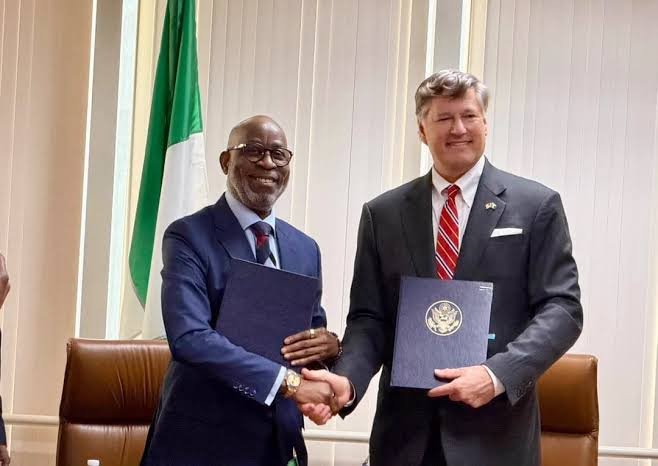
The agreement was signed and exchanged in New York on Wednesday on the sidelines of the 81st United Nations General Assembly by Nigeria’s Minister of Solid Minerals Development, Dele Alake, and US Deputy Secretary of State Christopher Landau.
The framework covers several areas, including geological data and exploration, mineral development and processing, infrastructure, as well as technical capacity building.
Reuters reported that Nigeria estimates the value of its mineral resources at about $700bn.
The agreement comes as the United States and China compete for access to Africa’s critical minerals, which are increasingly important to technologies such as electric vehicles, batteries and renewable energy infrastructure.
Chinese companies have already emerged as some of the leading foreign investors in Nigeria’s developing lithium industry.
Nigeria Seeks Greater Value From Minerals
For Nigeria, the agreement forms part of efforts to develop its largely underdeveloped mining industry and reduce the economy’s dependence on crude oil.
The country has deposits of lithium, tin, tantalum, niobium and other minerals that are becoming increasingly important to global supply chains covering batteries, electronics, renewable energy and defence.
The partnership could also provide the US with another potential source of critical minerals as Washington works to diversify its supply chains and reduce its dependence on China.
Alake said Nigeria was seeking to move beyond exporting raw minerals and instead develop industries capable of processing the resources locally.
“Our goal is to turn potential into lasting value at home through stronger local processing, new skills, quality jobs, and new opportunities for Nigerian businesses,” he said.
Landau described Nigeria as a regional power whose size and influence make it an important partner for the United States.
He said the agreement could contribute to increased prosperity for both countries and added that Washington was pleased to support Nigeria’s economic development.
The framework is expected to encourage business-to-business partnerships and promote a mining industry focused on adding value within Nigeria.
As implementation begins, Nigeria plans to identify commercially viable projects, attract investment and establish partnerships to support the development of its mineral resources.