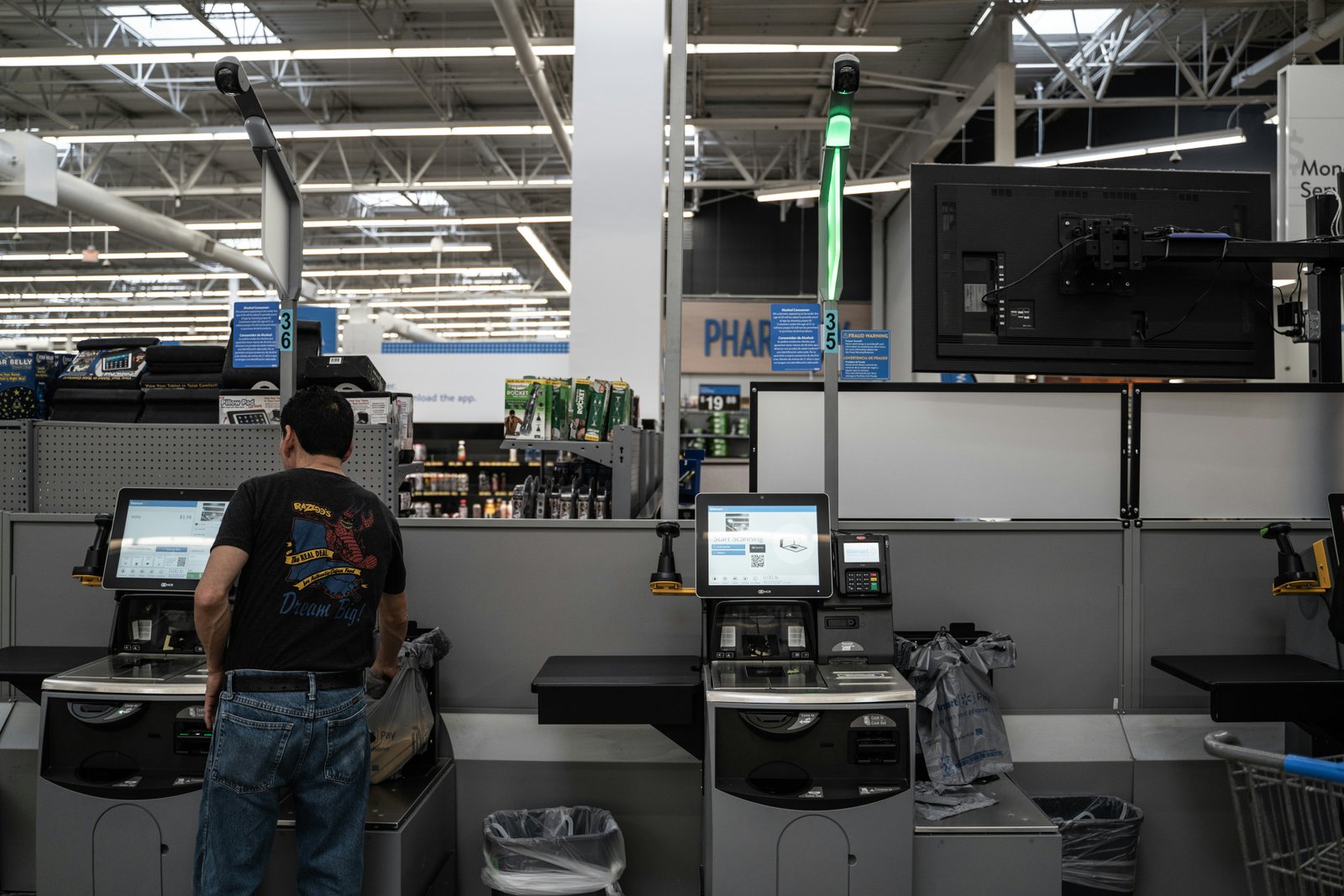

After years of installing self-checkout kiosks in stores across the country, major retailers are reversing course. Walmart, Target, Costco, and Dollar General are among the chains scaling back the technology, citing rising theft, customer frustration, and operational headaches.
Walmart has been removing self-checkout machines from stores in select test markets, including locations in South Philadelphia and Missouri, replacing them with traditional staffed lanes. A Walmart spokesperson said the changes are guided by feedback from customers and employees and are intended to “improve the checkout experience”.
The Theft Problem
The financial case for self-checkout is collapsing under the weight of losses. A June report from ECR Retail Loss found that grocery stores experienced an average 22% increase in merchandise losses in the year after installing self-checkout. Stores with self-checkout had average losses 33% higher than those without it.
Those losses include theft and accidental errors. Missed scans occur in between 1% and 4.8% of transactions, according to the ECR report. Retailers estimate that malicious behavior accounts for anywhere between 6% and 80% of missed scans — an enormous range that illustrates how difficult it is to distinguish deliberate theft from genuine mistakes.
Some stores have seen dramatic results. A Walmart location in Missouri removed all self-checkout machines after the kiosks led to 509 police calls in just five months.
The Customer Backlash
Shoppers have been vocal about their frustrations. A 2026 consumer sentiment survey found that many shoppers feel they are being “forced to work” for the stores they patronize without receiving a discount for their labor.
Social media has been flooded with complaints. One user wrote about the contradiction of scanning his own items only to be stopped for a receipt check: “You trusted me enough to do the cashier’s job, but now you need to check my work before I can leave? If you don’t trust customers to scan their own stuff, maybe don’t make self-checkout half the store”.
Another user complained about being watched while scanning: “I hate when Target and Walmart employees stand there watching me at self-checkout. Like, you can do this yourself! Why am I doing YOUR job while YOU watch me scan my own groceries and take my money?”.
The Rollback
The retreat is measurable. According to an April survey from Toast, 36% of small and midsize retail operators used self-checkout this year, down from 43% in 2025.
Dollar General removed self-checkout from approximately 12,000 stores in 2024. Sam’s Club, a division of Walmart, announced it would remove all self-checkout machines and roll out AI-powered “Scan & Go” technology. Costco has also begun rolling out similar technology but is not planning to axe self-checkout from all locations.
Some local governments are stepping in. In Long Beach, California, a 2025 ordinance required stores offering self-checkout to limit lanes to 15 items and maintain at least one staffed checkout lane. In New York City, a council member introduced legislation that would impose a 15-item limit and require one employee per every three self-checkouts.
The Counterargument
Not everyone believes self-checkout is dying. IHL Group, a retail research firm, argues that the narrative has it backwards. Their data shows that retailers growing sales fastest are more likely to keep self-service technology current, not abandon it. Self-service currency, they argue, is a leading indicator of a retailer’s overall technology modernization.
The ECR report also notes that customers have embraced the technology where it is available. More than half (54%) of all transactions now pass through self-checkout in stores where it is offered. The challenge, the report argues, is not whether self-checkout works, but how to make it work better — by designing systems that make accuracy easier for customers rather than trying to read their intent.
The Bottom Line
Major retailers including Walmart, Target, Costco, and Dollar General are scaling back self-checkout as theft losses rise and customers complain about doing the work of cashiers. Grocery stores with self-checkout see 22% higher merchandise losses. Some retailers are replacing kiosks with staffed lanes or AI-powered scan-and-go technology. Others argue the technology is not dying but evolving. The debate reflects a broader reckoning with automation that promised convenience but delivered frustration and loss.
My Opinion
Self-checkout was never about convenience for the customer. It was about cutting labor costs. Stores sold it as a faster, easier way to shop. But what they were really doing was shifting the work from paid employees to unpaid customers. You scan, you bag, you wait for a receipt check and you do it all while the store saves money on cashiers.
The backlash was inevitable. Customers noticed that they were doing the job and still being treated like suspects. They noticed that the machines break down, the bagging area is too small and yet when they needed help, there was no one around to ask.
Now the stores are reversing course, theft is up, customer satisfaction is down and the savings are not as big as they thought. That is what happens when you treat your customers like employees and your employees like overhead.
Self-checkout will not go away entirely. It will work in some stores for some customers. But the era of replacing half the checkout lanes with machines and calling it innovation is ending and that is a good thing.