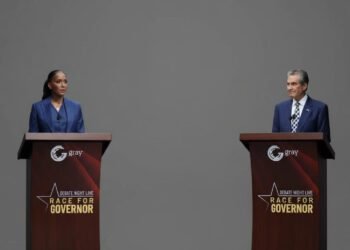
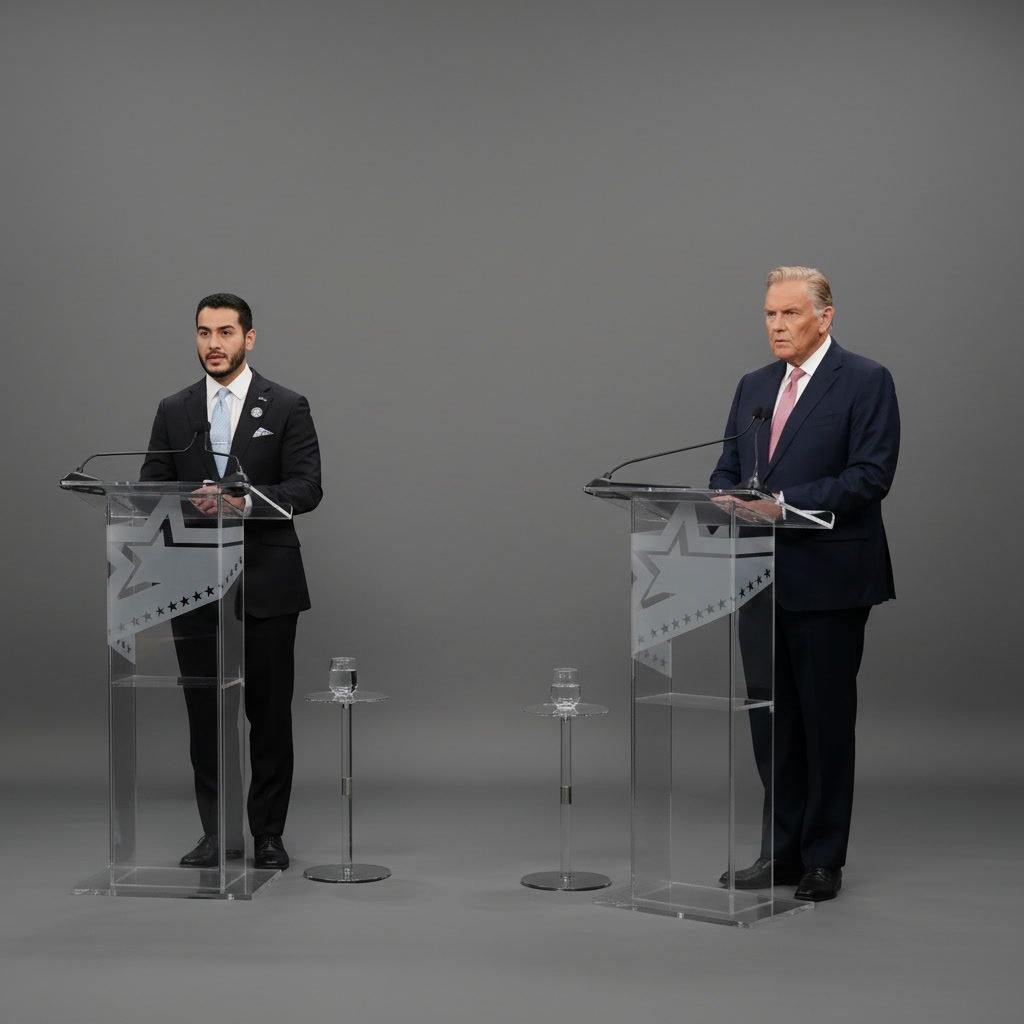
The first US Senate debate between Republican Mike Rogers and Democrat Abdul El-Sayed in Michigan was marked by personal attacks, heated exchanges and disagreements over President Donald Trump, immigration enforcement, and foreign policy.
The debate, hosted by Nexstar’s Grand Rapids station and NewsNation, became so intense that the arguments reportedly continued during a commercial break.
“In 30 years of doing debates, I’ve never seen it continue during the commercial,” WOOD TV moderator Rick Albin said. “But it did.”
The candidates traded accusations over corporate and foreign influence, their professional backgrounds and their ties to Trump. While El-Sayed sought to make the contest a referendum on the president, Rogers attempted to portray himself as bipartisan and accused his Democratic rival of dishonesty.
The exchange came after El-Sayed appeared alone at a debate last month when Rogers declined to participate, accusing the host outlet of bias.
The two candidates are scheduled to meet again on October 21 in a debate organised by WXYZ-TV.
Candidates Trade Personal Attacks
Personal criticism featured prominently throughout the debate, with both candidates questioning each other’s credibility and political positions.
El-Sayed repeatedly challenged Rogers over his relationship with Trump, at one point telling the Republican to “be serious, my guy”. He also criticised Rogers over his previous residence in Florida, suggesting that he was not sufficiently committed to Michigan.
When asked whether he would support providing Israel with defensive weapons if the country came under attack, El-Sayed said Michigan’s resources should be prioritised locally.
“I’ve been absolutely clear. I want our tax dollars spent here to provide schools here, and by here, I mean Michigan, not Florida,” El-Sayed said.
The Democrat also described Rogers as a “rubber stamp” for Trump and accused him of being beholden to corporate interests.
Rogers, meanwhile, questioned El-Sayed’s use of the title of doctor. El-Sayed holds a medical degree from Columbia University and a doctorate in public health from Oxford University, but has previously faced scrutiny for describing himself as a physician despite not practising medicine.
“And the doctor — well, he’s not really a doctor.” Rogers said during the debate.
“Matter of fact, if somebody came into his office and he tried to treat that patient, he’d go to jail. So, listen to this guy and what he’s trying to sell here today,” Rogers added later.
The Republican also alleged that El-Sayed and his family had connections to the Muslim Brotherhood. Rogers’s campaign has previously cited political donations to El-Sayed from people it linked to the organisation and claimed that the Democrat had “pledged his support” to the group.
However, Bridge Michigan reported last month that there was no evidence that El-Sayed had direct ties to the Muslim Brotherhood or had pledged support to it.
During a discussion about safeguards for surveillance cameras, Rogers spoke about programmes intended to identify suspected terrorists before appearing to suggest that El-Sayed might have a family connection to terrorism.
“Those programs were really, really important in catching people who were suspected of being terrorists and being terrorist — committing a terrorist act, that’s really, really important,” Rogers said.
“And why would that bother you? Well, if you have someone in your family that might be on —” Rogers added.
El-Sayed interrupted him, challenging the Republican to make his implication explicit.
“Go ahead and say it,” El-Sayed said, adding, “You’ve been tiptoeing around it the whole time, just say it.”
El-Sayed Makes Trump A Central Issue
El-Sayed repeatedly brought Trump into the discussion, arguing that the central question for Michigan voters was whether their next senator would challenge the president.
“It’s about whether or not you trust your next U.S. senator to stand up to Trump and Trumpism,” El-Sayed said.
“But when you’re running because Donald Trump called you and asked you to run, you can tell he’s not going to stand up to anybody,” he added.
The Democrat also referred to Rogers as a “sock puppet for the Trump administration” while discussing the Republican’s position on Trump’s war in Iran.
Rogers, who has received Trump’s endorsement, has sought to balance his relationship with the president with positions that differ from the administration on certain issues.
Earlier in the week, Rogers called for an end to the trade war with Canada. He had also previously advocated ending the conflict in Iran.
During the debate, Rogers said he had contacted Commerce Secretary Howard Lutnick to push for an agreement on tariffs with Canada.
“I would like to see the deal made,” he said, later adding that, “Canada still has some high tariffs for U.S. goods, and they did it before this started. Those should be eliminated. There are tariffs that I think are too high and not helpful for us. We ought to get rid of those.”
Rogers Criticises Minnesota Immigration Crackdown
Rogers also expressed reservations about the Trump administration’s immigration enforcement operations in Minnesota, suggesting that some of the tactics used by US Immigration and Customs Enforcement had been inappropriate.
“I think the public efforts in Minnesota were probably not appropriate. I actually did fugitive raids when I was an FBI agent in Chicago. You always want to go in quiet, get the bad guy, get out of the neighborhood for less problems,” Rogers said.
“So that’s — that to me was something that they could have done differently.”
The former congressman indicated that the enforcement tactics were subsequently adjusted.
The administration’s immigration crackdown has faced increased scrutiny following several shootings involving federal immigration officers, including two incidents in Minnesota. Critics have argued that the enforcement campaign has gone too far.
A man was also shot by an ICE officer in New York on Thursday, adding to the controversy surrounding the operations.
El-Sayed Declines To Choose Between Israel And Iran
Foreign policy produced another contentious exchange when El-Sayed was asked which country he considered the greater threat to the United States: Iran or Israel.
The Democrat repeatedly resisted choosing between the two, arguing that the question oversimplified the situation before describing both countries as dangerous in different ways.
“I’m just going to say that that’s a ridiculous hypothetical because here’s what’s happening right now: Our ostensible ally in Israel has lobbied us to go to war with Iran,” El-Sayed said.
“We have watched as Iran has responded by bombing all kinds of countries in the Middle East and then choking off the world’s energy supply. So, this is a situation in which I don’t think we should be a part.”
When pressed again, El-Sayed criticised the question before outlining his view of the two countries.
“I think both of them have proven dangerous in their own way. One at risk of attacking us. One getting us into wars we have no business fighting,” he said.
The debate highlighted the candidates’ differing approaches to Trump, immigration and foreign affairs, with personal accusations frequently interrupting discussions of policy ahead of their next scheduled encounter on October 21.