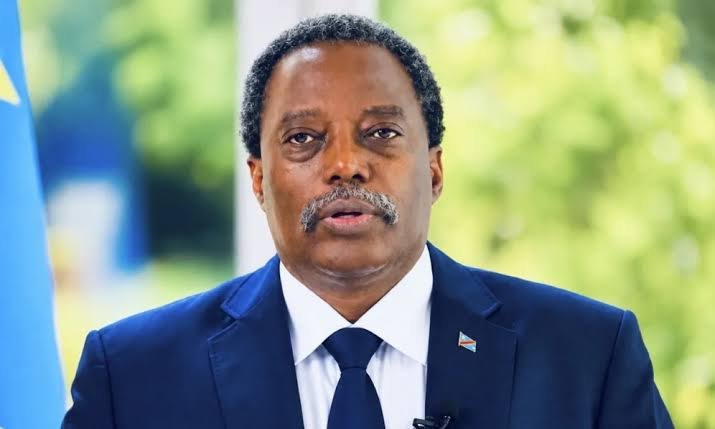
Former Democratic Republic of Congo President Joseph Kabila has returned to the centre of the country’s conflict, this time as the leader of a rebel alliance seeking to remove President Félix Tshisekedi, the man he once helped bring to power.
Kabila, 55, previously served as a commander in the rebel movement that overthrew Mobutu Sese Seko in 1997 and installed his father, Laurent Kabila, as president. He succeeded his father in 2001 following his assassination and governed the country for 18 years before handing over power to Tshisekedi.
The former allies later formed a coalition government, but their relationship deteriorated after Tshisekedi moved to end Kabila’s political dominance in parliament in December 2020.
Kabila’s appointment earlier this month as leader of the Front for the Refoundation of the Nation (FRN) has confirmed longstanding suspicions that he was working with the M23 rebels, who have captured large parts of eastern DR Congo, including the major cities of Goma and Bukavu.
The development has triggered concern across the country, which holds significant deposits of gold, diamonds and minerals essential for producing mobile phones and electric vehicle batteries.
For Kabila, the alliance could provide an opportunity to regain political influence. The M23, on the other hand, stands to benefit from the experience and political connections of a former head of state, although its military gains have not translated into widespread national support.
It remains uncertain whether the alliance can achieve its objective of removing Tshisekedi from office.
Policy analyst Henry-Pacifique Mayala told the BBC that Kabila had limited options for returning to political relevance.
“He actually was left with no other choice,” he said.
Kabila faces a death sentence after being convicted in absentia of treason and is also under United States sanctions over allegations that he supported the M23 rebels.
Mayala suggested that the former president may have secured assurances before joining the alliance, adding that the rebels’ military strength could improve his bargaining position in any future negotiations with the government.
“I’m not sure that he is making this huge leap in the dark without having received considerable assurance,” he said.
Kabila’s involvement has also raised questions about the possibility of the conflict spreading beyond eastern DR Congo. The M23’s territorial advances have largely been restricted to the eastern provinces, about 1,500km from the capital, Kinshasa.
Although Kabila’s political networks could give the rebellion a wider national presence, there is no certainty that the group has the military capacity to extend its operations across the country.
His influence in Kinshasa is also unclear. During his presidency, Kabila was often regarded as an outsider in the capital, where Lingala is widely spoken. He was more comfortable communicating in Swahili, the dominant language in parts of eastern DR Congo and several East African countries.
His father’s rebel movement had travelled across the country from the east over seven months before capturing Kinshasa in May 1997 and removing Mobutu, who had ruled for more than three decades.
Although there is little indication that Kabila’s FRN intends to replicate that military campaign, the former president recently compared Tshisekedi’s leadership to Mobutu’s rule.
“You have a tyrant who wants to impose and dictate what he thinks is right and not necessarily follow the constitution, which is the supreme law of the land,” he told Conspiracy Trackers Great Lakes, a research group supportive of the M23.
Kabila accused the government of using the death penalty, reinstated after a moratorium introduced during his presidency, to intimidate civilians, politicians, military personnel and himself.
“This is personal,” he said.
He also presented his opposition to Tshisekedi as a struggle against authoritarianism, referring to Section 64 of the country’s constitution. The provision calls on citizens to resist anyone who takes power or exercises it in violation of constitutional rules.
There have been reports that Tshisekedi may seek constitutional changes to enable him to pursue a third term. An opposition coalition known as C64, named after Section 64, has been campaigning against such a move.
However, the coalition has declined to support Kabila’s rebellion, arguing that the country’s security challenges cannot be resolved through military action alone. It instead announced plans to pursue direct discussions with both leaders as part of what it described as a “genuine and inclusive national dialogue”.
Richard Moncrieff, a Great Lakes analyst at the International Crisis Group, said Tshisekedi still held considerable political and military advantages.
“Tshisekedi has strong American backing. He has a lot of money. And he generally controls the political system and, as far as we can see, the military system,” Moncrieff said.
Tshisekedi, in his first public response to Kabila’s appointment as FRN leader, accused his predecessor of lacking concern for the country and its people.
“In my view, it’s simply proof that he has never loved this country, and even less its inhabitants,” he said last week.
Kabila is also widely believed to have played a role in Tshisekedi’s emergence as president after the disputed 2018 election, rather than opposition candidate Martin Fayulu, whom leaked results provided by the Catholic Church indicated had won.
Corneille Nangaa, the former head of the electoral commission who announced Tshisekedi as the winner, later claimed that an agreement had been reached between Kabila and Tshisekedi before the final results were declared. Nangaa is now one of Kabila’s deputies in the FRN.
“I can confirm that I helped draft the deal,” Nangaa told France 24 in September 2023. “Tshisekedi is a liar. He knows there was an agreement and he knows what was contained in the deal.”
Tshisekedi has consistently maintained that he won the election legitimately.
Following the disputed poll, Kabila and Tshisekedi established a power-sharing arrangement that allowed Kabila’s coalition to retain control of parliament after the new president assumed office in January 2019.
The agreement collapsed in December 2020 when Tshisekedi moved to dismantle his predecessor’s parliamentary influence and establish his own majority. Their relationship subsequently broke down, forcing Kabila into self-imposed exile in South Africa.
While abroad, Kabila became increasingly critical of the government. He returned to DR Congo in 2025 and was seen in Goma, which was under rebel control. In September of the same year, a military court sentenced him to death in absentia over charges that included treason and financing violence in the east. He rejected the allegations.
Kabila’s new position has also drawn attention to his complicated relationship with Rwandan President Paul Kagame.
Relations between DR Congo and Rwanda were strained during the early years of Kabila’s presidency. Rwanda accused its neighbour of failing to remove ethnic Hutu militias linked to the 1994 Rwandan genocide from its territory. The presence of the armed groups has repeatedly been cited by Rwanda as justification for its military involvement in eastern DR Congo.
The M23 emerged in 2012, claiming to defend the rights of ethnic Tutsis and protect them from the militias. It also fought against the Congolese army, which was then under Kabila’s leadership.
Rwanda was accused from the outset of supporting the group but has consistently denied the allegations, despite evidence cited by international observers.
Relations between Kinshasa and Kigali later improved, with Kabila’s administration cooperating with Rwanda against the Hutu militias.
Alex Adams, Africa programme director at the European Council on Foreign Relations, said Kabila’s leadership of the rebellion could bring his political interests closer to Kagame’s security objectives, even though both men may have different priorities.
“Kabila wants to recover political influence nationally, while Kagame is primarily concerned with Rwanda’s security and strategic position in eastern Congo. This is an alignment of convenience rather than a partnership built on deep trust,” he said.
Mayala also suggested that Kabila’s involvement could help Rwanda respond to accusations that it was interfering in DR Congo’s domestic affairs.
“This is a former president. It’s finally a Congolese rebellion,” he said.
Fighting in eastern DR Congo has continued despite a peace agreement overseen by United States President Donald Trump last year. Under the arrangement, the US also secured an agreement to access the country’s mineral resources.
Washington has since imposed sanctions on several Rwandan officials and organisations, accusing them of contributing to the continuation of the conflict. The US has also appeared to align itself with Tshisekedi’s government.
With elections scheduled for 2028, Tshisekedi has warned that the ongoing violence in the east could disrupt the electoral timetable.
Kabila, meanwhile, has questioned whether elections alone can resolve the country’s political problems, suggesting that a more fundamental political transformation may be necessary.
“Does Congo need elections or a revolution?” he asked, arguing that lasting stability would require changes to the country’s executive and legislative structures.
International security analyst Ovigwe Eguegu said Kabila appeared to be relying on military force to regain political relevance, while Tshisekedi was seemingly seeking to remain in power beyond the constitutional limits.
“It looks like the Congolese people are going to lose either way, because neither of these two sides present a credible economic transformation plan for both the eastern Congo and the entirety of the country,” Eguegu said.