


The battlefield of the future has arrived, and it’s rolling on tank treads across the frozen mud of eastern Ukraine.
Since Russia’s full-scale invasion began three years ago, this war has been a laboratory for high-tech warfare. Drones swarm the skies. Uncrewed boats have crippled Russia’s Black Sea Fleet. Now, Ukraine is deploying thousands of armed ground robots to the front lines — and robot-on-robot battles are already happening.
“Robot wars are already occurring,” says Oleksandr Afanasiev, commander of the Ukrainian army’s K2 brigade UGV battalion — the world’s first, he claims.
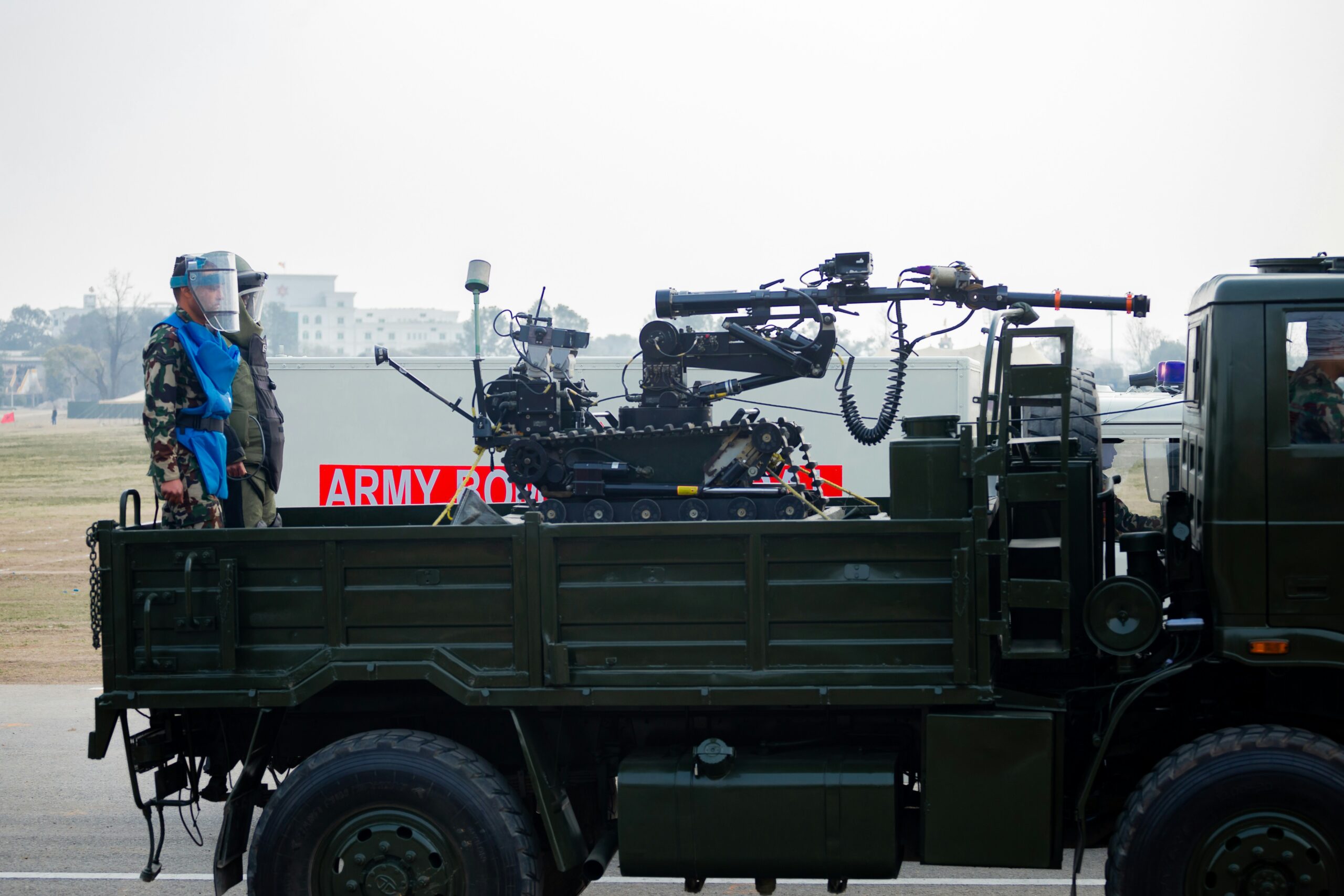
His battalion mounts Kalashnikov machine guns on uncrewed ground vehicles (UGVs) and sends them into battle where humans cannot survive.
“They open fire on a battlefield where an infantryman would be afraid to turn up. But a UGV is happy to risk its existence,” Afanasiev says.
The Robots of War
Ukraine’s lethal UGVs come in many forms:
· Machine gun carriers — remote-controlled platforms armed with Kalashnikovs, capable of engaging Russian positions from cover
· Kamikaze UGVs — battery-powered, explosive-laden vehicles that silently approach enemy hideouts and detonate
· Grenade launcher platforms — armed with automatic grenade launchers for indirect fire support
· Mine layers and wire spoolers — deploying obstacles to channel enemy movement
Unlike aerial drones that buzz overhead, these ground robots make no sound approaching their targets. They creep forward silently, carrying death.
The deputy commander of the 33rd Detached Mechanised Brigade’s tank battalion, who goes by the callsign Afghan, claims one Ukrainian UGV armed with a machine gun ambushed a Russian personnel carrier, while another robot defended a Ukrainian position for weeks.
The Human in the Loop
For now, most UGVs are remotely controlled by operators over the internet from safe positions kilometers away. The decision to fire remains human.
“Robots can misidentify the wrong person or attack a civilian. That’s why the final decision must be made by an operator,” Afghan says.
But autonomy is creeping in. UGVs can move on their own, observe, and detect enemy positions. The ethical boundaries are self-imposed — for now.
Valerii Zaluzhnyi, Ukraine’s former commander-in-chief and now ambassador to the UK, predicts a future where strike UGVs operate not just alone but as part of large, AI-powered swarms.
“In the near future we’ll see dozens and even hundreds of smarter and cheaper drones attack from various directions and heights, from the air, ground and sea at the same time,” he told London’s Chatham House think tank.
Why Robots Now?
Necessity drives innovation. Aerial drones have expanded Ukraine’s “kill zone” to 20-25 kilometers from the line of contact. Humans cannot safely operate in that space.
Infantry remains irreplaceable, Afanasiev says, but “it needs to be supported by UGVs. Ukraine can afford to lose robots, but it simply cannot afford to lose battle-ready soldiers.”
Manpower shortages plague Ukraine’s military. Recruiting replacements for fallen soldiers grows increasingly difficult. Robots fill the gap.
Russia’s Robot Army
Russia is not standing still. Its forces have deployed the Kuryer combat UGV, which can be equipped with flamethrowers or heavy machine guns normally found on tanks, with five hours of autonomous operation.
The Russian army also uses Lyagushka (“Frog”) kamikaze vehicles to blow up Ukrainian positions.
Clashes between Russian and Ukrainian killer robots are inevitable, says Yuriy Poritsky, CEO of Ukrainian UGV manufacturer Devdroid, which produced hundreds of “strike droids” for the military last year.
“Sooner or later, we’ll end up in a situation where our strike UGV will come up against their strike UGV on the battlefield. Robot wars may sound like science fiction, but there’s nothing sci-fi about the battlefield. It’s our reality.”
His company is working on systems that would enable ground drones to return automatically if communications with operators are lost. Further ahead, they want machines programmed to travel autonomously to locations, carry out tasks — including engaging enemy soldiers — and return to base.
The Coming Wave
Another Ukrainian manufacturer, Tencore, produced more than 2,000 UGVs for the army in 2025. Director Maksym Vasylchenko expects demand to jump to around 40,000 units in 2026, with at least 10-15% armed with weapons.
“Strike drones will become indispensable, there’s no question about it,” he says.
Further ahead, Vasylchenko believes robots will engage in combat in human form. “It won’t be science fiction anymore.”
What Comes Next
The front lines of Ukraine have become a testing ground for the future of warfare. Drones in the air. Boats on the water. Now robots on the ground.
More than 7,000 UGV missions were conducted in January alone. Armed robots have already taken prisoners, ambushed armored vehicles, and defended positions for weeks without human presence at the site of battle.
The robot wars are here. And they’re only getting started.