Ghana has announced plans to seek membership of BRICS as the West African country looks to expand its economic and geopolitical partnerships with emerging economies.
Ghana’s Foreign Affairs Minister, Samuel Okudzeto Ablakwa, disclosed the government’s decision in Accra on October 6 during a joint press briefing with visiting Indian External Affairs Minister S. Jaishankar.
Ablakwa said the decision followed a strategic determination by the Ghanaian government to broaden its international partnerships while keeping the country’s national interests at the centre of its foreign policy.
“On the occasion of this important visit, I announced Cabinet’s strategic decision to apply for BRICS membership. The Government of Ghana is determined to position Ghana as a reliable friend to all as we expand our geopolitical and economic frontiers, anchored fundamentally on our national interest and freedom of choice in this fast-evolving multipolar world,” Okudzeto Ablakwa said in a post on X.
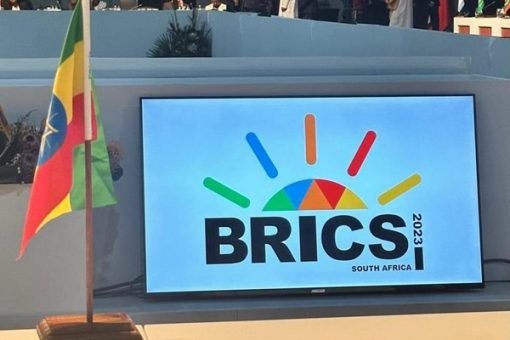
BRICS currently has 11 full members: Brazil, Russia, India, China, South Africa, Egypt, Ethiopia, Indonesia, Iran, Saudi Arabia and the United Arab Emirates.
An NDTV analysis of International Monetary Fund data projects that the bloc will account for about 41 per cent of global gross domestic product in 2026 when measured by purchasing power parity. The corresponding figure for the G7 is estimated at about 28 per cent.
On a PPP basis, the BRICS economies are projected to generate approximately $91tn in economic output, potentially giving Ghana access to a grouping that includes some of the world’s largest emerging economies.
Ablakwa stressed that Ghana’s move towards BRICS should not be interpreted as an attempt to abandon its existing relationships with Western countries, institutions or traditional development partners.
“BRICS offers us that opportunity to have options in development,” he said, adding: “We must have new friends.”
The minister identified India, China and Brazil as key economic partners for Ghana, noting a significant increase in trade between Ghana and India.
According to Ablakwa, Ghana’s trade with India rose from around $3bn in 2024 to approximately $7bn.
President John Mahama also highlighted the expansion of Ghana’s exports to India during his discussions with Jaishankar in Accra.
Beyond expanding trade, the Ghanaian government wants stronger cooperation with emerging economies to help transform the country’s natural resources into higher-value products.
Ablakwa said Ghana was pursuing what he described as “resource sovereignty”, with the aim of developing partnerships that would allow the country to move beyond the export of raw materials.
For India, Jaishankar said New Delhi was supportive of Ghana’s ambitions but noted that any decision on membership would ultimately require consideration by the wider BRICS grouping.
Ghana’s announcement is therefore the beginning of a formal process rather than an immediate admission into the bloc. The country will still have to submit its application and obtain the necessary support from existing BRICS members.
If its bid is successful, Ghana would become the fourth full African member of BRICS, joining South Africa, Egypt and Ethiopia.