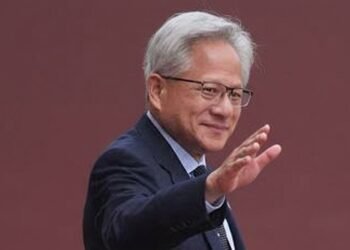
Elon Musk and more than 165,000 other people in the technology industry have signed an open letter urging Nvidia’s board to reinstate Jensen Huang as chief executive, days after his resignation from the artificial intelligence chipmaker.
The petition calls on the company’s directors to reconsider their decision and allow an independent investigation to establish the facts surrounding the circumstances that led to Huang’s departure.
The former CEO stepped down on Thursday, bringing an end to his 33-year leadership of the multi-trillion-dollar company he co-founded. His resignation followed reports that he had engaged in at least two extramarital relationships, including one with a woman accused of spying for China and another with an employee.

The controversy has also attracted attention from US lawmakers across party lines, with several demanding that Huang and Nvidia appear before Congress to address possible national security implications.
Some members of President Donald Trump’s Republican Party have also questioned what the administration knew about Huang’s alleged relationship with the suspected Chinese spy.
The Financial Times reported that Huang had discussed the possibility of returning to Nvidia with people close to him.
According to the report, one of his allies said a group of influential Silicon Valley executives was assembling a “war room” to campaign for his reinstatement, with plans to seek backing from the White House.
“Everyone that matters in tech outside the frontier labs loves Jensen,” the ally said, adding that Huang supported the effort.
Two major Nvidia shareholders, Brad Gerstner and Gavin Baker, also called on the company’s board on Friday to keep “all options” open regarding its leadership.
However, US Treasury Secretary Scott Bessent expressed a different position on Sunday, suggesting that Nvidia should consider appointing someone from outside the company as its next chief executive.
“They need a dramatic shake-up,” Bessent said during an appearance on Fox News.
Bessent also urged Nvidia to clarify whether it knowingly allowed its most advanced artificial intelligence chips to reach China, arguing that the issue was more significant than Huang’s reported relationship with the woman suspected of spying for Beijing.
The United States has restricted the sale of its most advanced AI chips to China as part of efforts to maintain its technological advantage over Beijing.
Although Trump approved the sale of Nvidia’s H200 chips to China in late 2025, the restrictions remain in place for more advanced processors used to power sophisticated AI models.
“Nothing above the H200s can be sold to the Chinese,” Bessent said, stressing the need to determine “whether Nvidia had a culture of compliance around the US export restrictions”.
He added that he expected Nvidia to provide answers concerning its internal investigation into Huang’s conduct within the next 10 days.
Among the prominent figures who signed the petition alongside Musk are Epic Games founder and CEO Tim Sweeney and Y Combinator president Garry Tan.
Uber co-founder Travis Kalanick also defended Huang, acknowledging that he had made mistakes but arguing that they did not justify removing him from the company he established.
Kalanick wrote that Huang had “erred, yes – to err is to be human – but I do not believe anything he has done rises to the bar of separating him from his company”.
The petition has also attracted support from Nvidia employees, with more than 7,500 signatories identifying themselves as members of the company’s workforce. That figure represents approximately 18 per cent of its employees.
The widespread support highlights Huang’s influence within the technology industry, where he is regarded as one of the leading figures behind the expansion of artificial intelligence.
Under his leadership, Nvidia grew into a major force in the AI sector, investing in data centres and emerging technology companies. Its influence in the industry earned it the nickname “the central bank of AI”.
Despite its success, the company has faced criticism over concerns that its investments and the rapid expansion of artificial intelligence could contribute to a speculative market bubble.
Huang has also opposed efforts to place restrictions on the AI race, a position that has brought him into disagreements with Anthropic, the company behind Claude, and its chief executive, Dario Amodei.