

Democratic Leader Hakeem Jeffries has secured his party’s nomination for the next Speaker of the US House of Representatives, positioning him to take the leadership role when Democrats assume control of the chamber in January.
Jeffries received 251 votes against 11 during a closed-door meeting on Wednesday, where current and incoming Democratic lawmakers also selected other members of their leadership team.
The caucus elected Representative Katherine Clark of Massachusetts as the next majority leader, making her the first woman to occupy the position.
Although the Speaker is formally elected by the entire House at the beginning of a new Congress, Jeffries is widely expected to secure the required 218 votes, with Democrats projected to control more than 250 seats.
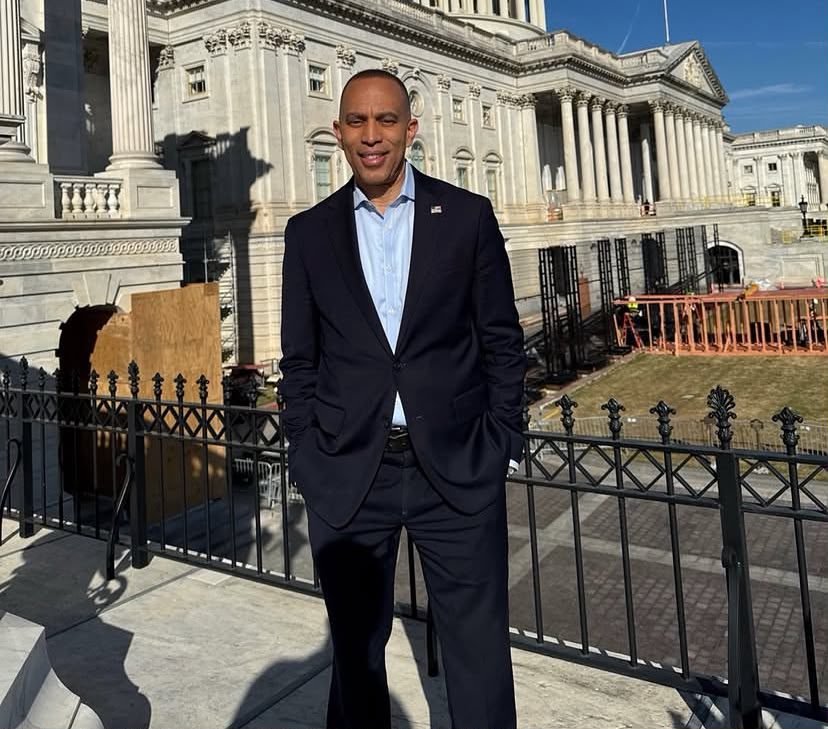
If elected, the New York Democrat would make history as the first Black person to serve as Speaker of the House.
However, his nomination was not without opposition, as some incoming progressive lawmakers expressed reservations ahead of Wednesday’s internal election.
Seven newly elected progressives who voted against Jeffries said they wanted firm policy commitments from him on several issues, including healthcare, immigration enforcement, campaign finance and the conflict in Gaza.
In a joint statement, they said, “Whether on Medicare for All, stopping ICE terror, getting money out of politics, or ending the genocide in Gaza, our constituents sent us to Congress with a mandate on these issues. We have worked to secure commitments from Leader Jeffries in good-faith conversations.
“While we have seen meaningful progress, there is still work to be done to ensure that the direction our party takes this coming Congress reflects what our constituents are demanding of leadership.”
The lawmakers who issued the statement were Darializa Avila Chevalier of New York, Adam Hamawy of New Jersey, Frederick Haynes of Texas, Melat Kiros of Colorado, Donavan McKinney of Michigan, Chris Rabb of Pennsylvania and Claire Valdez of New York.
Despite their opposition, no other Democratic lawmaker entered the race to challenge Jeffries directly. His party’s expected majority in the House also limits the influence individual members can exert in seeking concessions.
Jeffries had earlier indicated that he preferred a recorded vote for the nomination rather than an uncontested approval by acclamation.
Speaking to reporters on Tuesday, he said the party should follow the same procedure it adopted during its 2018 leadership elections, when Democrats moved from minority to majority status.
“Certainly seems to me it would be appropriate that we take exactly the same approach to give every single person the opportunity to weigh in one way or the other on who the caucus feels is best positioned based on track record, experience, vision,” Jeffries said.
During Wednesday’s meeting, House Democrats also selected lawmakers to occupy other key leadership positions for the incoming Congress.
Representative Pete Aguilar of California was elected Democratic whip, while Joe Neguse of Colorado secured the position of assistant speaker. Representative Ted Lieu of California was also elected chairman of the Democratic caucus.
The House Democrats’ leadership contest was considerably less divisive than the ongoing struggle within their party in the Senate.
Long-serving Democratic leader Chuck Schumer is facing a challenge from Senator Chris Van Hollen as the party prepares to select its next Senate majority leader.
Schumer, however, has expressed confidence that he has enough support to retain the position in the leadership election scheduled for early next month.