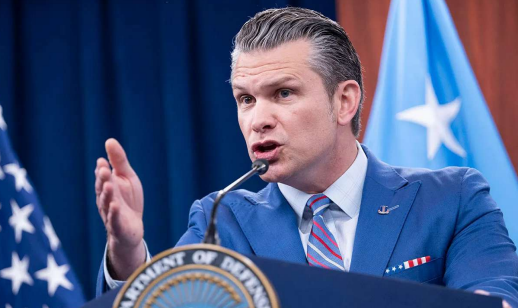
The Navy had selected 31 sailors to promote from captain to one-star admiral. The list was approved by Navy leaders, the chairman of the Joint Chiefs of Staff, and the then-Navy secretary. Then Defense Secretary Pete Hegseth intervened.
He struck nine people from the list — including all of the women.
As a result, the Navy is not promoting a single woman to the one-star admiral rank this year, even though women make up about one-quarter of all Navy officers and nearly one-third of the sea service’s midgrade ranks, according to military data from 2024.
Several female officers now say they see the unusual intervention as a sign that their careers have hit a ceiling. They worry for the future generation of female military leaders.
‘A Ceiling Has Been Placed’
The Associated Press spoke with eight female Navy officers of varying ranks and time in service after Hegseth’s cuts became public. They spoke on condition of anonymity out of fear of retribution from their superiors.
The more junior officers said they saw the development as a sign that their careers would become politicized if they rose too far in the ranks. Some said they felt they now had a limit on how far they could be promoted. Others said it made them feel less valued within the military and wondered whether that was not part of the intent.
One officer said the impact was not confined to women. In conversations with other sailors in her unit, she said male sailors were hesitant to deal with what appears to be a growing politicization of simply following the orders of previous administrations.
The Pentagon’s Response
The Pentagon has not offered any rationale for why the women, or any of the other six people, were removed from the promotion list.
Sean Parnell, the Pentagon’s top spokesman, said on social media this week that “military promotions are given to those who have earned them” and that the Pentagon “will never consider the color of a service member’s skin or their gender as a factor in promotions.” The Pentagon did not immediately respond to a request seeking further comment.
But Hegseth has long argued, without offering evidence, that women in the military benefit from preferential treatment and are not suited for combat roles.
“For too long, we’ve promoted too many uniformed leaders for the wrong reasons based on their race, based on gender quotas, based on historic so-called firsts,” Hegseth told hundreds of military leaders in September. The approach, he asserted, made the Pentagon “less capable and less lethal.”
The Navy’s Process
The Navy’s process for choosing which officers to promote to the one-star rank has been relatively constant and transparent over the years. The service convenes a group of officers, called a promotion board, that examines the records of eligible officers and chooses the most qualified.
The board that selected the initial slate of 31 officers for promotion was directed by then-Navy Secretary John Phelan, a Trump appointee, to “recommend for promotion the best qualified officers within their respective competitive category.”
Phelan’s order said the Navy cannot discriminate based on criteria such as race and sex, and it specifically noted that “this guidance shall not be interpreted as requiring or permitting preferential treatment of any officer or group of officers on the grounds of race, religion, color, sex.”
The full list of 31 people to be promoted was approved by Phelan, other Navy leaders, and the chairman of the Joint Chiefs of Staff, Gen. Dan Caine, before it reached Hegseth, who chose to make the changes.
An Unusual Intervention
While Hegseth is within his rights to intervene in the list, “it’s just not the norm,” said Katherine Kuzminski, a researcher specializing in military recruiting and retention at the Center for a New American Security.
Kuzminski noted that “this is a decision that’s not being made by the U.S. Navy — it’s being made by the secretary of defense” and said Hegseth’s growing interference in operational aspects of the military services such as promotions is creating “tension” about what “normal” will look like going forward.
Some of the more senior Navy officers who spoke with the AP expressed concerns about the message it sends to the next generation of young sailors.
In addition to pulling the recent promotions of three women to admiral, Hegseth, shortly after he took office, fired Adm. Lisa Franchetti, the service’s top officer and the first woman to hold the job. He never explained his rationale. Since then, he also has fired two other female three-star admirals without explanation.
The Message to Future Generations
Some of the officers who spoke to the AP said that while they were encouraging female sailors to stick with the Navy, they acknowledged that message is coming at a difficult time.
Kuzminski said the rhetoric and actions surrounding women in the military “affects individual service member decision-making and it also affects family unit decision-making,” including whether people make a career of the military.
Following the month-long hold on military promotions by Sen. Tommy Tuberville during the Biden administration, surveys showed that partisan politics spilling into the day-to-day lives of troops affected their decision-making.
The Bottom Line
Defense Secretary Pete Hegseth removed nine Navy officers from a captain-to-admiral promotion list, including all of the women. As a result, no women will be promoted to one-star admiral this year. Female officers say they now fear a “career cap” and that their advancement has become politicized. Hegseth has long argued that women in the military benefit from preferential treatment and are not suited for combat roles. The Pentagon has not explained why the women were removed. The unusual intervention has created tension about the future of military promotions.