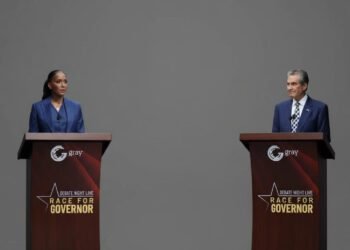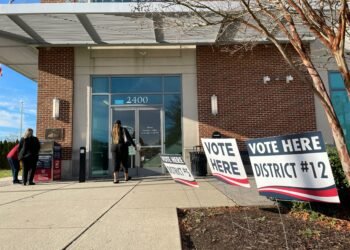

Nearly 30 House members who were sworn in at the start of this Congress have launched campaigns for other, more prestigious offices. Voters have not been especially interested in granting them promotions.
The trend was on full display in recent weeks. Representative Randy Feenstra lost the GOP nomination to be Iowa governor Tuesday despite a late endorsement from President Donald Trump. Representative Dusty Johnson fell short in his bid for governor of South Dakota. A week prior, Representative Chip Roy lost a runoff to be Texas attorney general.
House Democrats have been similarly hapless. In the Illinois Senate primary, Representatives Robin Kelly and Raja Krishnamoorthi both lost to the state’s lieutenant governor. In Texas, Representative Jasmine Crockett fell to a state representative in the Democratic Senate race.
The pileup of losses is staggering. And the lawmakers who have been on the campaign trail have a simple explanation: It is hard for members of a dysfunctional and unpopular institution to ask voters to reward them with even bigger jobs.
“There’s definitely those out there who think, ‘Well, it’s broken, and they’ve been in it a long time, and obviously it’s still broken,’ so we kind of get the blame for it,” said Representative Buddy Carter, who fell short last month in Georgia’s Republican Senate primary.
The Toxicity of Washington
If congressional service was once considered a helpful asset — half of last year’s elected freshmen senators served previously in the House — members now fear that their time on Capitol Hill has become politically toxic.

In the races House members are losing, state-level officials and political outsiders have found more success.
“The voters all across the country aren’t particularly fond of D.C., so are you perceived to be part of the establishment or someone that’s been battling it?” said Representative David Schweikert, who is now running for the GOP nomination for Arizona governor.
As he spoke to a reporter in the Capitol, he held a mug with the words, “I’d rather be in Arizona.”
Other House members are finding long odds as they look for seats in the Senate or in state houses — even as some distance themselves from their current positions. In Tennessee, GOP Representative John Rose has trailed Senator Marsha Blackburn in public polling even as he plays down his service in Washington. In one recent ad, he identified himself as “a father, a farmer and a CEO.” His website makes no mention that he is a sitting member of Congress.
The Exception That Proves the Rule
Not every House member is losing. Some have found success.
Representative Mike Collins advanced in the Georgia Senate primary that Carter lost and has led most polls of the GOP runoff. Representatives Andy Barr and Ashley Hinson are now the Republican Senate nominees in Kentucky and Iowa, respectively. Representative Julia Letlow is the favorite in a GOP Senate runoff in Louisiana. One Democrat sworn in for the 119th Congress, New Jersey’s Mikie Sherrill, is now governor.
But those successes stand out precisely because they are rare.
The ‘Anti-Incumbent’ Mood
The rest of the year is likely to be a mixed bag. GOP Representatives Kevin Hern of Oklahoma and Harriet Hageman of Wyoming appear well on their way to winning Senate nominations in solid red states. Polls show Representative Byron Donalds is on track to be Florida’s next governor. Trump-endorsed Representative Barry Moore is well-positioned to win an Alabama Senate seat if he can emerge from a competitive Republican runoff.
But Democratic Representatives Angie Craig of Minnesota and Haley Stevens of Michigan have struggled to break out in their respective Senate primaries. GOP Representative John James faces a tough general election in the Michigan governor race, as does Representative Tom Tiffany, a Republican running for governor in Wisconsin.
All of them will have to convince voters that their years of service in Washington are worth rewarding.
“People are anti-incumbent,” said one House Republican who is seeking reelection and was granted anonymity to speak candidly. “They’re mad. They want change across the board.”
The Impact on House Leadership
The pileup of losses could weigh even more heavily on House leaders who have struggled to get members to show up for votes in the closely divided chamber. Speaker Mike Johnson has already canceled multiple voting days this year to accommodate House members’ primary schedules, and the risk of no-shows is likely to increase.
Dusty Johnson, usually a reliable leadership ally, missed votes Wednesday just as a contentious effort to curb Trump’s military campaign against Iran hit the House floor.
The Bottom Line
Nearly 30 House members have launched campaigns for higher office this cycle. Most have lost. Voters are rejecting candidates they see as part of a “broken” and unpopular institution. State-level officials and political outsiders are winning instead. Some House members have succeeded, but they are the exception. The trend here is that being a member of Congress is no longer an asset on the campaign trail but a liability.