
The Independent National Electoral Commission has asked the National Assembly to approve N873.78 billion for the 2027 general elections, nearly three times what was spent on the 2023 polls, with N209 billion earmarked for technology upgrades including BVAS procurement and a N162.5 billion overhaul of the IReV portal.
INEC Chairman Prof. Joash Amupitan submitted the proposal Thursday before the joint Senate and House Committee on Electoral Matters, warning that subjecting the commission to rigid funding caps could undermine critical reforms and expose Nigeria to “avoidable crises”.
“This budget is prepared in line with Section 3(3) of the Electoral Act 2022, which mandates the Commission to prepare its election budget at least one year before the general election,” Amupitan told lawmakers.

The Breakdown
The N873.78 billion proposal is divided into five components:
· Election operations: N375.75 billion
· Election technology: N209.21 billion
· Capital costs: N154.90 billion
· Administrative costs: N92.31 billion
· Miscellaneous: N41.61 billion
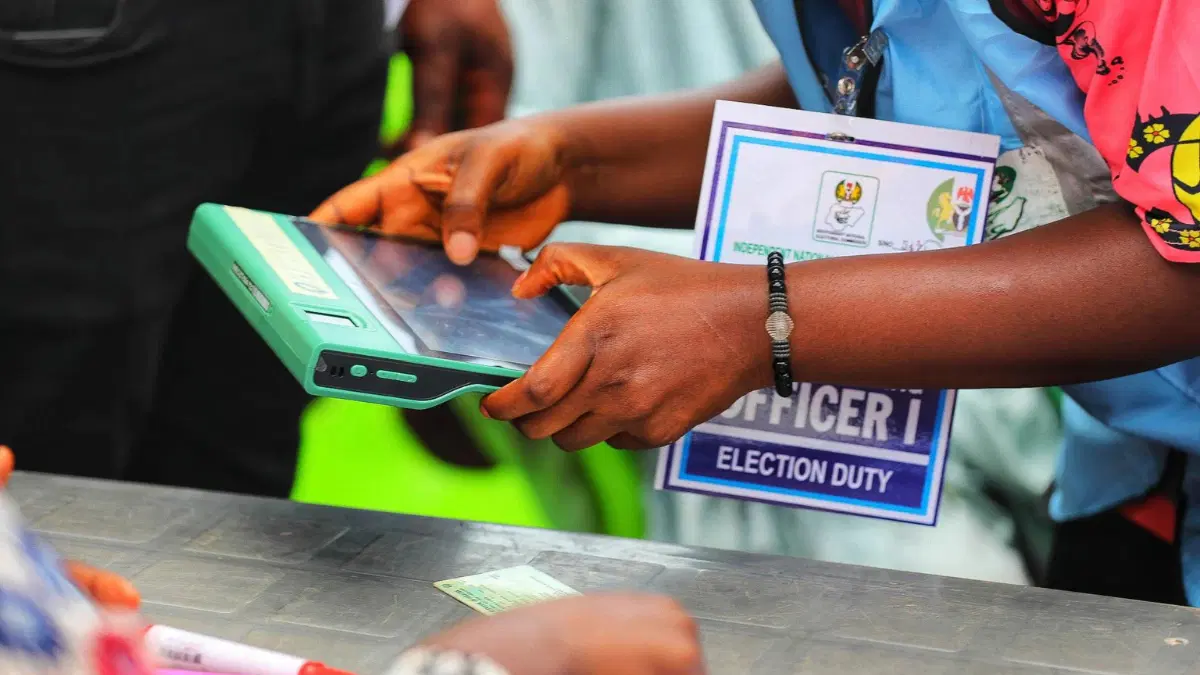
The technology allocation includes N163.2 billion for additional BVAS devices, N162.5 million for IReV portal upgrade, N1.2 billion for a hybrid e-EC8A result management system, and N12.2 billion for printing Permanent Voter Cards for continuous voter registration.
Separate from N171bn 2026 Budget
Amupitan clarified that the election budget is distinct from INEC’s N171 billion statutory proposal for 2026 operations, which covers by-elections, off-cycle polls, personnel costs, and overheads.
The Ministry of Finance had proposed a N140 billion envelope for the commission, but Amupitan argued the envelope system is unsuitable for INEC’s operations, which require urgent and flexible funding.
Lawmakers Divided, Oshiomhole Backs INEC
Senator Adams Oshiomhole said external agencies should not dictate INEC’s budget framework given the sensitive nature of its mandate, urging Parliament to work with the commission’s actual requirements to avoid future complaints of underfunding.
Rep. Billy Osawaru called for INEC to be placed on first-line charge, with funds released in full and on time.
But Rep. Bayo Balogun, Chairman of the House Committee on Electoral Matters, cautioned the commission against over-promising. He recalled that during the 2023 elections, INEC created the impression that the IReV portal would display results in real time “like CNN,” only for the system to crash.
“IREV was not even in the Electoral Act; it was a creation of INEC,” Balogun said. “Be careful how you make promises”.
NYSC Seeks N32bn for Corps Members
The proposed election budget does not include a separate request by the National Youth Service Corps seeking N32 billion to increase allowances for 450,000 corps members deployed as ad-hoc staff. Under the proposal, each corps member would receive N125,000 for five days of election duty, including training.
The Joint Committee said it would consider the request and approved a motion recommending one-time release of INEC’s annual budget.
Historical Context
The 2023 general elections cost N313.4 billion. The 2019 polls cost N189 billion, while the 2015 elections cost N109 billion.
Senator Simon Lalong, Chairman of the Senate Committee on INEC, assured the commission of legislative support. But the figure (nearly triple what was spent just four years ago) now sits with lawmakers who must decide whether to approve it, cut it, or demand more answers before Nigerians go to the polls in 2027