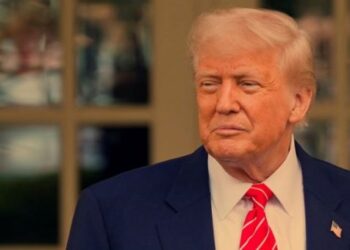


U.S. President Donald Trump has issued a stark new foreign policy ultimatum, warning that he is prepared to order a “many-time strike” campaign of military action inside Nigeria if violence against Christians continues, dramatically expanding his doctrine of unilateral intervention from Latin America to the heart of West Africa.
In a wide-ranging interview with The New York Times, Trump was asked if the Christmas Day U.S. airstrikes in Nigeria’s Sokoto state—targeting Islamist militants—were an isolated event. “I’d love to make it a one-time strike. But if they continue to kill Christians, it will be a many-time strike,” the President declared, framing America’s role as the global enforcer for a specific religious community.

A Clash of Narratives: “Genocide” Claims vs. On-the-Ground Reality
Trump’s warning rests on a controversial premise that has inflamed diplomatic tensions: the claim, popular in some right-wing U.S. circles, of a “genocide” specifically targeting Nigeria’s Christians. When challenged in the interview by data showing that most victims of jihadist groups like Boko Haram and ISWAP are in fact Muslims, Trump conceded, “I think that Muslims are being killed also in Nigeria. But it’s mostly Christians.”
This assertion stands in direct opposition to the Nigerian government’s stance and the assessments of most independent monitors of the conflict. Abuja has forcefully rejected the accusation of failing to protect Christians, emphasizing that “Muslims, Christians and those of no faith alike” are victims of the widespread insecurity plaguing the north. Nigeria’s population of over 230 million is roughly evenly split between the two faiths.
Nigeria’s Diplomatic Tightrope: Sovereignty vs. “Constructive Engagement”
Faced with the threat of further U.S. military action on its soil, the Nigerian response has been one of cautious, diplomatic defiance. A spokesperson for the foreign minister did not directly address Trump’s threat but told the BBC, “We will continue to engage constructively and work with partners, including the United States, on the basis of mutual respect, international law, and Nigeria’s sovereignty.”
The statement reaffirmed that “Nigeria remains committed to protecting all citizens, Christians and Muslims alike, without discrimination.” This delicate phrasing emphasises the impossible position Abuja finds itself in: managing a critical security partnership with a superpower whose leader is publicly questioning its competence and sovereignty, while trying to maintain domestic unity in a religiously diverse nation.
A New, Dangerous Precedent of Faith-Based Intervention
Trump’s warning marks a dangerous evolution in his foreign policy. It moves beyond the oil-and-drugs justification used for Venezuela to establish a new, faith-based red line for military action. By directly tying U.S. firepower to the protection of a single religious group within a sovereign nation, he risks inflaming sectarian tensions within Nigeria and setting a precedent that could see America drawn into complex internal conflicts across the continent.
For Nigeria, its internal security crisis is now a potential casus belli for the United States. The Sokoto strikes were not an endpoint, but a shot across the bow. The next move depends not just on the actions of jihadists in the Sahel, but on President Trump’s interpretation of who their victims are—a calculation that has put U.S.-Nigeria relations on a knife-edge and opened a volatile new front in America’s controversial “policeman of the world” role.