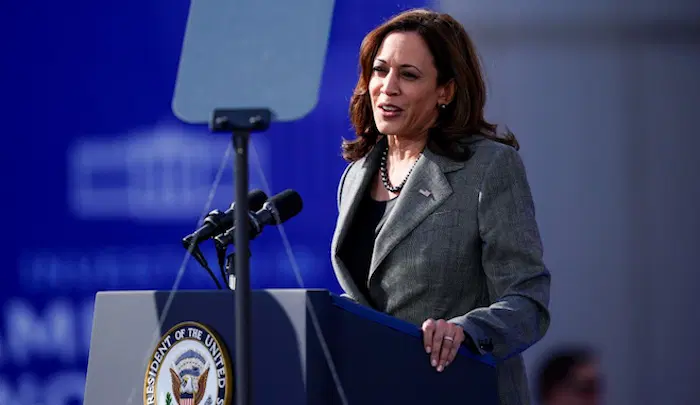
During a recent video event hosted by the advocacy group Win With Black Women, former Vice President and recent Democratic presidential nominee Kamala Harris explicitly floated the idea of “expanding the Supreme Court” as part of a sweeping playbook to counter a series of major conservative policy wins. The high-profile endorsement of court-packing has led to a constitutional debate over the rule of law and the institutional survival of the nation’s highest court.
From the Political Fringe
For nearly nine decades, the idea of court-packing, intentionally adding seats to a court to alter its ideological balance, was treated as a radioactive third rail in American governance. The tactic famously backfired on President Franklin D. Roosevelt in 1937, shattering his legislative coalition despite a historic landslide victory. When the issue reemerged during the 2020 election cycle, mainstream Democrats carefully danced around it, with President Joe Biden later creating a toothless advisory commission to pacify the party’s progressive base.
That caution has officially evaporated. In the last ten years, partisan manipulation of judicial numbers has quietly become an accepted political tool at the state level: State Republicans packed their own Supreme Court after justices backed a legal challenge against GOP-leaning congressional maps. Conservative legislatures successfully expanded their high courts to secure reliable majorities.
By bringing this strategy into her national policy platform, Harris has signaled that court-packing is no longer a radical scheme championed by anti-system iconoclasts. It is now a fully palatable option for the institutional center of the Democratic Party.
The primary advantage of court-packing is its simplicity under the text of the Constitution. Unlike moderate, highly popular reforms, such as term limits, which nearly 75 percent of Americans support but would require a grueling constitutional amendment process, the size of the Supreme Court is entirely up to Congress. The Judiciary Act of 1789 originally established six seats, and the court reached ten seats during the Lincoln administration. If a political party controls the White House, the House, and a filibuster-proof Senate majority, they can legally expand the court to 15 or 5,000 seats overnight.
However, legal experts warn that a legally sound court-packing bill would trigger an unprecedented collapse in institutional legitimacy. Historically, the Supreme Court has no military force of its own; it depends entirely on voluntary compliance and a lean force of fewer than 4,000 U.S. Marshals to enforce its decisions across hundreds of thousands of annual cases.
If a hyper-politicized, newly expanded Democratic Court attempted to reinstate abortion access or strike down conservative voting maps, red states would likely look to historical precedents like the “massive resistance” campaign against Brown v. Board of Education (1954). Governors could simply order state police forces to ignore federal mandates. Forcing compliance would require the White House to deploy the U.S. military against state national guards, risking localized civil conflicts.
Burning Down the House to Save the Furniture
The current conservative Supreme Court majority has done massive, structural damage to voting rights, reproductive freedom, and the basic guardrails of American democracy. It is totally understandable why Democrats are furious and desperate for a weapon to fight back. But turning to court-packing as a quick fix is the political equivalent of swallowing poison to kill a cold. It is a shortsighted, nuclear option that completely destroys the illusion of an independent judiciary.
The fundamental flaw in Kamala Harris’s “expanded playbook” is the naive assumption that the other side won’t play the exact same game. If Democrats pass a bill in 2029 to expand the court to 13 justices just to appoint four liberals, they are guaranteed that the next time Republicans win a trifecta, they will immediately repack it to 17 or 21 seats. Within a few election cycles, the Supreme Court ceases to be a legal institution and morphs into a giant, farcical legislative committee where the law changes entirely depending on who won the last election.
When you strip a court of its neutral legitimacy, you destroy its primary superpower: the ability to make people obey rulings they don’t like. A packed court wouldn’t have the moral or political authority to enforce civil rights protections on a rebellious red state. It would generate endless constitutional crises, mass civil disobedience, and a complete breakdown of federal authority. If the only way to save the judiciary’s policy outcomes is to turn the Supreme Court into an open, partisan joke, then you haven’t saved the rule of law at all—you’ve just helped burn it down.