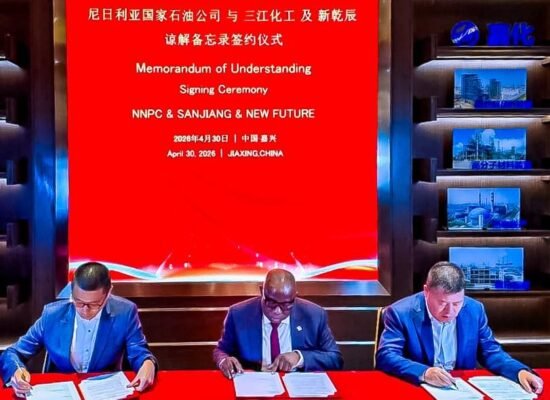

The state-owned oil company in Nigeria has unveiled a new plan to restart two of its largest refineries, marking a departure from previous government-funded rehabilitation efforts in favour of a commercial partnership model involving foreign investors.
The Nigerian National Petroleum Company Limited has stated that its memorandum of understanding with two Chinese firms for the rehabilitation and operation of the Port Harcourt and Warri refineries is currently undergoing detailed technical and commercial assessment, adding that a final investment agreement has not yet been concluded.
Bayo Ojulari, Group Chief Executive Officer, said the review process is designed to test whether the proposed partnership can establish refinery operations that are both profitable and sustainable over time, instead of relying on another round of short-term rehabilitation efforts.
“Fixing a refinery is not just about pipes and pumps; it requires the right partners,” Ojulari said, noting that the memorandum of understanding merely provides a structure for exploring collaboration and does not amount to a binding agreement.
In contrast to earlier rehabilitation efforts that were mainly funded by the government, the potential Chinese partners are expected to cover the expenses for the due diligence exercise, enabling comprehensive technical, financial, and operational evaluations to be carried out before any long-term agreements are signed.
The move comes after NNPC signed an agreement in April with China’s Sanjiang Chemical Company Limited and Xinganchen (Fuzhou) Industrial Park Operation and Management Co. Ltd. to assess the rehabilitation, operation, and potential expansion of the Port Harcourt and Warri refineries through a technical equity partnership arrangement.
NNPC also said the talks are not limited to refinery rehabilitation, but may also cover wider investment opportunities in petrochemicals and gas-driven industries, such as methanol production, aimed at boosting the commercial potential of the country’s downstream oil and gas sector.
Nigeria, despite being the continent’s biggest crude oil producer, has long depended on imported refined petroleum products due to the persistent underperformance of its state-owned refineries.
The Port Harcourt refinery has a total installed capacity of 210,000 barrels per day, while the Warri refinery is designed to process up to 125,000 barrels per day.
Combined with the Kaduna refinery, Nigeria’s state-owned refining facilities have a total capacity of about 445,000 barrels per day. However, despite multiple rehabilitation efforts spanning several administrations and costing billions of dollars, the refineries have continued to experience frequent outages and low operational output.
These ongoing challenges have fuelled renewed debate on whether the government should keep financing refinery refurbishments or instead hand over operations to private-sector players with the expertise to run them on a commercial and sustainable basis.
The launch of the 650,000-barrels-per-day Dangote Refinery has added further pressure to the sector, transforming Nigeria’s downstream fuel market and increasing expectations that local refining can be profitable at scale.
NNPC views the proposed collaboration with Chinese companies as more than just another refinery overhaul. Rather, it is a strategic effort to show that Nigeria’s state-owned refineries can remain viable in an industry that is increasingly defined by efficiency, private investment, and commercial profitability.