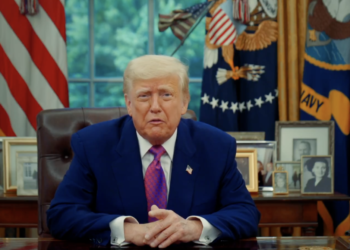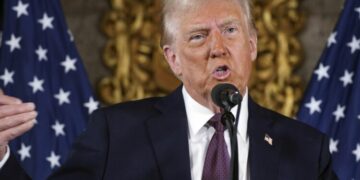


The Middle East conflict has taken a sharp geopolitical turn as President Donald Trump signaled a massive escalation in military force, on Friday the President announced that the U.S. would be hitting Iran “very hard over the next week.” This vow for increased violence comes at a confusing strategic moment, arriving just hours after the U.S. issued a partial 30-day waiver for purchases of sanctioned Russian oil, a move intended to lower global energy prices that have skyrocketed by 40% since the war’s inception.
The Russian Oil Pivot and Allied Fury
The decision to grant a 30-day license for Russian oil products currently at sea has sent shockwaves through the G7. German Chancellor Friedrich Merz expressed open frustration, stating that the U.S. went against the “clear opinion” of its closest allies. The action is particularly controversial in Kyiv. President Volodymyr Zelensky warned that the waiver could provide Moscow with a $10 billion infusion, arguing that the policy “certainly does not help peace” while Russian intelligence is allegedly providing Iran with targeting data on U.S. warships.

A Regional War Without Borders
After two weeks of relentless combat, the human toll has surpassed 2,000 deaths, with millions more displaced. The conflict is no longer contained within Iran and Israel:
•Lebanon: Israeli warplanes are pounding Beirut, with officials warning of “Gaza-scale” devastation as hundreds of thousands seek refuge.
•The Gulf: For the first time in decades, the UAE, Kuwait, and Bahrain are on the front lines as Iranian drones breach their airspace.
•Iraq: The U.S. military confirmed the deaths of six crew members following a refueling aircraft crash in western Iraq, while French and Italian bases have come under direct attack.
Defiance in Tehran
Despite assertions from U.S. Defense Secretary Peter Hegseth that Iranian leadership is “cowering” and that the new Supreme Leader, Mojtaba Khamenei, is “disfigured,” top Iranian officials made a high-profile appearance at a Quds Day rally in Tehran. President Masoud Pezeshkian and security chief Ali Larijani were seen marching in the rain, a move verified by Reuters to project strength. Judiciary chief Gholamhossein Mohseni-Ejei told the crowds, “People are not afraid of these attacks… we will not back down in any way,” directly challenging the U.S. narrative of a regime on the brink of collapse.
Economic Desperation and the Strait of Hormuz
The International Energy Agency has officially labeled this the “biggest oil supply disruption in history.” With the Strait of Hormuz remaining a volatile chokepoint, Trump has suggested the U.S. will begin escorting shipping vessels if necessary. While the Russian oil waiver caused Brent crude to ease slightly to $99.80, the domestic political pressure of rising gasoline and diesel prices appears to be driving a “contradictory” foreign policy where the U.S. fights an Iranian regime that is being supported, at least “a little bit,” by the very Russian energy exports Trump just re-authorized.