


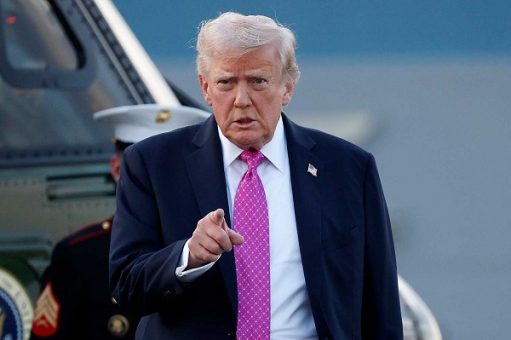
US President Donald Trump’s approval rating in New Jersey has fallen to 29 per cent, with 66 per cent of voters disapproving of his performance, according to a new poll by Fairleigh Dickinson University.
The survey, conducted among 805 voters in October, found that five per cent of respondents either did not know or declined to state their position on the president’s performance.
The findings also showed a decline in support for New Jersey Governor Mikie Sherrill, whose approval rating dropped 10 percentage points to 48 per cent from 58 per cent in March.
However, her disapproval rating remained unchanged at 32 per cent, while the number of voters who were uncertain about her performance increased by 12 percentage points.
Dan Cassino, a professor of government and politics and executive director of the university’s polling programme, said voters appeared less certain about their views of the governor despite her having spent several months in office.
“Normally, you’d expect attitudes toward the governor to become more, rather than less, certain over time,” Cassino said. “But for whatever reason, Democrats are not as happy with the governor as they were when she took over.”
Sherrill’s spokesperson, Steve Sigmund, however, maintained that the governor’s focus on affordability and her rejection of conventional political practices continued to resonate with residents.
“Gov. Sherrill’s relentless focus on affordability and rejecting politics as usual in 2025 gave Democrats a playbook to win this cycle,” Sigmund said.
“New Jerseyans’ strong approval of her job leading the state shows that they recognize she is delivering on these commitments.”
Although the survey did not ask respondents why they were dissatisfied with Sherrill’s performance, the governor has faced criticism and controversies since the previous poll.
She requested and secured the resignation of Lieutenant Governor Dale Caldwell after an independent investigation concluded that he had sexually harassed a woman on his staff and committed other ethical lapses. Caldwell has denied the allegations.
Sherrill also faced criticism from some progressive groups over her decision to deploy state police to protests outside the Delaney Hall Immigration and Customs Enforcement detention centre in Newark.
The demonstrators accused officers of treating protesters similarly to ICE personnel, citing the use of riot gear and mounted officers, as well as alleged assaults.
Cassino suggested that growing uncertainty over Sherrill’s performance could be linked to the Democratic Party’s unpopularity nationally and an increase in the number of voters identifying as progressive or liberal.
Among Democrats in New Jersey, the governor’s approval rating fell from 88 per cent in March to 71 per cent in the October survey.
The poll was conducted through text-to-web surveys by Princeton-based Braun Research between October 16 and 22 on behalf of Fairleigh Dickinson University.
“It’s not clear what Sherrill has done to cause voters who should be among her most loyal supporters to distance themselves,” Cassino said. “But whatever it is, this is a blinking yellow light for the administration.”
The survey also examined Trump’s standing among Republican voters in the state. His approval rating stood at 95 per cent among self-identified supporters of the Make America Great Again movement, 68 per cent among conservatives and 21 per cent among moderates.
Cassino said Trump’s prominence within the Republican Party could have implications for its candidates in the upcoming midterm elections.
“Trump isn’t running for reelection, but he has made himself the face of the Republican Party,” he said. “The fact that he’s this unpopular means that he’s dragging down Republican candidates in a way that a less visible president might not be.”
The November 3 midterm elections will determine whether Republicans retain control of both chambers of Congress, the Senate and the House of Representatives.
Polling has pointed to a potential Democratic gain in the House, with New Jersey’s 7th Congressional District emerging as a closely watched contest. Republican Representative Tom Kean Jr., who is seeking another term, is considered vulnerable, while Democratic challenger Rebecca Bennett, a former US Navy pilot, is viewed as well-positioned in the race.
In South Jersey’s 2nd District, Republican Representative Jeff Van Drew is considered to have a more secure position. However, his Democratic challenger, Cape May Mayor Zack Mullock, has attracted increased attention as political analysts discuss the possibility of a broader Democratic surge.
The poll’s findings highlight the contrasting political challenges facing New Jersey’s Democratic governor and the Republican president as both parties prepare for a consequential midterm election.