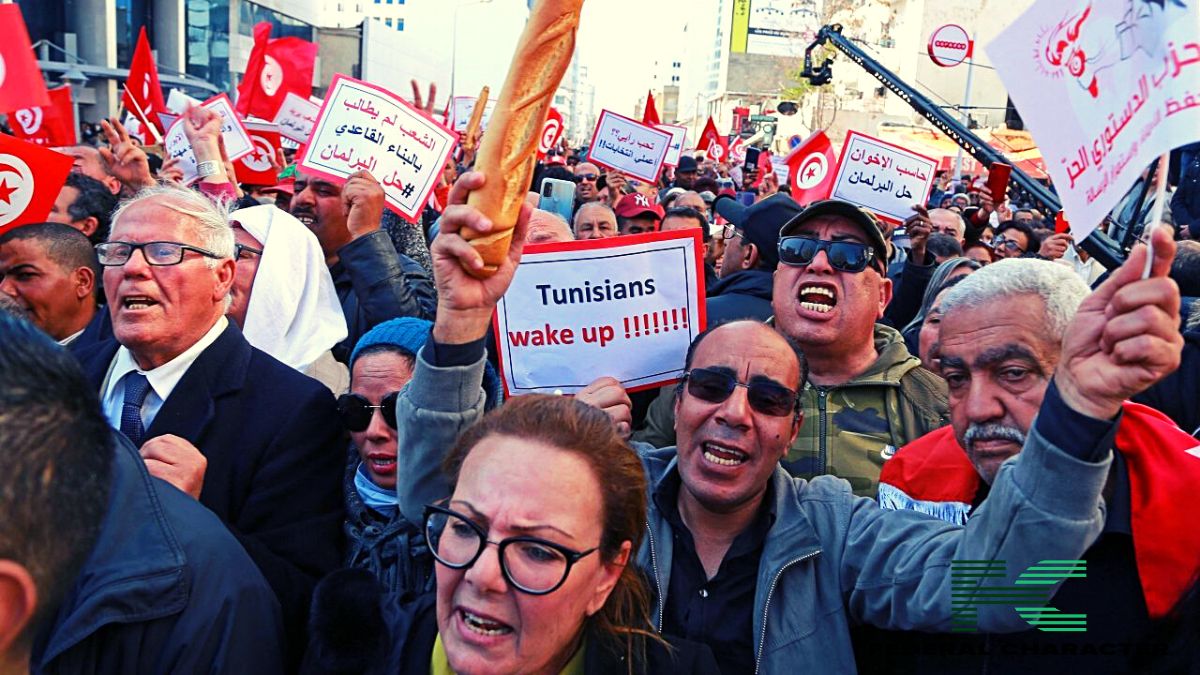

Hundreds of demonstrators flooded the streets of Tunis on Tuesday, marking the second anniversary of President Kais Saied’s rise to power. The protesters, organized by the main opposition coalition Salvation Front, demanded an end to “autocratic rule” and the immediate release of detained opposition leaders.
The central Habib Bourguiba Avenue witnessed a gathering of around 300 people, holding aloft placards that passionately demanded “Freedom for political detainees” and unequivocally expressed their disapproval with the slogan “Down with the coup.” Meanwhile, in another part of the capital, supporters of the Free Constitution Party, led by the party’s leader Abir Moussi, passionately waved Tunisian flags and chanted slogans decrying the increased poverty and hunger in the country, while also calling for an end to President Saied’s rule.
Since 2021, President Saied has consolidated significant powers, leading to the dissolution of parliament and the introduction of a new constitution that grants him almost absolute authority. These moves have sparked widespread controversy and discontent among the opposition.
The situation escalated further in April, when authorities arrested Rached Ghannouchi, a prominent critic of President Saied and leader of the opposition, along with other officials from Ghannouchi’s party, including former Prime Minister Ali Laryedh. Moreover, earlier in February, about 20 prominent political leaders, many of whom were members of the Salvation Front, were detained on charges of conspiring against state security.
The opposition’s central accusation is that President Saied’s actions amounted to a coup, while he staunchly defends them, stating that they were legal and necessary measures taken to save Tunisia from the turmoil and rampant corruption that had plagued the country.
In the backdrop of these events, Tunisia faces a severe economic crisis, desperately requiring external financial aid to avoid defaulting on its debts. Citizens bear the brunt of this situation, grappling with exorbitant living costs and acute shortages of essential commodities like sugar, semolina, oil, coffee, and rice.
The protesters’ resolve echoes the historical significance of Tunisia’s past struggles. The Tunisian Revolution in 2011, also known as the Jasmine Revolution and the Tunisian Revolution of Dignity, was a powerful 28-day campaign of civil resistance that culminated in the ousting of long-time president Zine El Abidine Ben Ali. The revolution paved the way for the democratization of the country and ushered in free and democratic elections. This momentous event not only inspired similar uprisings against authoritarian leaders across the Arab region but also led to the removal of Egypt’s Hosni Mubarak and Libya’s Moammar Gaddafi in the same year.
President Ben Ali’s reign was marked by both accomplishments and criticisms. He came to power in 1987 through a bloodless and non-violent takeover, initially earning praise from Tunisians, including Islamists. During his rule, Tunisia emerged as a moderate voice in the Arab world, and Western governments regarded him as a bulwark against Islamist extremism. However, criticisms were directed at his slow progress toward democracy and concerns over his consolidation of power.
The spark that ignited the revolution in 2011 was the self-immolation of a young man in the impoverished center of the country, which fueled widespread protests initially centered on joblessness but soon taking on a political dimension, fueled by the outrage over a government crackdown that resulted in numerous casualties.
Despite several attempts at reconciliation by President Ben Ali, including job creation and promises not to seek re-election, the public sentiment remained unforgiving, leading to his eventual exile in January 2011, along with his wife Leila Trabelsi. This historic moment triggered a wave of revolutions across the Arab world.
As Tunisia faces new challenges in the present, the echoes of its past reverberate through the voices of protesters demanding change and accountability from those in power. The nation stands at a critical juncture, grappling with its history while striving to shape its future.