
If you’ve been on Obasanjo’s internet at all since last weekend, you already know peace has not rested. Timelines have been loud, fanbases have been activated, box office numbers have been weaponised, and suddenly everybody is now a cinema analyst. At the centre of the madness? Two women. Two films. Two box office juggernauts.
Funke’s Behind The Scenes is sitting comfortably at over ₦2.4 billion, chest out, no apologies. Toyin’s Oversabi Aunty has crossed the ₦1 billion mark, officially joining the big girls’ table. Naturally, Nigerians did what Nigerians do best — they turned it into a rivalry.
Which one is better?
Who deserves it more?
Who “worked harder”?
Who is the real box office queen?
Relax. Take a chill pill. Nobody is collecting crown from anybody today.
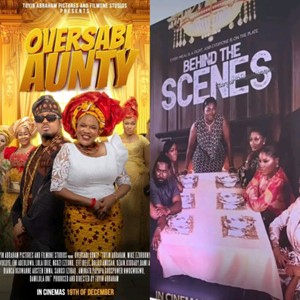
BEHIND THE SCENES: BASIC STORY, HEAVY EXECUTION
Let’s start with Behind The Scenes, because numbers first, like Nigerians like to do.
Directed by Funke Akindele and Tunde Olaoye, the film stars Destiny Etiko, Ibrahim Chatta, Ini Dima-Okojie, Iyabo Ojo, Uzor Arukwe, Tobi Bakre, Victoria Adeleye, and, of course, Funke herself. A proper Nollywood Avengers lineup.
Behind The Scenes is not her most complex story, not her most daring script, not her boldest risk, but it is very on-brand Funke Akindele: emotionally loaded, family-centred, exaggerated enough to spark conversation, and polished enough to pull crowds
The story centres on Aderonke “Ronky-Fella” Faniran, a wealthy real estate mogul, generous to a fault, carrying the emotional and financial burden of her dysfunctional family like it’s her God-given calling. She gives, gives, gives, until there’s nothing left of her, emotionally or mentally.
Now let’s be honest. This story is not new. Nollywood has told this story in different fonts, colours and villages. The self-sacrificing rich sibling. The entitled relatives. The exploitation masked as family. We’ve been here before.
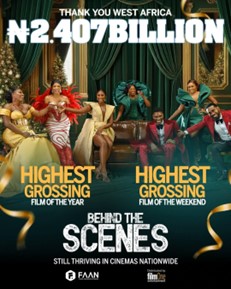
But where Behind The Scenes shines is execution.
That said… let’s ask questions.
Why fake your death?
Why traumatise your children?
Why set up CCTV like Big Brother Naija just to confirm what you already know, that your family is exploiting you?
Some plot choices felt unnecessarily dramatic even by Nollywood standards. Generosity crossed into outright foolishness at some points. Paying five months’ salary for your friend’s company? Madam, are you Santa Claus or Dangote?
The runtime also dragged. Too much crying. Too much wailing. At some point I was like, okay we’ve understood, please stand up.
But here’s the inconvenient truth Nigerians don’t like to admit:
People don’t go to Funke Akindele films for realism. They go for emotional release. They want to cry. They want to shout at the screen. They want to say, “This thing is happening in my family.” And Funke delivers that every single time.
The visuals are clean. The set design is intentional. The makeup and special effects, especially the corpse scene, were surprisingly well done. That alone tells you money entered this production.
Add strong performances — Scarlet Gomez absolutely ate that role, Tobi Bakre delivered with quiet intensity, and Funke herself played entitlement like it was written in her DNA — and you have a film that might not be revolutionary, but is undeniably effective.
Still, this is Funke Akindele. Her strength has never been originality of story but clarity of message and mass appeal. The message here is simple: protect yourself, even from family. And Nigerians connected with it deeply — hence the numbers.
OVERSABI AUNTY: RELATABILITY IS THE REAL STAR
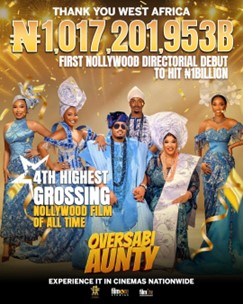
Now let’s move to Oversabi Aunty, Toyin Abraham’s cultural missile.
From the moment Toyin started screaming “Oversabi Aunty” at Priscilla Ojo’s wedding, it was obvious that marketing genius was activated. She planted the title in our heads before the trailer even dropped. Smart woman.
And when the film finally arrived, it delivered something powerful: relatability.
Every Nigerian family has an Oversabi Aunty. If you’re shaking your head right now, check well, you might be the Oversabi Aunty.
The film tackles hypocrisy, maternal competition, neglect, and the emotional damage parents don’t even realise they’re causing. And what’s beautiful is how subtly some of these things are portrayed.
Chuka’s anger issues? Firmly planted in neglect. The eldest child shouting like her mother, even though she hates it? Learned behaviour. These are small details, but they land hard.
Performance-wise, this film was solid across the board. Mike Ezuruonye was Fantastic. The frustration, the facial expressions, the Igbo-Yoruba code-switching, top tier. Enioluwa and Kidbaby did surprisingly well for first-timers. Apa? Comedy machine.
Toyin Abraham herself leaned fully into chaos, sometimes a bit too much — but honestly, that’s the character. Oversabi no dey calm.
The costumes deserve their own standing ovation. From iro and buba to August meeting wrappers, everything felt intentional and deeply Nigerian. That August women meeting scene alone probably triggered half the audience’s childhood memories.
Yes, the film had flaws. Some scenes were unrealistic. The pregnancy storyline could have been handled better. The corpse discovery scene? Abeg, Nigerians know how dead body smells, please. But the heart of the story remained strong.
SO… WHICH ONE IS BETTER?
Now drumrolls
I pick nobody.
And that’s the honest truth.
Both films did what they set out to do. Both connected with their audience. Both made serious money. Both had flaws. Both had strengths. And most importantly, both were made by women who understand Nigerian audiences deeply.
So yes, if I’m putting on my critic’s hat and judging strictly on story, structure, pacing and logic, I’ll give Behind The Scenes and Oversabi Aunty a 6.8/10 each.
But here’s the part some people don’t like to hear: box office dominance is not the same thing as artistic perfection, and it doesn’t have to be. These films didn’t come to impress at Cannes. They came to move Nigerians, fill cinemas, and dominate conversation. And in that, they scored a full 10/10.
This is not a war. This is not Avengers vs Justice League. This is a win-win.
THE REAL CONVERSATION WE SHOULD BE HAVING
Funke Akindele has turned December cinema releases into her personal throne room. Year after year, she shows up, dominates, and leaves numbers behind. Love her or not, nobody is touching her consistency right now. She rules the cinemas, full stop.
Toyin Abraham, on the other hand, is proving growth. From comedy roles to box office power, she’s stepping into a new league with confidence and strategy.
This is what crazy investment in Nollywood looks like, paying off. This is what happens when women are given space, resources, and trust to lead big projects.
We need more of this.
More money.
More screens.
More women.
More risk-taking.
Whether you watched Behind The Scenes, Oversabi Aunty, or both, Nollywood won. And when Nollywood wins, we all eat.
End of discussion. 🎬🔥