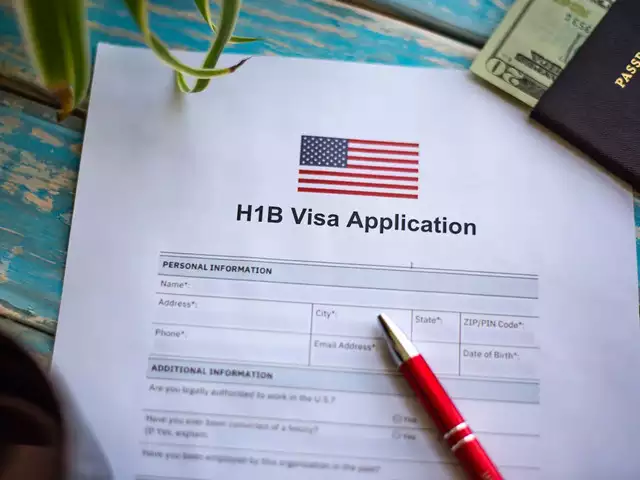

A US district court has set aside an interim final rule issued by the Trump administration in October 2025 that ended automatic extensions of employment authorisation documents for H-4 visa holders, the spouses of H-1B professionals with approved green card applications.
However, the relief is limited only to the seven plaintiffs who challenged the rule and does not apply nationwide. Other H-4 visa holders seeking the same benefits will need to approach the court individually.
The seven plaintiffs had argued that the abrupt withdrawal of automatic EAD extensions, without public consultation, could lead to widespread job losses amid chronic processing delays at US Citizenship and Immigration Services.
The Impact
More than a lakh Indian spouses, largely women, hold EADs. A 2016 rule introduced automatic extensions of up to 180 days beyond the expiry of an EAD, allowing eligible spouses to continue working while their renewal applications were processed.
In spring 2022, USCIS temporarily increased the extension period to 540 days. The extended period was made permanent from January 2025 to prevent employment disruptions caused by processing delays.
However, in October 2025, the Department of Homeland Security abruptly ended the automatic-extension mechanism through an interim final rule.
The Legal Arguments
The lawsuit argued that H-4 spouses can apply to renew their EADs only within 180 days of the expiry of their existing work permits. Since an H-4 spouse’s status extension must be filed alongside the H-1B worker’s extension, any delay by the employer in filing the H-1B application can further reduce the dependent spouse’s renewal window.
The plaintiffs also pointed to USCIS processing delays that routinely exceed 180 days, arguing that the absence of automatic extensions could make job loss unavoidable for many H-4 EAD holders.
The Court’s Ruling
In an order dated September 10, 2026, the US district court for the Central District of California granted a preliminary injunction in favour of the seven plaintiffs. The court held that DHS had failed to follow the procedure required under the Administrative Procedure Act when introducing the rule.
The government had justified the move on national security grounds, arguing that automatic extensions could allow individuals to continue working before background checks and eligibility reviews were completed. Judge David O. Carter held that DHS had not demonstrated the emergency circumstances required to bypass the usual notice-and-comment process.
The district court noted that the government already had continuous-vetting mechanisms. It also found that DHS had not adequately considered the interests of H-4 EAD holders, their families, and employers.
The Implications
Jonathan Wasden, the immigration litigation attorney representing the plaintiffs, said the ruling rejected both the government’s claimed emergency and its failure to meet the substantive requirements of rulemaking. “This means that the final rule the government has been hinting at in recent months is dead on arrival,” he added.
The Bottom Line
A US district court has blocked the Trump administration’s rule ending automatic EAD extensions for seven H-1B spouses. The relief is limited to the plaintiffs and does not apply nationwide. The court found that DHS failed to follow proper rulemaking procedures and did not demonstrate emergency circumstances. The ruling is a significant win for the plaintiffs but leaves other H-4 EAD holders to seek their own legal relief.
My Opinion
To break down everything written here: A federal judge has ruled that the Trump administration broke the law when it abruptly ended automatic EAD extensions for H-4 visa holders. The court found that DHS failed to follow proper rulemaking procedures and did not demonstrate the emergency circumstances required to bypass public consultation.
That is a clear, legal rebuke.
But the problem is that the relief applies to seven people. Seven. Out of more than a lakh H-4 EAD holders in the United States, most of them Indian women who have built careers, contributed to their communities, and supported their families while their spouses work on H-1B visas.
Seven people got justice. Everyone else gets to keep living in fear.
This is not how the legal system should work. When a federal court finds that an agency acted unlawfully, the remedy should protect everyone affected by that unlawful action, not just the individuals who happened to have the resources and the lawyers to sue. The absence of a nationwide injunction means thousands of H-4 spouses must now decide whether to file their own lawsuits, hire their own attorneys, and navigate a legal system that is already expensive, slow, and intimidating.
The Trump administration’s rule was cruel from the start. It ended automatic extensions that had been in place for years, extensions that allowed spouses to keep working while their renewal applications were processed. It did so without public consultation, demonstrating any emergency, and without adequately considering the interests of the families it would affect.
The court saw through it. The judge called it what it was. But the ruling’s limited scope means the damage continues for thousands of families who did nothing wrong and followed every rule.
The government has hinted at a final rule in recent months. Wasden says that rule is now “dead on arrival.” I hope he is right. But until there is a nationwide injunction, until every H-4 EAD holder is protected, the fight is not over.