Multiple explosions rocked the Iranian capital Saturday morning as Israel launched what it called a “pre-emptive attack” on the country, pushing the Middle East into a renewed military confrontation and further dimming hopes for a diplomatic solution to Tehran’s long-running nuclear dispute with the West.
Israeli Defence Minister Israel Katz confirmed the strikes, describing them as necessary “to remove threats” to the State of Israel. He also declared an “immediate state of emergency throughout the entire country” in anticipation of possible Iranian retaliation.
The first apparent strike happened near the offices of Supreme Leader Ayatollah Ali Khamenei in downtown Tehran, according to witnesses and Iranian media. It wasn’t immediately clear whether the 86-year-old Khamenei had been in his offices at the time. He hasn’t been seen publicly in days as tensions with the United States have grown, and an official later told Reuters he had been transferred to a secure location.
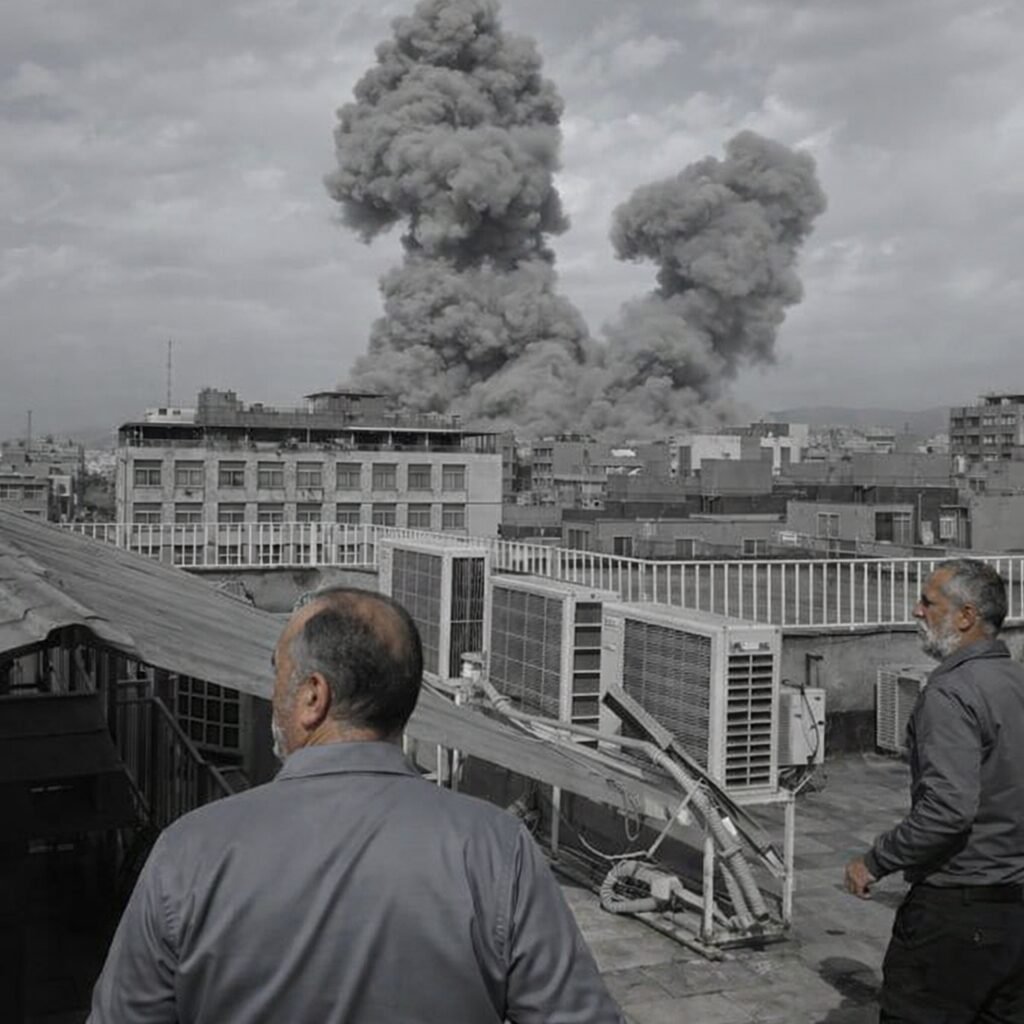
Smoke Over Tehran
The BBC received images of smoke rising over Jomhouri Square and Hassan Abad Square in the Iranian capital. Iranian state-affiliated Fars News Agency reported that several missiles hit the Republic area of Tehran, with further explosions later heard in the north and east of the city.
Two loud blasts were heard in Tehran by AFP journalists, and two plumes of thick smoke were seen over the centre and east of the Iranian capital. The Fars news agency reported that “the type of explosions suggests that this is a missile attack”.
Iran shut down its airspace after the attack, warning pilots away as explosions rang out across the capital.
Israel Braces for Retaliation
At around 08:15 local time (06:15 GMT), sirens sounded across Israel, alerting residents to the threat of possible missile attacks. The Israeli military issued a “proactive alert to prepare the public for the possibility of missiles being launched toward the state of Israel”.
The country shifted to “Essential Activity” status, suspending educational activities, large gatherings, and non-essential work nationwide. Mobile alerts urged residents to stay near protected shelters l.
Israel also closed its airspace to civilian flights following the strikes.
U.S. Involvement Confirmed
The United States is participating in the Israeli strikes, according to a U.S. official and a person familiar with the operation who spoke to the Associated Press on condition of anonymity. Reuters also cited an Israeli defence official saying the operation was coordinated with the U.S.
The attack comes as the United States has assembled what analysts describe as the largest military buildup in the Middle East in decades, including a vast fleet of fighter jets and warships repositioned in the region to pressure Iran into a deal over its nuclear program.
On Friday, President Donald Trump said he was frustrated by Iran’s position in talks but had not made a final decision on whether to carry out an attack. “I’m not happy with the fact that they’re not willing to give us what we have to have,” Trump told reporters.
Nuclear Talks in Ruins
The strikes came just hours after a third round of nuclear negotiations between the U.S. and Iran in Geneva ended inconclusively, with mediators suggesting further discussions would be held next week. Trump had previously given Tehran a deadline of 10 to 15 days to make a deal or face “really bad things”.
The attack follows repeated U.S.-Israeli warnings that they would strike again if Iran pressed ahead with its nuclear and ballistic missile programmes. It also comes after Israel and Iran engaged in a 12-day air war in June 2025 that saw both sides exchange strikes.
Iran has always insisted its nuclear programme is for civilian purposes, but the International Atomic Energy Agency recently estimated Iran had 440.9 kilograms of uranium enriched to up to 60% purity — a technical step away from weapons-grade levels of 90%.
Regional Fallout
Countries across the region and beyond scrambled to respond. The U.S. Embassy in Jerusalem authorised the departure of non-emergency personnel and family members due to “safety risks”. Germany “urgently” advised against travel to Israel, and France issued similar warnings. China told its citizens to evacuate from Iran “as soon as possible”.
The UK Foreign Office said its embassy staff had been temporarily withdrawn from Iran.
Tensions are also mounting along Israel’s northern border with Lebanon, where the militant group Hezbollah — a key Iranian ally — remains a significant security concern. On Friday, Israeli forces struck multiple Hezbollah positions and underground shafts in southern Lebanon, targeting infrastructure used to plan attacks against Israeli territory.
What Happens Next
It remains unclear whether Iran will immediately strike back, but it had previously warned that American military personnel and bases spread across the region would be targets for any retaliation.
Supreme Leader Khamenei has not been seen publicly in days, and his location is now officially undisclosed. Iranian officials have offered no casualty information from the strikes.
The attack represents a dramatic escalation in a conflict that has simmered for decades. With nuclear talks collapsed, U.S. forces massed in the region, and both sides preparing for what comes next, the Middle East once again stands at the brink of a potentially devastating war.