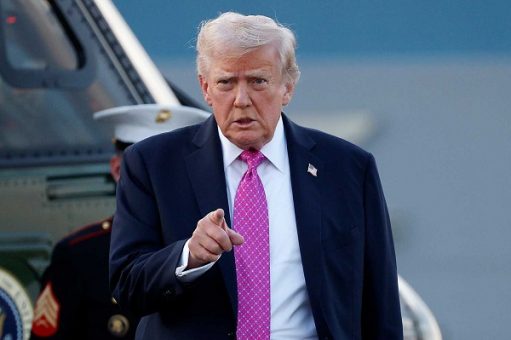

Four weeks after launching a military campaign against Iran, President Donald Trump said Friday the United States is “considering winding down” its operations — declaring victory even as Israeli forces struck Iran’s Natanz nuclear facility and the region braced for what comes next.
“We are getting very close to meeting our objectives as we consider winding down our great Military efforts in the Middle East with respect to the Terrorist Regime of Iran,” Trump posted on Truth Social.
But his message was layered with contradictions. He simultaneously rejected any notion of a ceasefire — “you don’t do a ceasefire when you’re literally obliterating the other side,” he told reporters — and insisted that Gulf nations, not the United States, must now police the Strait of Hormuz.
“The Hormuz Strait will have to be guarded and policed, as necessary, by other Nations who use it — The United States does not!” Trump wrote. “If asked, we will help these Countries in their Hormuz efforts, but it shouldn’t be necessary once Iran’s threat is eradicated.”

The Battlefield Reality
While Trump spoke of winding down the war continued.
Iranian media reported Saturday that the Shahid Ahmadi-Roshan Natanz enrichment complex had been attacked. Technical experts said no radioactive leaks had occurred and nearby residents were not at risk. Israel said it was unaware of such a strike.
Israel also struck Tehran, Karaj, and the central city of Isfahan. Three members of a family were killed in a strike on a residential building in the city of Ramsar, Iranian media reported.
In Lebanon, Israeli airstrikes on Hezbollah positions continued, killing at least four militants. More than 1,000 people have been killed in Lebanon and over 1 million displaced since the war began on March 2, when Hezbollah fired on Israel in support of Tehran.
Air raid sirens sounded across Israel throughout the day as Iran launched ballistic missiles. One struck near the U.S.-British military base Diego Garcia in the Indian Ocean, the Wall Street Journal reported, though it did not hit the base.
The Human Toll
More than 2,000 people have been killed in Iran since the U.S. and Israel launched their initial strikes on February 28.
Vital energy infrastructure across Iran and neighboring Gulf states has been attacked. Oil prices have surged 50%. The Strait of Hormuz, through which roughly 20% of global oil and liquefied natural gas passes, is effectively closed to most shipping.
European natural gas prices surged as much as 35% this week as Iran and Israel struck key energy facilities.
The Leadership Vacuum
Trump’s mixed messages have left traditional U.S. allies struggling to respond. Leading allies from Europe, Japan, and Canada have pledged to join “appropriate efforts” to ensure safe passage through the Strait of Hormuz—but Germany and France have spelled out that fighting must stop first.
Trump accused NATO allies of cowardice over their reluctance to help open the strait.
The White House, in an effort to ease the supply crunch, announced it would waive sanctions on Iranian oil for 30 days to allow the sale of 140 million barrels on tankers. The administration previously eased sanctions on a similar amount of Russian oil.
Iran’s New Leader
As Muslims celebrated Eid al-Fitr, marking the end of Ramadan, and Iranians marked Nowruz, the Persian New Year, Iran’s new supreme leader issued a message of defiance.
Ayatollah Mojtaba Khamenei, who has not been seen in public since the initial Israeli attack that killed his father and predecessor, Ayatollah Ali Khamenei, said Iranians had responded with “unity and resistance” and “dealt a disorienting blow to the enemy.”
Russian President Vladimir Putin sent Nowruz greetings to Iran’s leaders, using the occasion to say Moscow remained a “loyal friend and reliable partner.” But some Iranian sources say they have received little real help from Moscow in the biggest crisis for Iran since the 1979 Islamic Revolution.
What Comes Next
Trump says the war is nearly won. But U.S. Marines and heavy landing craft are headed to the region on a mission whose goals are not yet clear. A U.S. official told Axios the strikes could continue for “a couple more weeks.”
The contradictions in Trump’s messaging reflect a deeper uncertainty: after four weeks of war, with Iran’s leadership decimated and its nuclear infrastructure damaged, what does victory actually look like?
For Trump, it may be enough to declare it. For the region, the war is not over.