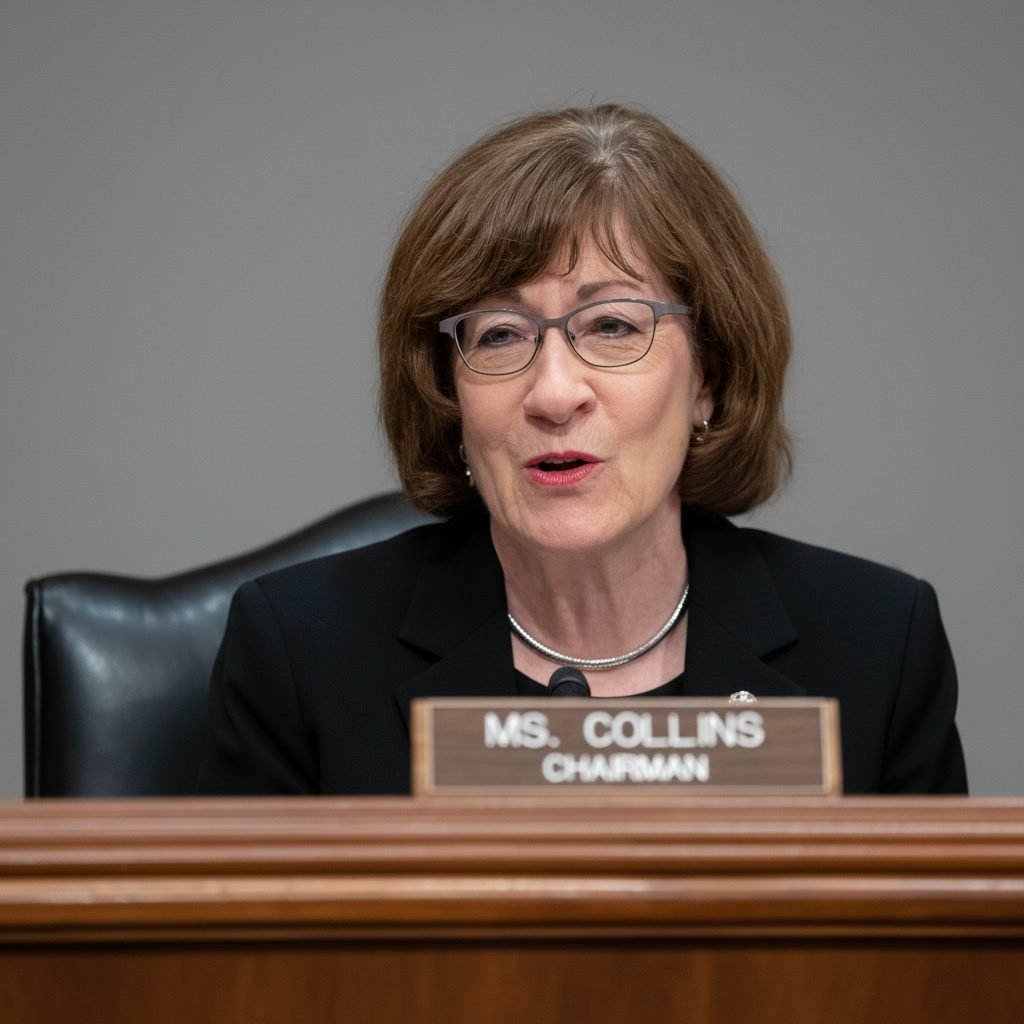
Sen. Susan Collins is facing renewed criticism from Democrats and reproductive rights groups over her 2018 vote to confirm Supreme Court Justice Brett Kavanaugh, with opponents arguing that the decision helped pave the way for the court’s eventual reversal of Roe v. Wade.
The issue has become a central part of the campaign to unseat the Republican senator from Maine, who is seeking another term in the Senate.
On Friday, Maine Democratic Senate candidate Troy Jackson released an advert targeting Collins over her votes to confirm Kavanaugh and Justice Neil Gorsuch, both of whom later voted with the Supreme Court majority to overturn Roe.
Collins’ vote on Kavanaugh has attracted particular attention because she was seen as a decisive supporter of his confirmation following contentious Senate hearings that included allegations of sexual misconduct against him.
In a video posted on social media, Jackson challenged the perception that Collins remains a supporter of abortion rights.
“Let’s put this idea that Susan Collins is pro-choice, you know, completely behind us.”
“That ship has completely sailed if she ever was. I mean, Kavanaugh’s certainly shown that’s something that she was willing to do,” Jackson said.
He also criticised Collins for supporting the confirmation of Erica Schwartz this summer as director of the Centers for Disease Control and Prevention.
Jackson was referring to comments Schwartz made during her confirmation hearing when Sen. Josh Hawley asked about the CDC’s work on abortion data. Schwartz responded that “abortion surveillance is absolutely a critical component of what the CDC is currently doing.”
Jackson is not the first Democratic candidate to make Collins’ Kavanaugh vote a major campaign issue.
Before leaving the race, former Democratic candidate Graham Platner released a 15-second advert titled “Wrong on Kavanaugh”, accusing Collins of breaking a promise to protect Roe.
Jackson has now adopted a similar strategy and secured the backing of major reproductive rights organisations.
Reproductive Freedom for All and the Planned Parenthood Action Fund have endorsed Jackson. Planned Parenthood described him as a “reproductive rights champion”.
Reproductive Freedom for All has also launched a $250,000 direct-mail campaign aimed at women who support abortion rights.
“Susan Collins’ lack of leadership and broken promises on reproductive freedom are a glaring vulnerability in this race. She promised to protect her constituents’ fundamental freedoms, and instead helped Donald Trump take them away,” the group’s president, Mini Timmaraju, said in a statement last week.
However, Jackson’s own history on abortion gives Republicans an opportunity to challenge the Democratic campaign’s message.
The logger and labour activist entered politics as a Republican who opposed abortion before changing his position over time. Planned Parenthood gave him a 100 per cent rating for his support of reproductive rights in 2021, when he was serving as Maine’s Democratic Senate leader.
Speaking recently about how his views developed, Jackson told The New York Times, “I’ve made mistakes early on in understanding abortion.
Jim Melcher, a political science professor at the University of Maine at Farmington, said Collins’ Kavanaugh vote is now more than eight years old and that she has already successfully sought re-election since then.
However, the current contest is the first Senate election Collins has faced since the Supreme Court’s Dobbs decision overturned Roe.
“I’m not sure how much more she’s going to lose from that compared to what she already lost in 2020. I think those people that voted against her for that reason will continue to do so. But I’m not sure it’s going to lead to fresh opposition,” Melcher said.
He said the issue nevertheless gives Jackson a reason to remind voters of Collins’ role in Kavanaugh’s confirmation.
“It makes sense for Jackson to remind voters of that. Maine, broadly speaking, is a relatively pro-choice state. That’s something that she’d always highlighted about her campaign, so it makes sense for Democrats to talk about this,” he added.
Collins’ campaign, however, argues that her overall record demonstrates that she has consistently supported abortion rights.
Her supporters note that Collins voted to confirm all three current Democratic-appointed Supreme Court justices, as well as Chief Justice John Roberts, who joined the dissent when the court overturned Roe.
Collins’ campaign communications director, Blake Kernen, also criticised the Democratic candidates and their reproductive rights allies.
“These partisan groups just don’t know what to do about Maine. First, they had to rationalize supporting Graham Platner, who blamed women for their own rapes and had to drop out after a rape allegation,” Kernen told The Hill.
“Now they are stuck with Troy Jackson, who was not only Graham Platner’s strongest supporter, but who spent 12 years in elected office as a staunch opponent of reproductive rights and who bullied his female colleagues when he was Senate President.”
Kernen was apparently referring to an incident involving Jackson in which he reportedly threw a water bottle during a heated meeting, an action that allegedly frightened a female lawmaker.
Collins has repeatedly said she does not regret her decision to vote for Kavanaugh.
Jackson’s campaign argues that the consequences of that vote are now being felt by Americans seeking abortion access.
“When Roe v. Wade fell because of Susan Collins’s vote to put Brett Kavanaugh on the Supreme Court, Troy Jackson got to work protecting abortion rights in Maine, helping pass some of the strongest protections in the country,” Jackson campaign spokesperson Maggie Amjad said.
“Even now, Collins still proudly says she doesn’t regret her vote that helped overturn Roe. While she keeps making excuses for the damage she caused, Troy will keep fighting to repair it and restore abortion rights nationwide.”
Collins has represented Maine in the Senate since 1996 and is viewed as one of the Republicans facing the toughest re-election contests this cycle.
Jackson, however, is entering the race with a major financial disadvantage. Melcher said the contest is expected to be both competitive and costly.
He predicted the race will likely be “very close again, and be very expensive.”
“Collins still has followers that are very devoted to her and will show up. There are people who are very enthusiastic about her, but her popularity is not where it was 10 years ago, and I think a lot of it is over the abortion question and about whether or not she’s done enough to satisfy some people about being resistant to Donald Trump,” Melcher said.