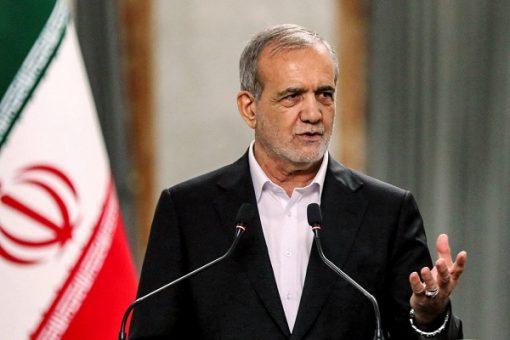

Iranian President Masoud Pezeshkian has indicated that Tehran is prepared to reach an agreement with the United States to end the ongoing conflict before Americans vote in November’s midterm elections.
Pezeshkian made the remarks on Thursday during a brief meeting with NBC News and other media organisations on the sidelines of the United Nations General Assembly.
“We don’t want it to get to the midterm elections,” Pezeshkian said.
He added that Iran would like the United States to return to an earlier agreement that outlined plans for a temporary ceasefire between the two countries.
“We wish Americans to return to the MOU before the midterms,” Pezeshkian added, referring to the memorandum of understanding reached between Washington and Tehran in June, which later collapsed.
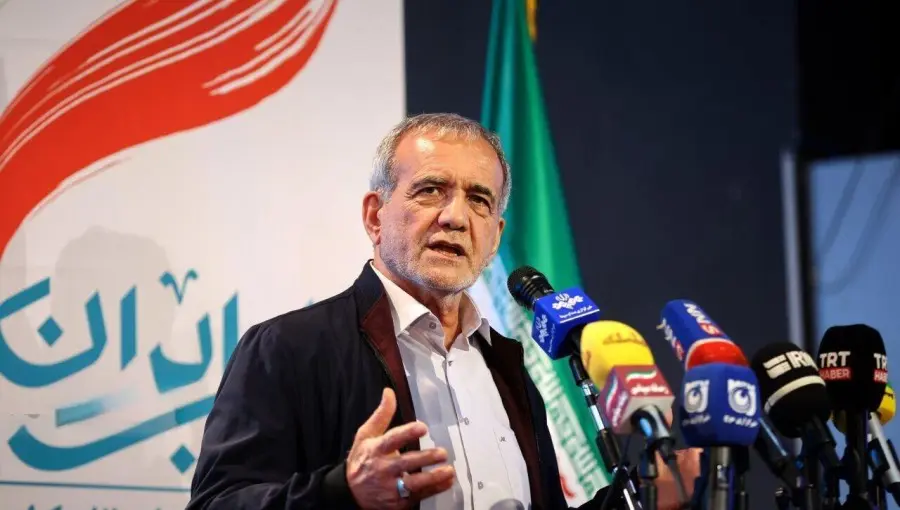
The White House, however, responded by accusing the Iranian government of a series of actions and said President Donald Trump was determined to prevent Tehran from obtaining a nuclear weapon.
In a statement responding to NBC News, White House spokesperson Anna Kelly said: “The Iranian regime has murdered thousands of its own people, killed Americans overseas, executed acts of terrorism in the Strait of Hormuz, and launched indiscriminate attacks against its neighbors in the region.”
“The President is courageously ensuring that such an evil country never possesses a nuclear weapon, which will make the entire world safer and more stable,” Kelly added.
Pezeshkian’s comments came shortly after Trump suggested that Iran might wait until after the US midterm elections before reaching an agreement with Washington.
Speaking to world leaders at the United Nations on Tuesday, Trump said, “I believe we’ll make a deal right after the election because it doesn’t make sense for them not to,” adding, “They’re waiting to see how I do in the midterm election.”
Meanwhile, Iranian Foreign Minister Abbas Araghchi said Tehran had submitted a proposal to the US through mediators that could lead to the reopening of the Strait of Hormuz and the resumption of negotiations.
Araghchi said the proposal could take effect once Washington agreed to its terms, with talks expected to resume after seven days.
“We have introduced a plan to the United States through the intermediators that, if certain conditions are met, the Strait of Hormuz will be open at the end of seven days and talks will be restarted,” Araghchi said.
“The conditions we have asked the U.S. to meet is nothing new, nothing more than what was already in the Islamabad agreement, which was signed by the U.S. president.”
He said one of the conditions involved Washington accepting a maritime transit route through the Strait of Hormuz that had been agreed upon by Iran and Oman.
The Strait of Hormuz has remained a major point of concern since Iran blocked the strategic waterway after the conflict began. Before the disruption, about 20 per cent of the world’s oil supply passed through the strait.
Trump has continued to defend the US military campaign against Iran, while saying he was weighing whether to pursue an agreement or “annihilate” the country.
Pezeshkian also spoke about his relationship with Iran’s new Supreme Leader, Mojtaba Khamenei, saying he had met with him twice, including a seven-hour meeting about a month ago.
Mojtaba Khamenei assumed the position in early March after his father, Ayatollah Ali Khamenei, was killed in an Israeli attack that also claimed the lives of family members and other senior Iranian figures.
Pezeshkian said he had observed no health or physical problems during his meetings with the new leader.
He said he did not see “any issues with his health or physical appearance” in their meetings, adding that they sat on the floor on traditional pillows.
Pezeshkian also said Iran remained open to inspections of its nuclear facilities, which Tehran has consistently maintained are intended for civilian purposes.
The Iranian president further rejected claims that his government was seeking to assassinate Trump or members of his family.
“This has not been the position of the Iranian government that we seek to assassinate President Trump or his family members,” Pezeshkian said.
His comments came against the backdrop of previous US allegations involving Iranian-linked plots against Trump and an Iranian-American journalist who has criticised Tehran over its treatment of women.
US authorities previously charged an Iranian man over an alleged murder-for-hire plot targeting Trump while he was the Republican presidential candidate in 2024. Two other individuals were also charged in connection with an alleged plan to kill the Iranian-American journalist and activist.
US authorities linked the alleged plots to efforts to avenge the killing of Iranian military commander Qassem Soleimani, who died in a US drone strike ordered by Trump during his first presidency.
Pezeshkian has previously denied that Iran sought to assassinate Trump, telling NBC News’ Lester Holt in Tehran last year that the Iranian government would “never” do so.