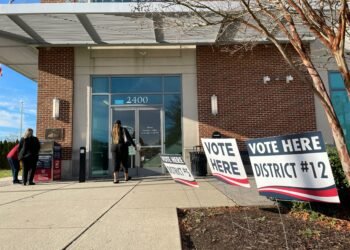
Election officials in Clark County, Washington, have strengthened security around ballot drop boxes following a 2024 attack that damaged about 500 ballots.
The county has upgraded its drop boxes with technology capable of immediately alerting officials when unusual activity is detected. Clark County Auditor Greg Kimsey said the new systems can send text notifications when the temperature inside a box rises above a set level, when the box is struck with significant force or when it is moved outside its geo-fenced location.
The county has also acquired improved fire-suppression equipment designed to protect ballots from destruction during a fire. Surveillance cameras are being installed at all drop box locations, although cameras were already operating at the sites targeted in the 2024 attacks.
“I’m really pleased that even just immediately following that horrible incident, voters continued to use ballot drop boxes,” Kimsey said. “We think we’ve taken the appropriate steps to ensure the safety of the ballots in the ballot drop boxes. We’ve been retrieving ballots on a little more frequent schedule than we have in the past.”
The measures come amid renewed debate across the United States over the use and security of ballot drop boxes.
Drop boxes are available in many states as an alternative method for voters to return ballots before Election Day. Their use, however, became increasingly controversial following the 2020 presidential election, when false claims of widespread voter fraud fuelled conspiracy theories and attacks against the voting system.
Since then, election officials and lawmakers from both major political parties have focused more closely on the security of drop boxes, although they have often approached the issue from different perspectives.

Some jurisdictions have spent millions of dollars upgrading the boxes, while Democratic officials in several states have advocated expanding their availability. Oregon and Pennsylvania, for instance, have added drop boxes in an effort to provide voters with more options for returning ballots.
Some Republican officials have instead pushed for tighter restrictions or outright bans. Their concerns include the collection of ballots by unauthorised individuals, often referred to as “ballot harvesting”, as well as differences in security and chain-of-custody procedures between jurisdictions.
Election officials who support drop boxes argue that they have become increasingly useful because of concerns over delays in the US Postal Service’s processing of election mail.
Democratic Senator Maria Cantwell and Washington Secretary of State Steve Hobbs said a report showed that ballots rejected for arriving late increased by 32 per cent during the state’s August 2026 primary compared with the 2024 primary. In two counties, late-ballot rejections increased by more than 300 per cent.
A Brookings study examining primary ballots in California, Washington and North Carolina also found that rejection rates for ballots arriving late roughly doubled in areas affected by changes to USPS processing.
“We’re really emphasizing to our voters that they use the drop box rather than the mailbox. And if they are going to use the mailbox, just mail it early,” Hobbs told CNN. “If you’re 10 days from the election, that’s the danger area where your ballot may or not make it.”
The Postal Service has maintained that voters who return their ballots at least a week before Election Day should allow enough time for delivery.
USPS said it achieved an on-time delivery score of 97.94 per cent for election mail during this year’s primaries, while it reported delivering 99.6 per cent of ballots within three days during the 2024 general election.
“As we move closer to the election, we will implement procedures consistent with past Federal election cycles to ensure completed ballots are expedited to election offices,” a USPS spokesperson told CNN, referring to the “extraordinary measures” used during election periods.
Those measures are expected to begin on October 24 and will include additional pickups, Sunday processing and expedited handling. In some cases, ballots will be removed from the normal mail stream, manually postmarked and taken directly to election offices.
The debate over drop boxes has also been accompanied by physical attacks.
In 2024, three ballot boxes in Vancouver, Washington, and Portland, Oregon, were bombed. The FBI linked the incidents to the same assailant, although no suspect was arrested. In Portland, where stronger fire-suppression technology was installed, only three of the roughly 400 ballots inside a targeted box were damaged.
“It’s one of those nightmare scenarios. You don’t really plan for it,” Hobbs said. “Thermite was used, which you can’t just pick up anywhere. You can’t just put it out with water or your standard fire extinguisher. You need a special chemical that takes oxygen out of the air. The drop box in Washington did not have that.”
Other attacks have also been reported. Ahead of California’s June primary, ballots were burned at a drop box in Los Angeles, according to the Los Angeles County Registrar-Recorder.
The threats have prompted election authorities in several parts of the country to invest in more sophisticated equipment.
Newer ballot boxes in counties across Pennsylvania, Illinois and California feature tamper-resistant designs, fire protection and digital systems for tracking ballots. Some can photograph voters making deposits, scan ballot-return envelopes to begin chain-of-custody procedures and create electronic records for election officials.
“There’s a range of drop boxes: There’s the really, really good ones with fire suppression, then ones that are pretty good, then there’s crummy ones which look like you bought at Home Depot or something,” said Scott McDonell, clerk of Dane County, Wisconsin. “So, I tell the clerks, if you’ve got a Home Depot one, don’t do it. Get the money to get a decent drop box.”
The availability of drop boxes also varies widely across the country. More than 10 states, including Texas and North Carolina, do not use or allow them, according to the National Conference of State Legislatures.
Since 2021, 16 states have introduced laws restricting drop boxes in some form, with eight banning them altogether, according to Voting Rights Lab. Other states have limited their number or locations. Ohio, for example, permits only one drop box per county.
Wisconsin has taken different positions on the issue at different times. Its Supreme Court blocked the use of drop boxes for the 2022 election when the court had a Republican majority. Following a shift in the court’s composition, drop boxes were permitted again in 2024, with individual local election authorities deciding whether to use them.
“What we have in many situations is oddly a blue-red division whether or not a community has drop boxes,” said Ann Jacobs, a Democratic commissioner on the Wisconsin Elections Commission. “Many of the red communities, thinking they’re still somehow illegal and not proper, are not having them available to their voters. Oddly, that makes absentee voting harder for their voters because they can’t just turn them in.”
In Wyoming, Republican lawmakers have so far stopped short of completely eliminating the boxes.
Last year, the state House overwhelmingly backed a proposal to ban stand-alone drop boxes after Secretary of State Chuck Gray pushed for the measure. The bill failed in the Senate, where lawmakers instead considered requiring more secure receptacles to be installed inside government buildings such as courthouses.
“We just couldn’t get past that disagreement,” Wyoming state Sen. Brian Boner told CNN, adding that lawmakers are still discussing a path forward.
Boner said he supports replacing stand-alone boxes because of security concerns but acknowledged the practical difficulties faced by voters in his rural, working-class district.
“Frankly, in rural Wyoming, that’s just not enough time to even do the round trip into town and back,” he said. “We have lots of coal miners, oil and gas field workers, and ranchers who maybe that’s their only opportunity — when they come in, perhaps after business hours, to vote early if that’s what they want to do.”
The security debate intensified after the 2020 election, with ballot drop boxes becoming a frequent target of false fraud claims. The widely discredited film “2000 Mules”, for example, alleged that organised “mules” were using drop boxes to commit widespread voter fraud. Its creator later acknowledged in 2024 that some of the claims were flawed.
Physical threats have also been recorded. In 2022, masked individuals carrying telescopic camera lenses followed voters at drop box locations in Arizona, prompting voter intimidation referrals from the state’s secretary of state to the Justice Department.
Meanwhile, changes to postal operations have encouraged some election officials to advise voters to avoid waiting until shortly before Election Day to mail their ballots.
The USPS has been restructuring its national network in an effort to reduce costs, shifting more mail from air to ground transportation, extending expected delivery times for First-Class Mail and consolidating processing at regional centres.
The agency has also reduced the number of trips between thousands of local post offices and processing facilities, potentially leaving some mail waiting longer before receiving a postmark.
A September report by the US Government Accountability Office said USPS had missed most of its recent service targets, adding that its cost-cutting measures “have slowed service for some mail and had a disproportionate impact on rural customers.”
The delays can be significant for election mail because states have different deadlines for accepting ballots.
About 15 states allow ballots that arrive after Election Day to be counted if they were postmarked by the required deadline. In other states, ballots must be physically received by election officials before voting closes.
Arizona Secretary of State Adrian Fontes said voters should understand the rules in their state.
“We try very hard to work with folks to know that Arizona is not a postmark state, we’re an in-hand state,” he said. “We want folks to just make it clear they’ve got options to return it in person if they don’t want to return it by mail.”
Fontes also said Arizona is encouraging voters to track their ballots online and sign up for text notifications when available.
In states without drop boxes, voters may still have other options for returning absentee ballots. Indiana, for example, allows voters to take them to early voting centres.
Kate Sweeney Bell, clerk of Marion County, Indiana, said some voters have expressed growing concerns about using the mail.
“They think that something hinky is happening at the United States Postal Service, and instead of mailing them, they want to know whether they can put them in a drop box,” said Sweeney Bell, a Democrat. “And I have to tell them, ‘No, we don’t have that, but here are your options.’”