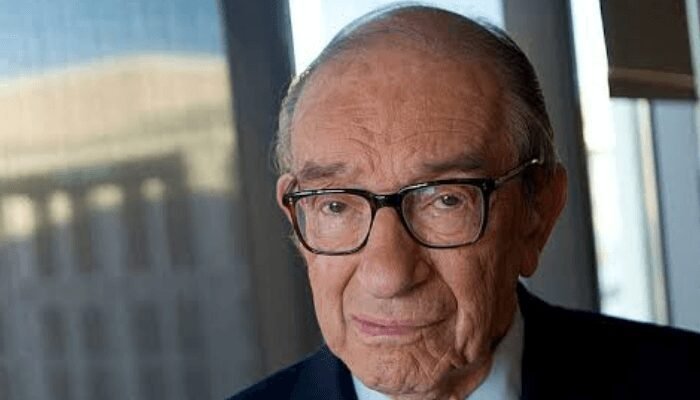
Alan Greenspan, the brilliant and deeply influential economist who guided American monetary policy through five historic terms as the chairman of the Federal Reserve, died Monday morning at the age of 100. His wife of 29 years, veteran NBC News chief foreign affairs correspondent Andrea Mitchell, confirmed that the ‘Maestro’ of the U.S. Economy, has passed following health complications associated with Parkinson’s disease. His passing marks the end of an era for global capitalism, leaving behind a hotly debated legacy that stretched from the final decades of the Cold War to the birth of the modern digital marketplace.
A Century of Numbers
Born in New York City in 1926, Greenspan’s early life was a mix of mathematics and music. Before conquering Wall Street, he studied at the prestigious Juilliard School, touring the country as a young man playing the saxophone and clarinet in a professional jazz swing band.
However, his true calling was data. After shifting his focus to economics at New York University, Greenspan’s worldview was permanently altered in the 1950s when he became a close intellectual associate of Ayn Rand, the author of Atlas Shrugged. Greenspan credited Rand’s strict “objectivist” philosophy for opening his mind to the absolute power of laissez-faire capitalism and free, unregulated markets.
Steering the Ship
Greenspan eventually made the leap from running a successful Wall Street consulting firm to advising conservative politicians, serving under President Gerald Ford before Ronald Reagan officially nominated him to lead the Federal Reserve in 1987.
During his historic 19-year run at the helm of the central bank, Greenspan achieved an unprecedented, rock-star-like celebrity status.
The key milestones of his historic tenure include:
1. The “Black Monday” Rescue: Just days after taking office in October 1987, the stock market crashed by a record-shattering 22%. Greenspan acted instantly to flood the financial system with cash, inventing a protective strategy that Wall Street investors came to call the “Greenspan put.”
2. The Golden Decade: He successfully masterminded the longest economic expansion in modern American history, a historic boom stretching from 1991 to 2001 that oversaw the birth of the internet economy and massive global trade agreements.
Admired by both Republican and Democratic presidents especially Bill Clinton, with whom he shared a close working relationship, Greenspan was named “The Maestro” by the media for his uncanny ability to keep interest rates low and job markets booming.
My Opinion
While it is impossible to deny Alan Greenspan’s intelligence and calm leadership during moments of extreme crisis like 9/11, history has proven that his rigid and almost religious belief in self-regulating markets was a big mistake.
Greenspan famously coined the term “irrational exuberance” in 1996 to warn the public about stock market bubbles, yet he completely turned a blind eye to the toxic, predatory subprime mortgage crisis happening right under his nose in the early 2000s.
By aggressively fighting against the regulation of complex financial instruments, he stripped away the essential safety rails that protected regular working families from corporate greed. He assumed Wall Street banks would protect themselves out of pure self-interest. That foundational assumption was wrong.
While he was honest enough to admit to Congress in 2008 that there was a “flaw” in his ideology after the global economy collapsed, that apology did absolutely nothing for the millions of everyday people who lost their homes, their life savings, and their jobs in the Great Recession. He was a master of handling short-term crises, but his long-term policies laid the groundwork for an absolute economic disaster.
Bottom Line
Following his retirement from public service in 2006, Greenspan spent his final decades running an elite Washington consulting firm and writing detailed memoirs reflecting on the shifting tides of global wealth.
As the financial world pauses to reflect on the news that Alan Greenspan, ‘Maestro’ of the U.S. Economy has died, the current central bankers, including newly appointed Fed Chairman Kevin Warsh, are left managing an economy shaped entirely by his precedents. Greenspan will be remembered as a kind, mathematically gifted intellectual who possessed a deep love for his country, but whose legacy will always remain divided between the historic prosperity he created and the devastating crash that followed it.