
The Middle East teeters on the edge of a total regional collapse following a massive Israeli aerial campaign that has effectively leveled large swathes of Beirut’s southern suburbs. On Friday, the Israeli Defense Forces (IDF) launched 26 waves of strikes overnight, targeting what they described as Hezbollah command centers and weapons storage facilities. This escalation marks a significant expansion of the week-long war that began with the U.S.-Israeli assassination of Iranian Supreme Leader Ayatollah Ali Khamenei.
The ferocity of the bombardment is being described by witnesses as unprecedented, even for a city that has seen decades of conflict. Entire neighborhoods in the Dahiyeh district, a Hezbollah stronghold home to between 600,000 and 800,000 people, have been turned to rubble and ash.

A Mass Exodus and a Humanitarian Crisis
Hours before the bombs fell, Israel issued a blanket evacuation order for the entire southern section of Beirut. This move triggered a desperate mass exodus, with tens of thousands of Lebanese citizens fleeing on foot and in gridlocked traffic.
Sleeping in the Streets: Displaced families are now sleeping on sidewalks, beaches, and in public parks in downtown Beirut.
The UN Humanitarian Coordinator in Lebanon reported that nearly 100,000 people have already sought refuge in shelters, which are reaching full capacity at a “rapid” rate.
The Lebanese Health Ministry reports that 123 people have been killed and 683 wounded since Monday, a figure expected to rise sharply as rescuers reach the ruins of Dahiyeh.
Trump’s Power Play
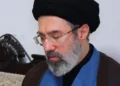
While the bombs fell on Lebanon, U.S. President Donald Trump made a controversial demand that has further complicated any path toward a ceasefire. In a telephone interview with Reuters, Trump insisted that the United States must have a direct role in choosing the next Supreme Leader of Iran.
”We’re going to have to choose that person along with Iran,” Trump said, explicitly rejecting the potential succession of Mojtaba Khamenei, the son of the late leader. Trump labeled the younger Khamenei a “lightweight” and argued that Washington must ensure a new leader “brings harmony” to prevent the U.S. from having to return to war in another five years.
”Existential War”: Iran and Hezbollah Strike Back
The conflict is no longer contained within borders. Iran’s Islamic Revolutionary Guard Corps (IRGC) retaliated on Friday with a combined missile and drone operation targeting the “heart of Tel Aviv.” Meanwhile, in a move that signals a widening of the war’s geography, Iranian drones reportedly attacked the Al Udeid airbase in Qatar, the largest U.S. military installation in the Middle East.
The militia issued a chilling message in Hebrew on its Telegram channel, ordering Israelis living within 5 km (3 miles) of the northern border to evacuate immediately, promising that the “expulsion campaign” in Beirut would not go unchallenged.
Speaking from the Raisina Dialogue in New Delhi, Iran’s Deputy Foreign Minister Saeed Khatibzadeh described the conflict as an “existential war” for the Islamic Republic, mocking Trump’s demands by stating the President “can’t even appoint the mayor of New York,” let alone the leader of Iran.
The Ground War Looms
As Israel expands its aerial bombardment to the eastern Bekaa Valley and southern Lebanon, President Trump has also encouraged Iranian Kurdish forces to launch their own ground offensive against Tehran.
This, combined with Israel’s reported ground incursions across the Litani River, suggests the coalition is moving toward a total “decapitation” and “dismemberment” strategy for the Iranian state and its proxies.
With 1,230 Iranians and hundreds of Lebanese already dead in just seven days, the question is no longer if the war will expand, but whether any of the regional powers can stop the slide toward a total Middle Eastern conflagration.