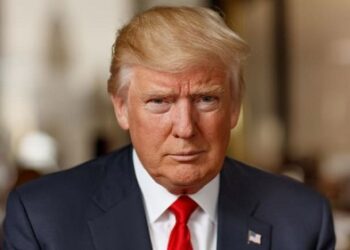
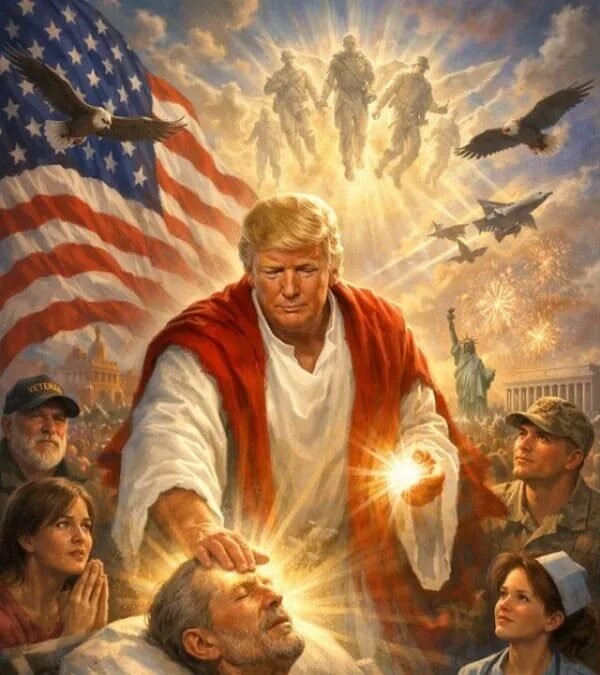
The image in question is provocative and sacrilegious to some. However, for others, it is darkly satirical. And it has fooled tens of thousands of people into thinking former President Donald Trump posted it himself.
The fake AI image shows Donald Trump dressed in messiah-like robes, standing between the spread legs of the Statue of Liberty as if she is giving birth. In his arms, Trump cradles a miniature baby version of himself, swaddled in the American flag. Beside him, an eagle prepares to fly off, clutching the umbilical cord in its beak. Other unidentified figures surround the scene.
The image was created by the satirical artist adam.the.creator. It was never posted by Trump. Yet it spread widely on X, amassing tens of thousands of likes and shares, with many users believing it came from the former president’s truth social account.
The Viral Storm
The reactions were swift and divided. Left-leaning critics seized on the image as evidence of what they have long argued: that Trump cultivates a messianic, almost worshipful persona among his followers. “Holy Mackerel,” one user wrote in response. Others on the right recoiled in disgust, viewing the image as sacrilegious and debasing. A few defended the image — or at least Trump — with one user commenting, “They’re persecuting @realDonaldTrump more than they persecuted him.”
Debunkers quickly noted that the image was never posted by Trump. It was never on his account. The artist, adam.the.creator, is known for surreal, often jarring political satire. His intent was likely commentary on the fervent devotion Trump inspires. But on a platform where context is easily stripped away, the line between satire and deception vanished.
Within hours, the image had been viewed and shared hundreds of thousands of times. Users who saw it assumed it was authentic. Some expressed outrage. Others shared it approvingly. Few stopped to verify its origin.
The April Precedent
This is not the first time AI-generated imagery of Trump has caused confusion. In April 2026 — just weeks ago — Trump himself posted and then deleted a similar AI-generated image that mistakenly showed him as a doctor. He shared it. Then he removed it. The incident highlighted how even the subject of AI visuals can be fooled by their realism.
The current viral image is different. Trump never posted it. He never endorsed it. But the fact that so many believed he did speaks to the power of AI-generated content to reshape political perception.
This story is a summary of posts on X and may evolve over time. As the platform’s own disclaimer notes, Grok can make mistakes. Users are urged to verify outputs.
The Misinformation Debate
The viral image has reignited a broader debate about AI-generated content and its role in political discourse. Satire has always existed. Political cartoons have always exaggerated. But when a satirical image is stripped of its context and shared thousands of times as authentic, the line between comedy and deception blurs.
Critics argue that platforms like X need stronger labeling systems for AI-generated content. If a user cannot tell at a glance whether an image is real or synthetic, the platform has failed. Proponents of free speech counter that labeling requirements are censorship. The debate is unresolved. The viral image is proof that the problem is not theoretical.
The artist, adam.the.creator, has not publicly commented on the image’s spread. It is unclear whether he intended it to be taken seriously or whether he is surprised by the reaction. What is clear is that hundreds of thousands of people saw the image. Many believed it was from Trump. And the conversation about AI, authenticity, and political deception is only beginning.
The Bottom Line
A fake AI image of Donald Trump as a messiah, standing between the spread legs of the Statue of Liberty as she gives birth to a baby Trump swaddled in the American flag, went viral on X. The image was created by satirical artist adam.the.creator and was never posted by Trump. It accumulated tens of thousands of likes and shares, with left-leaning critics calling it evidence of a “messiah complex” and conservatives expressing disgust. Debunkers noted the image was not authentic.
The incident follows Trump’s own deletion of a similar AI image he mistakenly shared in April 2026. Both cases highlight how AI-generated visuals are fueling misinformation debates on social media.