
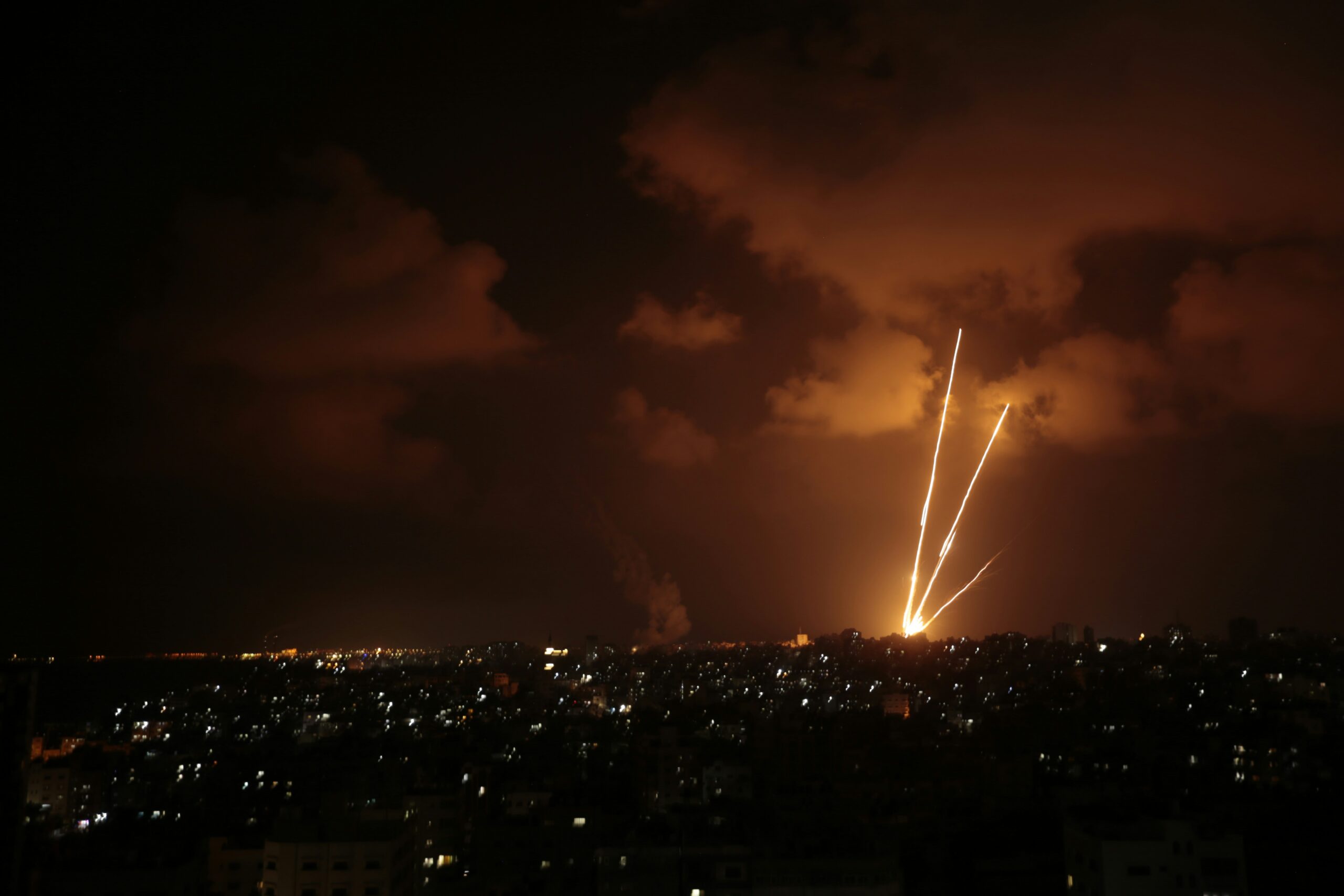
The State Department urged Americans across 14 Middle Eastern countries to immediately evacuate on Monday, three days after U.S.-Israeli strikes on Iran began, with regional airspace largely closed and commercial flights grounded. Then it told them they were on their own.
The U.S. Embassy in Jerusalem issued a stark statement: it was “not in a position at this time to evacuate or directly assist Americans in departing Israel.” Citizens were directed to sign up for shuttles organized by the Israeli Ministry of Tourism to the Taba border crossing with Egypt, with a warning that the U.S. government “cannot guarantee your safety” on that route.
Lawmakers from both parties erupted in fury Tuesday, accusing the Trump administration of abandoning American citizens in a war zone.
“American taxpayers are forced to give Israel $3.8 billion every single year, and here is our own U.S. embassy in Jerusalem telling Americans good luck getting out, you are on your own,” former Republican congresswoman Marjorie Taylor Greene, who resigned from Congress after a split with President Donald Trump, said in a social media post. “The betrayal is unbelievable.”
Democratic Senator Andy Kim echoed the outrage. “Warnings to citizens to evacuate three days into this war, when airspace is closed, is a clear sign of zero strategy and planning by the Trump admin. Now Americans have limited options to evacuate at an extremely dangerous moment with no government assistance. This administration is failing its citizens.”
‘Incompetence Everywhere’
The criticism mounted as major Gulf aviation hubs, including Dubai International Airport — the world’s busiest, which normally handles over 1,000 flights a day — remained closed for a fourth day Tuesday, leaving tens of thousands of passengers stranded. Ticket prices have soared.
U.S. security alerts for Americans in Kuwait, the United Arab Emirates, Iraq, Qatar, and Bahrain were disseminated after the strikes began, according to time stamps on social media posts by U.S. embassies in those countries. Some urged citizens to shelter in place or be prepared to do so — contradictory messaging that left many confused about whether to flee or hide.
Democratic Senator Chris Murphy summed up the frustration in a social media post: “So the State Department is forcing everyone to immediately leave the region, but is also refusing to help people leave the region. Incompetence everywhere.”
Representative Ted Lieu, a California Democrat, urged the Trump administration to schedule U.S. government evacuation flights for stranded Americans.
The State Department did not immediately respond to questions about how Americans should depart in the absence of available commercial flights or whether Washington was planning evacuation flights. On Monday, a U.S. official said the Department activated an inter-agency task force to manage the situation and launched a dedicated WhatsApp channel, which it said has amassed 15,000 followers. It did not mention any government assistance for citizen evacuation.
Contrast With Allies
The U.S. response stands in stark contrast to that of its allies. The United Kingdom, Germany, France and Russia have all organized evacuation flights for their citizens trapped in the region. British Prime Minister Keir Starmer chaired an emergency COBRA meeting and announced that UK nationals would receive consular assistance and evacuation options.
U.S. citizens, meanwhile, have been left to navigate closed airspace, grounded flights, and soaring ticket prices with no government support.
Trump’s Response
Speaking to reporters in the Oval Office on Tuesday, President Donald Trump was asked why there were no plans to evacuate U.S. citizens.
“It all happened very quickly,” he said, referring to the war with Iran.
The administration’s messaging has been further complicated by the absence of Senate-confirmed ambassadors across many countries in the region, including Saudi Arabia, Qatar, Iraq, Egypt, Kuwait, Algeria, and the UAE — a vacuum in diplomatic leadership at a moment of acute crisis.
The Toll
Crude oil benchmarks rose about 7 percent on Tuesday, soaring as the conflict widened. In a social media post overnight, Trump said there was a “virtually unlimited supply” of U.S. munitions and that “wars can be fought ‘forever,’ and very successfully, using just these supplies.”
For the thousands of Americans stranded across the Middle East, the question is not about munitions or military strategy. It is about how they will get home.
The U.S. Embassy in Israel’s guidance was painfully blunt: sign up for an Israeli-organized shuttle to the Egyptian border, and understand that Washington cannot guarantee your safety.
It was not immediately clear how many American and dual citizens are based in the region. The State Department urges its nationals to sign up with its database when they are abroad — a voluntary system that provides no comprehensive count.
What Comes Next
On Tuesday, the State Department ordered the departure of non-emergency U.S. government personnel and their family members from U.S. embassies in Bahrain, Qatar, the UAE, Kuwait, and Jordan. Similar measures have already been taken for missions in Lebanon and Israel.
For American citizens, no such departure orders exist. No evacuation flights have been scheduled. No government assistance has been offered. They are, as Greene put it, on their own.