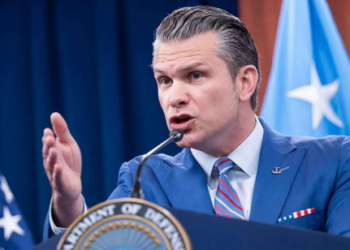
U.S. Homeland Security Secretary Markwayne Mullin said on June 28 that migrants living in the United States under temporary protected status should either pursue permanent residency options or prepare to return to their countries of origin.
The comments were made during CNN’s State of the Union following last week’s split decision by the U.S. Supreme Court, which cleared the way for President Donald Trump’s administration to end humanitarian protections for hundreds of thousands of Haitian and Syrian migrants — protections that had shielded them from deportation to countries affected by conflict and severe hardship.
“Either try to fill out the paperwork and be here under a permanent status, or we’ll help you get back to your country,” Mullin said. “We’ll actually give you a plane ticket, plus roughly $2,100 to help you reestablish when you get there, but temporary protective status, according to the courts and in its name itself, is not permanent status.”
Under U.S. federal law, the government can offer temporary legal protection to people escaping war, natural disasters, or other dangerous conditions. In many cases, those protections had been repeatedly extended over the years. Despite recent moves to terminate the status for some groups, the U.S. State Department continues to advise against travel to Haiti and Syria due to ongoing security concerns, including violence, crime, terrorism and kidnapping.
The United States initially granted Temporary Protected Status (TPS) to Haitian nationals following the devastating 2010 earthquake, while Syrian nationals became eligible after civil war broke out in Syria in 2012.
Plans for widespread deportations have continued to draw criticism, including from some Republicans. Speaking to CNN on June 28, Mike DeWine argued that conditions in Haiti remain unsafe for return and warned that removing hard-working migrants could negatively affect Ohio’s economy while worsening staff shortages across the healthcare sector.
During the 2024 campaign, President Donald Trump repeatedly promoted false claims alleging that Haitian immigrants in Ohio were eating household pets. However, the conservative majority of the U.S. Supreme Court later ruled that Haitian migrants challenging the administration’s policy were unlikely to prove that the decision was motivated by racial bias.
Reuters has previously reported that the growth of Haitian communities in parts of Ohio has contributed to local economic recovery in areas affected by post-industrial decline, helping support job growth and improved wages.
“It’s Haitians who many times are taking care of your mom or your dad who has Alzheimer’s, taking care of family members who might be in a nursing home,” said DeWine. “And to say we’re going to pull all those out, it’s just not in our own self-interest.”