

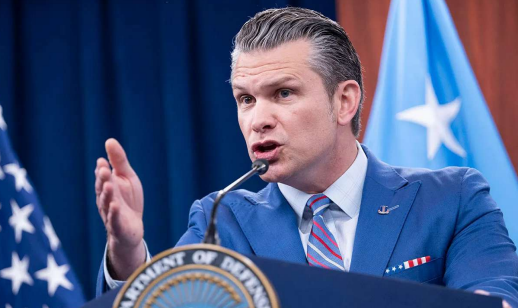
US Defence Secretary Pete Hegseth is facing growing resistance from members of his own Republican Party as his push for a record $1.5 trillion defence budget struggles to gain enough support in Congress.
Republican lawmakers have largely backed Hegseth since he narrowly secured Senate confirmation, defending him against several controversies and approving major increases in military spending. However, divisions within the party are becoming more apparent as lawmakers question whether the administration has made a strong enough case for another huge spending package ahead of the 2026 midterm elections.
The Senate went into its summer recess without reaching an agreement on Hegseth’s flagship proposal, which would significantly expand military spending and fund priorities backed by President Donald Trump, including new warships and the Golden Dome missile defence system.
Hegseth has made repeated visits to Capitol Hill in recent weeks in an effort to rally support, but some Republicans remain unconvinced that the party should spend valuable political capital on the proposal.
Sen. Lisa Murkowski of Alaska questioned how the Pentagon would maintain key programmes if future reconciliation bills failed to materialise.
“So what if that doesn’t come? I’ve asked [Pentagon officials]: you have your F-35s, your Patriot missiles baked into that — what’s your plan B? And it’s been tough to get an answer,” she said.
The administration’s strategy depends partly on Republicans using the partisan budget reconciliation process to secure about $350 billion of the proposed increase without Democratic support.
While many Republicans favour increased defence spending, some lawmakers are concerned about the political consequences of approving such a large package shortly before the midterm elections.
There is also resistance among senior Republicans to giving the White House greater control over defence spending. Senate Appropriations Committee Chair Susan Collins and Sen. Mitch McConnell have both expressed doubts about whether additional party-line spending legislation can pass.
“At the moment, there’s not a path forward for a supplemental, and it’s tied up with whether or not we have a reconciliation,” Sen. Jerry Moran said.
Hegseth’s tenure has already survived several major political challenges. Vice President JD Vance was forced to cast the decisive Senate vote when Hegseth’s confirmation ended in a 50-50 split, after three Republican senators opposed his nomination.
Since then, congressional Republicans have generally protected him from efforts to restrict his authority. They have backed him over controversies surrounding military operations, the deployment of National Guard troops to Democratic-led cities, senior military dismissals and the use of Signal to discuss sensitive operations.
Trump has also continued to support his defence secretary. Responding to reports that he had demanded answers from Hegseth over critically low ammunition supplies following the Iran conflict, Trump defended him publicly.
“I am extremely happy with the job that Pete Hegseth is doing. Everything has been extraordinary,” Trump wrote on Truth Social. “Pete is highly respected within the Military, and has made tremendous improvements, including getting rid of DEI, and increasing recruitment to historic levels.”
Republicans have already increased defence spending by $150 billion through the One Big Beautiful Bill Act. They also supported Hegseth on initiatives including renaming the Department of Defense as the Department of War and reducing diversity and inclusion programmes within the military.
The Pentagon is now seeking another $60 billion to cover costs associated with the Iran war, also through reconciliation. That request has passed the House but remains stalled in the Senate.
Hegseth has argued that the larger $1.5 trillion package is necessary to prepare the US military for growing global threats.
“Not funding this department at 1.5 trillion, I believe, is the greatest threat that our nation faces,” Hegseth told senators last month. “Either we invest in our warriors at this moment of … growing threats, or this is all just talk.”
However, both the Iran funding request and the broader defence package remain uncertain as Republicans weigh the risks of taking controversial votes before November.
Sen. Mike Rounds of South Dakota acknowledged that significant negotiations remain.
“We’ve got more work to do to get it done,” he said.
The Pentagon has also faced criticism from both parties over what lawmakers describe as inadequate communication about military operations, spending decisions and changes to US defence commitments abroad.
Republican lawmakers have particularly raised concerns about plans to reduce the US military presence in Europe, with House and Senate defence bills seeking to restrict troop reductions.
Democrats, meanwhile, believe the administration will struggle to secure enough support for the massive spending plan without providing Congress with more information.
“He’ll have a hard time justifying a trillion and a half dollars to Republicans who are demanding information along with all of us,” Sen. Richard Blumenthal said.