

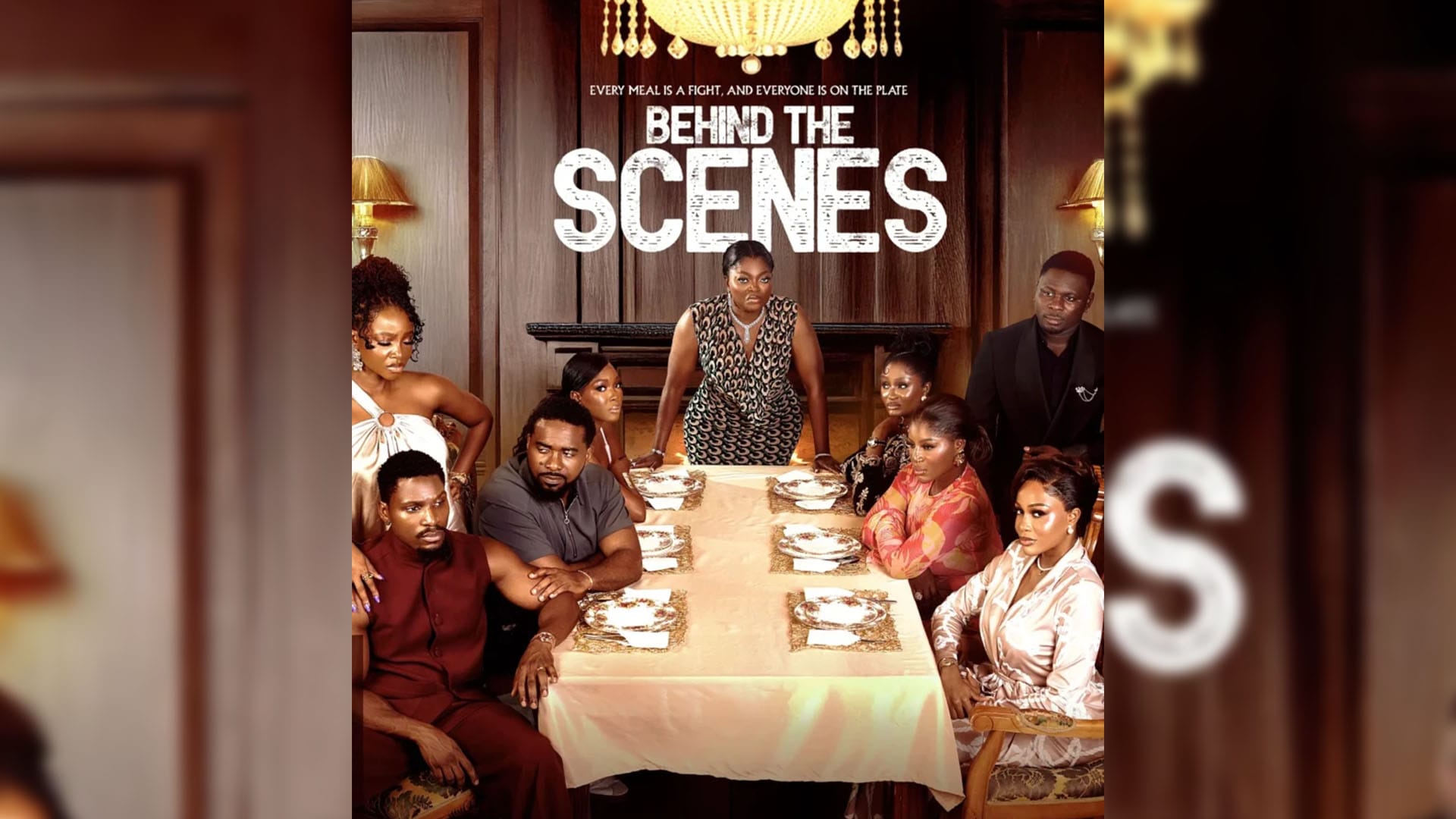
Behind The Scene, directed by Funke Akindele and Tunde Olaoye, brings together an impressive Nollywood ensemble including Funke Akindele, Destiny Etiko, Ibrahim Chatta, Ini Dima-Okojie, Iyabo Ojo, Tobi Bakre, Uzor Arukwe, and Victoria Adeleye. On paper, it promises emotional weight, social commentary, and star power. In practice, however, the film struggles under the weight of its own exaggeration.
At its core, Behind The Scene attempts to explore generosity, family exploitation, and self-neglect. Unfortunately, the execution reduces these themes to overly simplified situations that underestimate the audience’s intelligence. Rather than offering layered storytelling, the film repeatedly chooses shock value and melodrama, leaving little room for nuance or realism.

Story Overview: A Generous Woman to a Fault
The film follows Aderonke “Ronky-Fella” Faniran, a wealthy real estate mogul and mother of two who is widely admired for her kindness. She is the only successful child among three siblings, shouldering the financial burden of her irresponsible elder sister and younger brother after the death of their parents. Over time, her generosity becomes an expectation rather than an act of goodwill, and she neglects her own well-being in the process.
The central conflict arises when Aderonke decides to fake her own death to determine whether the people closest to her genuinely care about her—or merely her wealth. This decision becomes the foundation for the film’s most controversial narrative choices.
The Fake Death Plot: A Stretch Too Far
The idea that a highly intelligent and successful businesswoman would fake her death to discover obvious emotional truths is difficult to accept. Instead of confronting her siblings, setting boundaries, or distancing herself financially, Aderonke orchestrates an elaborate scheme involving hidden cameras placed around her home.
From an undisclosed location, she watches as her elder sister moves into the house, sells off her properties, and treats her children and domestic staff poorly. The film presents this as a revelation moment—Aderonke realizing she had been loving the wrong people.
The problem here is not the theme, but the logic. The narrative assumes that exploitation must be documented on camera before it can be understood. This choice strips the character of emotional intelligence and turns what should be a grounded family drama into an implausible experiment.
Death as a Tool, Not a Theme
Faking death has been used effectively in global cinema when handled with care and internal logic. In Behind the Scene, however, the concept lacks emotional consequence. Aderonke’s children are traumatized, yet the film glosses over this in its rush to prove a moral point.
The question remains unanswered: why would anyone go to such extremes instead of confronting unhealthy relationships directly? The film offers no convincing justification, making the entire premise feel forced rather than meaningful.
Exaggeration Masquerading as Message
Several scenes feel deliberately overstated to underline Aderonke’s generosity. One example includes her paying months of unpaid salaries for workers in a friend’s company—an act so unrealistic that it borders on parody.
Similarly, the portrayal of her siblings and their child as excessively rude and cruel feels cartoonish. The lack of subtlety weakens the message, as the characters become symbols rather than believable people. Instead of trusting the audience to understand exploitation, the film repeatedly shouts it.
Questionable Creative Choices
The inclusion of foreign workers at Aderonke’s construction site appears poorly thought out. Their presence feels disconnected from the story and adds little value, giving the impression of forced “international appeal” rather than narrative necessity.
More distracting was the sudden interruption of the story to promote a toothpaste brand. At that point, the film momentarily abandons storytelling altogether, reinforcing the impression that commercial interests outweighed artistic intent.
Star Power Over Substance
Behind the Scene follows a familiar pattern: assemble influential faces, simplify complex societal issues, release during a high-spending season, and rely on box office numbers as proof of success. While this strategy may work commercially, it risks eroding storytelling standards and discouraging thoughtful filmmaking.
Final Verdict
Behind The Scene had the potential to be a reflective drama about boundaries, self-worth, and family dynamics. Instead, it settles for exaggerated storytelling that underestimates its audience. While the performances are competent and the cast impressive, the narrative choices undermine the film’s credibility.
This is a movie best suited for casual viewing rather than critical engagement.