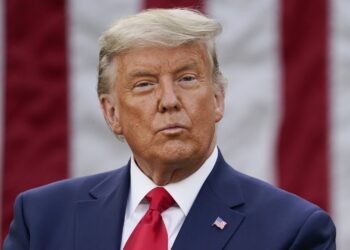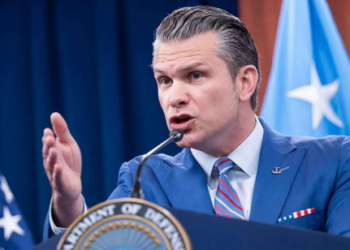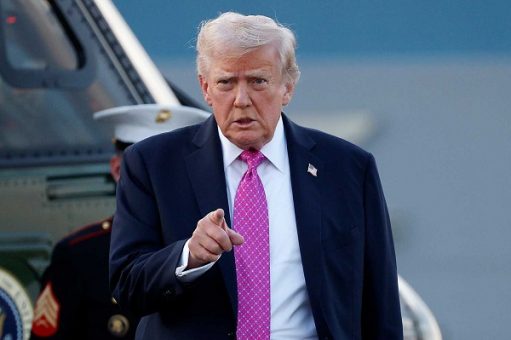

President Donald Trump has escalated his long-running feud with NATO to a new level, telling a British newspaper that U.S. membership in the 75-year-old alliance is “beyond reconsideration” and describing its European partners as unwilling to defend themselves — remarks that have triggered emergency consultations among allied capitals already strained by the ongoing Iran war.
“I just think it should be automatic,” Trump told the Telegraph, fuming that NATO allies have not joined America’s military operations against Iran. His invective underscores a fundamental misunderstanding of how the 32-member alliance works — and how deeply his partners fear he may act on his threats this time.
‘Beyond Reconsideration’
Asked whether he was reconsidering U.S. membership in NATO, Trump was blunt: “Oh yes… I would say beyond reconsideration.”

The remarks go further than his previous threats, which have punctuated his political career since before his first term. Trump has long dismissed NATO as a “paper tiger” and described it as “obsolete.” In early 2019, he nearly walked out of the alliance during his first term.
“We saw clear signs that Trump was preparing to act on his threat,” former NATO Secretary General Jens Stoltenberg wrote in his recent memoir, On My Watch. Stoltenberg credited a Fox News appearance — in which he praised Trump for pressuring allies to increase military spending — with pulling the president back from the brink.
This time, the stakes are higher. The U.S. is actively engaged in a war with Iran. European allies have refused to join. And Trump’s patience appears exhausted.
Why Allies Won’t Join
At the heart of Trump’s fury is Article 5, NATO’s collective defense clause. An attack against one member is deemed an attack against all — but invoking the principle requires consensus, and the 1949 treaty only referred to crises in Europe and North America.
One ally after another has held back from joining a war they weren’t consulted on, given they still don’t understand its goals in the face of mixed messaging from the Trump administration. Article 5 has only been triggered once — after the September 11 attacks on the U.S. in 2001.
Britain initially refused access to U.S. warplanes but later changed tack, saying bases could be used for “defensive operations.” That delay continues to be derided by Trump and his defense secretary, Pete Hegseth, who have repeatedly taunted Prime Minister Keir Starmer as being “no Churchill.”
On Tuesday, Italy denied U.S. aircraft permission to land as they were en route to the Middle East for combat operations. Spain has closed its airspace to U.S. planes conducting missions against Iran.
Rubio Joins the Chorus
Secretary of State Marco Rubio, who has previously described himself as a supporter of the alliance, has now signaled openness to a fundamental rethinking.
“I think there’s no doubt, unfortunately, after this conflict is concluded we are going to have to re-examine that relationship,” he told Fox News.
Referring to U.S. bases in Europe, Rubio said not using them “to defend America’s interests” meant “NATO is a one-way street.” He added it was “ultimately” up to Trump to decide the issue.
But it’s not Trump’s alone. Congress voted at the end of 2023 to prohibit the president from unilaterally withdrawing from NATO without the approval of a two-thirds Senate majority or an act of Congress — a firewall that would make unilateral withdrawal legally difficult.
What’s at Stake
Military spending has ramped up significantly by almost all NATO members, partly in response to Trump’s threats and partly because of Russia’s growing menace. The U.S. military budget now makes up some 62% of NATO’s total defense spending. The Pentagon has assets and intelligence capabilities that others still can’t match.
NATO leaders, and most of all its current secretary general Mark Rutte, will need to spend time again trying to convince and cajole Trump that it’s in his interest — and America’s — to stay.
Rutte, like Stoltenberg, is called the “Trump whisperer” for his efforts in public and private to keep the unpredictable president on side. The former Dutch leader, armed with his toolbox of praise, is widely seen as having played a significant role in pulling Trump back from the brink in his threats to “take” Greenland — a semi-autonomous territory of fellow NATO member Denmark — earlier this year.
But Rutte has also come under fire from other NATO states for going too far with his staunch support for a war against Iran that he said Trump was doing “to make the whole world safe.”
What Comes Next
Trump is scheduled to address the nation on Wednesday evening on the Iran war. Whether he uses that platform to clarify his NATO position — or escalate it — remains unclear.
For European allies, the immediate crisis is the war in the Middle East. But the longer-term crisis is the American president who is asking whether the alliance that has kept the peace in Europe for 75 years is worth keeping at all.
“Putin knows it too,” Trump told the Telegraph.
In Moscow, that may be the only part of his message that needs to be heard.