Less than 24 hours after President Donald Trump used his State of the Union address to declare tariffs on America’s fiscal future, Canada’s finance minister acknowledged what many had feared: the tariffs aren’t going away.
François-Philippe Champagne told reporters in Ottawa Wednesday that Canada must accept a baseline U.S. tariff as the new “price” of accessing the American market — a stark admission from America’s closest trading partner.
“I think it is pretty well understood now in the world that the view of the American administration is that there’ll be a price to access the American market,” Champagne said .
Trump’s Tuesday night address made that view unmistakable. The president devoted significant time to defending his tariff agenda just days after the Supreme Court struck down his previous global levies as unlawful. He called the ruling “unfortunate” and “totally wrong,” then announced new 10% tariffs under a different legal authority — Section 122 of the 1974 Trade Act — which took effect the same day as his speech.
“And as time goes by, I believe the tariffs, paid for by foreign countries, will, like in the past, substantially replace the modern-day system of income tax, taking a great financial burden off the people that I love,” Trump told Congress.
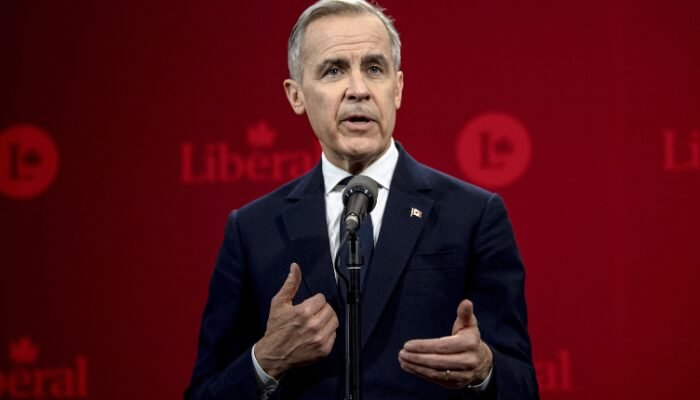
‘Every Country Is Paying a Price’
Champagne’s tone was resigned but not defeatist. While acknowledging the new reality, he insisted Canada is better positioned than any other U.S. trading partner.
“Every country of the world that I know of is paying a price,” he said. “What I’m saying is that Canada is paying the lowest price”.
Canada’s exemption under the USMCA trade agreement shields about 85% of Canadian exports from the new 10% tariff, as long as goods comply with North American rules of origin. The effective U.S. tariff rate on Canadian goods now stands at roughly 3.7% to 4.9% — lower than most nations, but still a permanent new cost of doing business.
However, punishing sectoral tariffs remain on steel, aluminum, autos, and softwood lumber — ranging from 25% to 50% — and those apply to all trading partners, not just Canada.
Greer’s Message: Tariffs Are Part of Any Deal
U.S. Trade Representative Jamieson Greer reinforced the message in interviews with CBC News following Trump’s speech. He made clear that any renegotiation of CUSMA — up for review this year — will include tariffs as a baseline feature.
“When we go to other countries and we make a deal with them, the other countries, they agree that we can have a tariff on them,” Greer said.
“If Canada wants to agree that we can have some level of higher tariff on them, while they open up their markets to us on things like dairy and other things, that’s a helpful conversation”.
Greer also criticized Canada for maintaining retaliatory measures against earlier U.S. tariffs, including removing American wine and spirits from shelves and restricting U.S. procurement opportunities.
“It’s quite a contrast with Mexico,” he added pointedly.
Carney’s Diversification Push
Prime Minister Mark Carney has signaled a fundamental shift in Canadian economic strategy, announcing plans to double non-U.S. exports by the next decade, particularly in metals and automotive sectors. Industry Minister Mélanie Joly pointed to her trip to Germany this week as evidence of the new approach.
“We’ve been overdependent on the U.S.,” Joly said. She announced a new auto manufacturing memorandum with the German government and meetings with Volkswagen executives to attract investment.
Saskatchewan Premier Scott Moe will accompany Carney to India this week to promote grains, pulses, uranium, and potash exports — part of the diversification push.
But the numbers are daunting. The U.S. remains by far Canada’s largest customer, accounting for about 75% of Canadian exports. No amount of diversification can replace that overnight.
Ford’s Fury
Ontario Premier Doug Ford offered a starkly different reaction. Watching Trump’s speech left his “blood boiling,” he said.
“I almost climbed through the television about 18 times watching it,” Ford told reporters in Niagara Falls.
He rejected the premise that Canada must accept permanent tariffs, warning that any U.S. duties will be met with retaliation.
“It’s tit for tat. You’re going to increase tariffs on us? I can tell you one thing, a tariff on Canada is a tax on Americans. They know it. They’re feeling the crunch down there”.
Ford suggested Canada could target exports the U.S. depends on — high-grade nickel from Ontario (65% of U.S. manufacturing needs), potash from Saskatchewan, aluminum from Quebec, and even road salt.
“Maybe we should cut them off on salt,” Ford said. “It doesn’t work, folks, when you have a protectionist government like President Trump. It fails every single time. Ronald Reagan is spinning in his grave right now”.
The USMCA Clock
The trade deal joining the three countries is up for formal review this year. Each nation must indicate by July 1 whether it wants to extend the agreement, renegotiate its terms, or let it expire.
Trump has privately asked aides why the U.S. needs to keep the pact at all, Bloomberg has reported. His frustration over the Supreme Court ruling could drive him to seek radical changes or even blow up USMCA entirely in pursuit of the tariff revenue he covets.
Trade lawyer Barry Appleton put it bluntly: “The president didn’t lose his leverage, he just lost a lever. We’re going to see weaponizations of a variety of different tools that were never, ever conceived of in that way, utilized in that fashion, because the president does not want to go to Congress”.
The New Reality
Champagne’s acknowledgment that tariffs are here to stay represents a significant shift in tone from Ottawa. For months, Canadian officials maintained that Trump’s tariffs were temporary, unjustified, and would eventually be lifted.
That hope is gone.
“What I’m saying is that Canada is paying the lowest price” is now the government’s message — not “we’ll fight these tariffs,” but “at least we’re doing better than everyone else.”
Whether that’s enough to sustain a trading relationship that underpins millions of Canadian jobs remains to be seen. The USMCA review begins soon. Trump’s tariff appetite shows no sign of fading. And Canada is left to negotiate from a position it never expected to occupy: grateful to be paying the lowest price, rather than fighting to pay none at all.