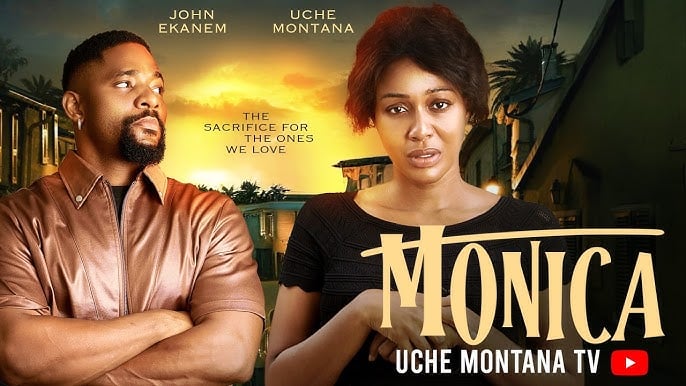
Some films entertain, others educate—but a few leave you emotionally unsettled long after the credits roll. Monica, produced by Nollywood actress Uche Montana, falls into the latter category. Released on her YouTube channel, the film is not your typical drama; it is an intense, emotionally draining experience that forces viewers to confront uncomfortable truths about family, sacrifice, and personal identity.
From the very beginning, Monica sets a heavy tone. It doesn’t rely on exaggerated drama or unrealistic twists. Instead, it tells a grounded story that feels eerily familiar. What makes it even more impactful is the revelation that it is based on a true story. That single detail shifts the entire viewing experience, turning what might have been seen as fiction into a reflection of real-life struggles many people silently endure.
Rather than asking whether such a story could happen, the film pushes viewers to consider how often it actually does.
Plot Overview
At its core, Monica tells the story of a firstborn daughter who sacrifices her own dreams, happiness, and personal growth for the sake of her family. As the emotional and financial backbone of her household, she carries responsibilities far beyond her years.
The film explores the weight of being “the strong one”—the child expected to fix everything, endure everything, and ask for nothing in return. Monica’s journey is not filled with grand victories but with quiet suffering, internal battles, and difficult choices that gradually take a toll on her well-being.
Themes That Hit Close To Home
One of the film’s greatest strengths lies in its themes. Monica dives deep into issues that are rarely discussed openly but are widely experienced—especially in African households.
It examines:
- The unspoken expectations placed on firstborn children
- Emotional manipulation within families
- The fine line between kindness and self-neglect
- Generational trauma and how it is passed down
The film does not preach or force its message. Instead, it allows these themes to unfold naturally through the characters’ actions and experiences. This subtle approach makes the message even more powerful, as viewers are left to process and interpret the lessons on their own.
A particularly striking aspect is how the story questions the idea of sacrifice. It challenges the belief that constantly putting others first is noble, asking instead: At what cost?
Character Performances
The performances in Monica elevate the film significantly. Each actor brings authenticity and emotional depth, making the story feel real rather than staged.
Uche Montana delivers a compelling performance as Monica, fully embodying the emotional weight of the character. Her portrayal captures the quiet pain, resilience, and internal conflict of someone who feels trapped by responsibility. She does not overact; instead, she allows the emotions to simmer beneath the surface, which makes her performance even more powerful.
Blessing Onwukwe stands out as Monica’s mother, portraying a character that is both frustrating and painfully believable. Her role as an emotionally distant and demanding parent adds tension to the story. What makes her performance remarkable is how easily it evokes strong reactions from viewers—anger, frustration, and even a degree of understanding.
Chris Biyibi, who plays the father, delivers a subtle yet effective performance. His character’s silence and inaction contribute significantly to Monica’s struggles, highlighting the impact of passive parenting.
Okorie Emmanuella, as the younger version of Monica, deserves recognition for setting the emotional foundation of the character. Her performance adds depth to the story, making Monica’s later struggles more understandable.
Overall, the cast works seamlessly together, with each performance adding layers to the narrative.
Storytelling And Execution
One of the most impressive aspects of Monica is its storytelling approach. The film avoids unnecessary exaggeration, opting instead for a realistic and relatable narrative style.
The pacing allows the story to breathe, giving viewers time to connect with the characters and absorb the emotional weight of each scene. While some moments feel stretched, they also contribute to the overall realism of the story.
The film’s ability to evoke multiple emotions—anger, sadness, frustration, and empathy—is a testament to its strong writing. Certain scenes feel almost too real, as though they were taken directly from everyday life.
Cinematography And Visual Elements
Visually, Monica keeps things simple. The cinematography is not overly stylised, but it effectively supports the storytelling. The focus remains on the characters and their emotions, rather than on flashy visuals.
However, there are a few noticeable shortcomings. The makeup occasionally feels inconsistent, with certain scenes appearing overly dramatic while others look more natural. These inconsistencies can be slightly distracting.
Additionally, the lack of visible aging in some characters affects the realism of the story. Characters appear almost unchanged despite the passage of time, which weakens the narrative continuity.
Areas That Needed Improvement
While Monica is a strong film overall, it is not without flaws.
- Some scenes feel unnecessarily prolonged, affecting the pacing
- Makeup inconsistencies occasionally distract from the story
- Certain characters lack physical transformation over time
- A deeper exploration of supporting characters could have added more depth
These issues, however, do not significantly diminish the film’s impact.
Final Verdict
Monica is a powerful, thought-provoking film that shines a light on the emotional burden of sacrifice and the complexities of family dynamics. It is not an easy watch, but it is an important one.
The film succeeds in telling a story that many can relate to, but few openly discuss. Its strength lies in its honesty, emotional depth, and the conversations it sparks.
While it has minor technical flaws, its message and performances more than make up for them.
Rating: 7/10
If you are looking for a film that goes beyond entertainment and challenges your perspective on family, responsibility, and self-worth, Monica is definitely worth watching