Mexican lawmakers have for years struggled to balance the country’s fight against drug cartel violence with the global rise of corridos tumbados — a music style critics say glorifies crime and narco-culture.
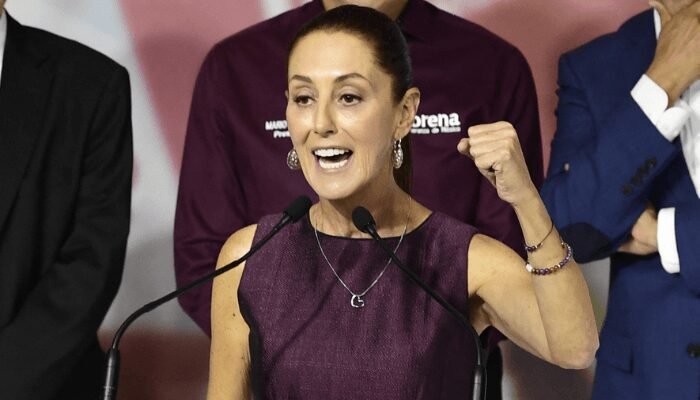
On Monday, popular corrido singer Junior H appeared alongside President Claudia Sheinbaum at her daily press briefing to support México Canta, a binational music competition organized by Mexico’s Ministry of Culture for artists from Mexico and the United States.
The 25-year-old artist backed the initiative, now in its second edition, which aims to reshape Mexico’s musical identity by encouraging non-violent storytelling and creative expression.
Reflecting on his career, Junior H referenced earlier hits such as “El Azul” (with Peso Pluma), widely linked to narco-themed narratives, and “El Hijo Mayor,” which fans have associated with the son of Joaquín “El Chapo” Guzmán.
“In my initial career, some of the stories that I shared in my music didn’t add to the positive message that reflects my current compositions,” he said. “I kept growing, and I learned that music, besides being a form of expression, also implies a responsibility when millions of people hear you worldwide.”
Born Antonio Herrera Pérez, Junior H — who grew up in Guanajuato before moving to Utah — said his perspective has evolved as his global audience expanded to over 30 million Spotify listeners.
“A culture of peace does not mean we cease to stop talking about our reality. It means finding new ways to express them,” he said. “I invite all young generations to participate, to believe in your talent and to never stop believing in your dreams.”
His remarks contrast with past statements, including a March performance of “El Azul” at the South by Southwest festival, where he reportedly said, “It’s the government against us, or us against the government,” in response to censorship concerns.
Currently, around 10 of Mexico’s 32 states have imposed restrictions on corridos in public spaces, arguing that some lyrics encourage criminal behaviour. Penalties in some regions reportedly include fines and possible jail time.
In October, Junior H was fined 400,000 pesos (over $23,000) after performing “El Azul” at a festival in Zapopan, Jalisco, and was later reportedly banned from performing in the city during the current mayor’s term.
Despite controversies, he remains scheduled to perform at the Baja Beach Fest in Rosarito on August 8.
President Sheinbaum, unlike her predecessor Andrés Manuel López Obrador, has taken a more open stance toward regional music, stressing that censorship is not the solution.
“We are not censoring [regional music], because I don’t believe in censorship,” she said. “I don’t think prohibiting music or its contents will solve anything. More than anything, we need to promote nonviolent music. That’s the objective of this contest.”
Entries for México Canta remain open until June 10, with semifinals scheduled in Los Angeles and Mazatlán in August, and the grand finale set for September 13.